 Coaching Centre
Precipitation reactions
How ionic compounds dissolve into ions, how mixing two solutions can form an insoluble precipitate, ionic equations and spectator ions, simple solubility rules, and using precipitates to test for ions and clean water.
Before some X-rays of the gut, patients drink a thick white "barium meal". Barium ions are poisonous, so why is it safe? The barium is in barium sulfate, which is so insoluble that almost none of it dissolves in the body. It coats the stomach and intestines, blocks X-rays and passes straight out. Whether a substance dissolves or not can be the difference between a poison and a medical tool.
Solutions of ions
When an ionic compound dissolves, water molecules pull its lattice apart and the ions spread through the water. Potassium iodide solution doesn't contain KI "molecules", but separate K⁺ and I⁻ ions:
KI(s) → K⁺(aq) + I⁻(aq)
Mix two such solutions and, for a moment, four kinds of ions are wandering around together. If any positive ion and negative ion in the mixture can form a compound that is insoluble in water, those ions clump together into a solid that clouds the liquid and settles. The solid is called a precipitate, and the reaction is a precipitation reaction.
Precipitation
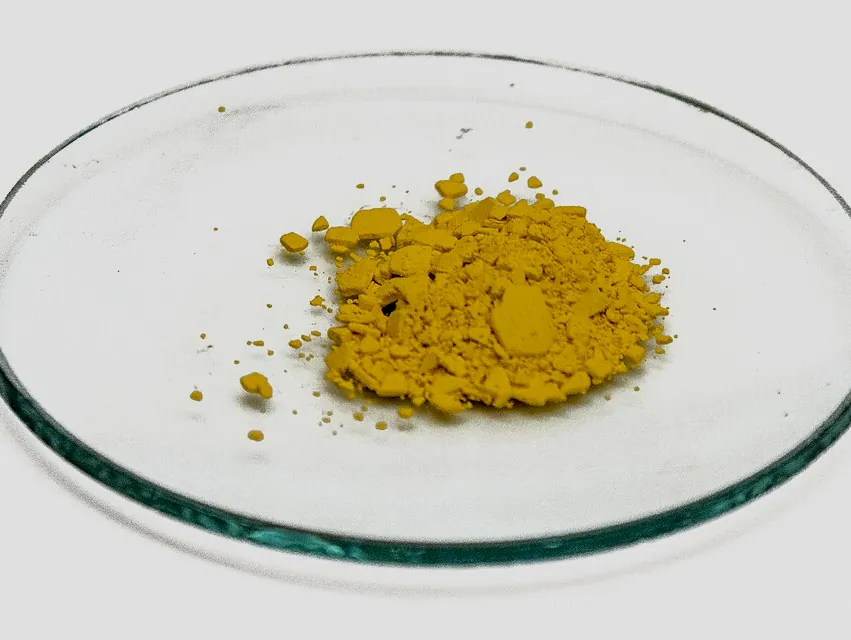
Mixing colourless lead(II) nitrate and potassium iodide solutions instantly produces a bright yellow precipitate of lead(II) iodide:
Pb(NO₃)₂(aq) + 2KI(aq) → PbI₂(s) + 2KNO₃(aq)
The ions have swapped partners. Precipitation reactions follow the pattern AB + CD → AD + CB, which is why they are sometimes called double displacement reactions. But look closely: the K⁺ and NO₃⁻ ions start dissolved and end dissolved. They take no part in the reaction and are called spectator ions. Leaving them out gives the ionic equation, which shows only what really changes:
Pb²⁺(aq) + 2I⁻(aq) → PbI₂(s)
To write an ionic equation: write the full balanced equation with state symbols, split every (aq) compound into its ions, cross out the ions that appear unchanged on both sides, and check that both atoms and charges balance.
Solubility rules
Chemists predict precipitates from a few patterns, worked out from experiments:
| Compounds containing | Solubility in water | Main exceptions |
|---|---|---|
| Sodium, potassium, ammonium ions; all nitrates | soluble | none you'll meet |
| Chlorides, bromides, iodides | mostly soluble | silver and lead(II) are insoluble |
| Sulfates | mostly soluble | barium and lead(II) insoluble; calcium and silver slightly soluble |
| Carbonates | mostly insoluble | sodium, potassium and ammonium are soluble |
| Hydroxides | mostly insoluble | sodium, potassium and ammonium soluble; calcium and barium slightly soluble or soluble |
Because every sodium, potassium and nitrate compound dissolves, these ions are almost always the spectators. A useful memory aid: if both possible new combinations are soluble, nothing happens and the ions just stay mixed.
- Mix Pb(NO₃)₂ with KI. Write the ionic equation and name the spectator ions.
- Test KNO₃ with every solution in row A. What do you notice, and why?
- Find the two ways to make a white precipitate with BaCl₂. Which one is the test for sulfate ions, and how could you tell them apart?
- Add NaOH to each solution in turn. How could the colour of the precipitate help you identify a metal ion?
Using precipitates
Testing for ions. Precipitates let chemists identify ions in an unknown solution:
- Add silver nitrate (with a little nitric acid): a white precipitate shows chloride ions, and a cream-yellow one shows iodide.
- Add barium chloride (with a little hydrochloric acid): a white precipitate shows sulfate ions. The acid removes carbonate first, which would otherwise also give a white precipitate.
- Add sodium hydroxide: copper(II) ions give a pale blue precipitate, iron(II) a dirty green one and iron(III) an orange-brown one.
Collecting the product. A precipitate can be separated by filtering, then washed with pure water and dried. This is how many pigments and medicines are made.
Cleaning water. Sewage treatment plants add iron or aluminium salts to make dissolved phosphate precipitate, so it can be removed before the water is released. Too much phosphate in rivers feeds algal blooms. In water-treatment plants, aluminium sulfate forms a fluffy aluminium hydroxide precipitate that traps clay and bacteria as it settles. The hard white scale inside a kettle is calcium carbonate, precipitated from "hard" water as it is heated.
Test yourself
Which pair of solutions forms a precipitate when mixed?
Silver chloride is insoluble.
In the reaction BaCl₂(aq) + Na₂SO₄(aq) → BaSO₄(s) + 2NaCl(aq), the spectator ions are
Na⁺ and Cl⁻ are dissolved before and after.
The ionic equation for copper(II) sulfate reacting with sodium hydroxide is
Copper(II) needs two hydroxide ions; atoms and charge balance.
Which compound is soluble in water?
All potassium compounds are soluble.
Sodium hydroxide is added to a solution and an orange-brown precipitate forms. The solution contained
Iron(III) hydroxide is orange-brown.
Label the filtration of a precipitate.
Use the solubility rules to sort these compounds.
An insoluble solid that forms when two solutions are mixed is called a . Ions that take no part in the reaction are called ions. All sodium, potassium and compounds dissolve in water. Barium chloride is used to test for ions. The liquid that passes through a filter paper is the .
A student mixes solutions of silver nitrate and magnesium chloride and a white solid forms. Name the solid, write the balanced full equation and the ionic equation, and explain how the student could obtain a pure, dry sample of the solid.
The white solid is silver chloride, which is insoluble, while magnesium nitrate stays dissolved. Full equation: 2AgNO₃(aq) + MgCl₂(aq) → 2AgCl(s) + Mg(NO₃)₂(aq). Magnesium and nitrate ions are spectators, so the ionic equation is Ag⁺(aq) + Cl⁻(aq) → AgCl(s). To get a pure, dry sample, the student should filter the mixture: the silver chloride stays on the filter paper as the residue and the magnesium nitrate solution passes through as the filtrate. The residue should be rinsed with a little distilled water to wash away any remaining dissolved ions, then dried in a warm oven or left to dry, away from bright light because silver chloride slowly darkens in sunlight.