 Coaching Centre
Evidence from living things
Comparative anatomy (homologous and analogous structures, divergent and convergent evolution, the pentadactyl limb), vestigial structures, embryology and Haeckel's drawings, and molecular evidence from DNA and proteins such as cytochrome c.
A dolphin has no back legs. But a dolphin embryo, about four weeks old, grows two small bumps where hind legs would be, with the same limb-building genes switching on as in other mammals. Then the genes switch off and the bumps disappear. Inside an adult dolphin's body, two small bones remain where a pelvis would be.
Homologous structures
Comparative anatomy compares the body structures of different species. The forelimbs of a human, cat, horse, dolphin, bat and bird do very different jobs: grasping, walking, galloping, steering, flying. Yet each is built from the same set of bones in the same order: one upper arm bone (humerus), two forearm bones (radius and ulna), a group of wrist bones (carpals), hand bones (metacarpals) and finger bones (phalanges). This shared plan with five digits is the pentadactyl limb.
Features that share the same basic structure because they were inherited from a common ancestor are homologous structures, even if their functions now differ. An engineer designing a wing, a flipper and a hand from scratch would not use the same bones for all three. Evolution explains it: all these animals descend from a four-limbed ancestor, and natural selection modified its limb in different ways in different environments. This is divergent evolution.
- Look at each animal in turn. Which bone group has changed the most between the human arm and the bat wing?
- Use the readouts to find which limb has the most finger bones (phalanges). How does having extra finger bones suit that animal?
- Choose the horse and turn on Show the human arm behind. Which of your fingers matches the horse's hoof? What are the two thin splint bones?
- Choose the butterfly. Why is its wing analogous to a bird's wing but not homologous?
Analogous structures and convergent evolution
A butterfly's wing and a bird's wing both work for flight, but they are built completely differently: the insect wing is a sheet of chitin with no bones, growing from the body wall. Structures with the same function but different structure and origin are analogous structures. They show that natural selection can arrive at similar solutions to the same problem in unrelated groups. This is convergent evolution.
Australia is full of examples, because marsupials evolved in isolation and came to fill the same roles as placental mammals on other continents:
| Lifestyle | Australian marsupial | Placental mammal elsewhere | Shared features |
|---|---|---|---|
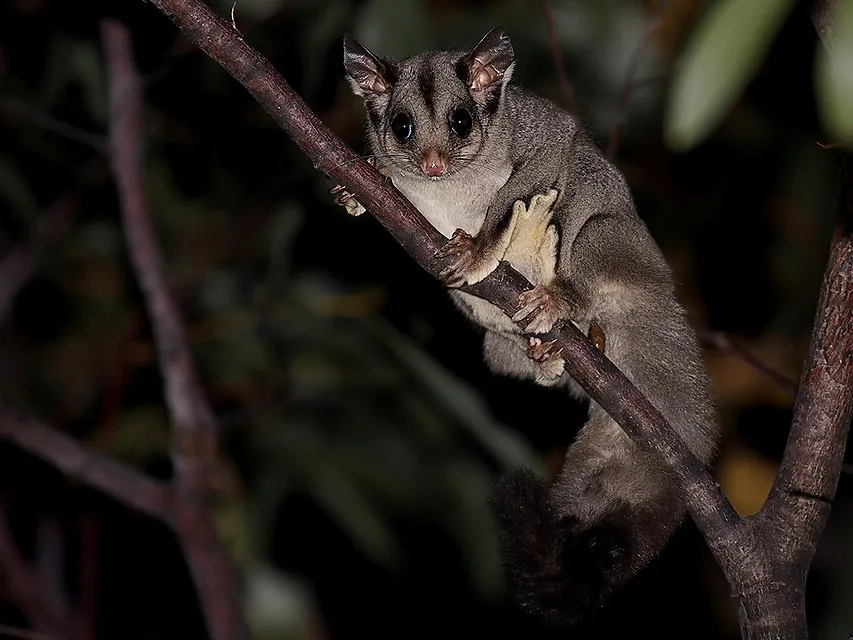
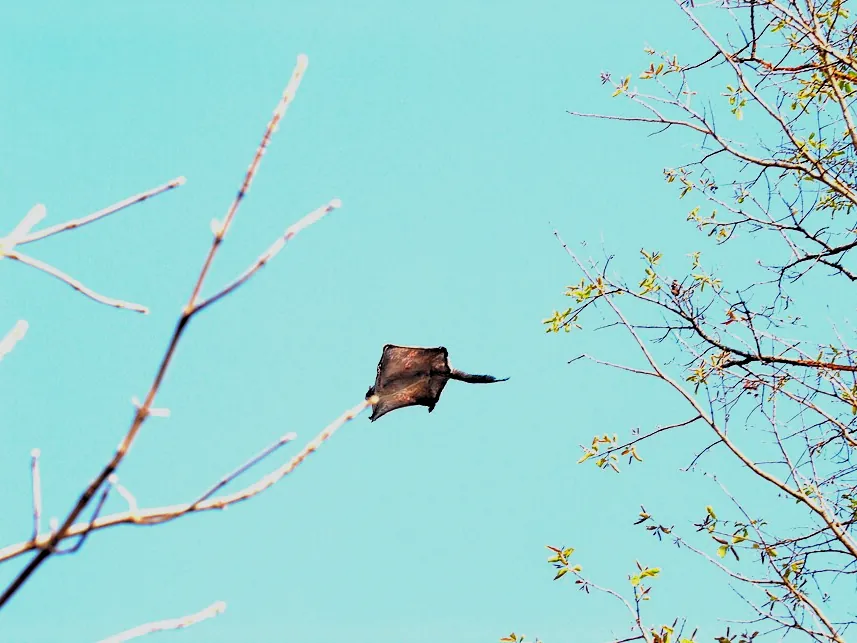
| Gliding between trees | Sugar glider | Flying squirrel (North America) | Skin membrane between front and back legs; flattened tail; big eyes for night |
| Burrowing in sand | Marsupial mole | Golden mole (southern Africa) | No functional eyes; shovel-like front claws; silky fur |
| Eating termites | Numbat | Anteaters (South America) | Long sticky tongue; strong digging claws |
| Large hunter | Thylacine (extinct 1936) | Wolf | Similar skull shape, teeth and body size |
DNA shows that a sugar glider is far more closely related to a kangaroo than to a flying squirrel, despite looking so similar. Similar features are only good evidence of a close relationship when they are homologous.
Vestigial structures
A vestigial structure is a reduced feature that has lost most or all of its original function, but is still there because it was inherited from ancestors that used it:
- Whales and some snakes, such as pythons, have small pelvis bones; pythons even have tiny claw-like spurs where hind legs once were.
- Emus and cassowaries have small wings with feathers but cannot fly.
- Humans have a tailbone (coccyx) made of fused tail vertebrae, tiny muscles that raise goosebumps (useful for fluffing up fur, not for skin with little hair), and muscles that can wiggle the ears.
- The human appendix is a much smaller version of the caecum that plant-eating mammals use to digest cellulose. It is not useless: it contains immune tissue and may store helpful gut bacteria. But it no longer digests plant material, and people live normally without it.
Vestigial structures make sense only if species have changed over time.
Evidence from embryos
Comparing embryos (embryology) shows features that adults have lost. Early embryos of fish, birds, reptiles and mammals, including humans, all have a tail and a series of folds in the neck region called pharyngeal arches. In fish these develop into gills; in mammals the same arches become parts of the jaw, the middle ear bones and the larynx. Dolphin embryos grow hind-limb buds, and baleen whale embryos grow tooth buds that are reabsorbed before birth.
A word of caution. In 1874 the German biologist Ernst Haeckel published famous drawings of embryos that exaggerated how alike they are, and you may still see them in older books. Modern photographs show that early embryos differ more than Haeckel drew. But the shared features, such as the tail and pharyngeal arches, are real, and modern developmental genetics shows that the same genes build them in all vertebrates.
Evidence from DNA and proteins
All living things use DNA, the same four bases, the same genetic code and the same 20 amino acids to build proteins. This shared biochemistry points strongly to a single common origin of life. Differences in DNA build up over time, so the more closely related two species are, the fewer differences in their DNA and proteins.
Cytochrome c is a protein of 104 amino acids, used in respiration by almost every living thing. The table shows how many amino acids differ between pairs of species, from one published set of comparisons (different studies give slightly different counts).
| Monkey | Rabbit | Duck | Penguin | Tuna | |
|---|---|---|---|---|---|
| Human | 1 | 9 | 11 | 14 | 21 |
| Monkey | 8 | 10 | 13 | 21 | |
| Duck | 6 | 3 | 19 |
Use the table to rank the animals from most to least closely related to humans, and explain what the data suggest about ducks and penguins.
DNA comparisons are even more powerful, because they can compare billions of bases. Humans and chimpanzees differ at about 1.2% of the DNA bases that can be lined up; counting pieces of DNA that have been added or lost, the overall difference is closer to 4%. Humans and chimpanzees also share scars in the same places in their DNA: copies of ancient viruses that inserted themselves into the genome of a common ancestor. The chance of the same virus landing in the same place independently is effectively zero.
Because some genes change at a fairly steady rate, the number of differences can be used as a molecular clock to estimate when two lineages split, checked against dated fossils. When DNA was first used to build family trees in the 1970s and 1980s, it could have contradicted the fossil and anatomical evidence. Instead, it broadly confirmed it, while also sorting out puzzles: for example, showing that whales are most closely related to hippos.
Test yourself
- A bat's wing and a whale's flipper contain the same bones in the same order. They are
Same structure, inherited from a common ancestor, different function.
- A bird's wing and a butterfly's wing are analogous because they
Insect wings have no bones and grow from the body wall.
- The marsupial mole of Australia and the golden mole of Africa look very alike. This is best explained by
DNA shows they are only distantly related.
- What was wrong with Haeckel's embryo drawings?
The shared features he highlighted, like pharyngeal arches and tails, are real, but he overstated the similarity.
- Using the cytochrome c table, which animal is most closely related to the rabbit?
On this protein alone the duck has the fewest differences. One small protein can mislead; this is why scientists compare many genes, which show rabbits are much closer to humans than to ducks.
- Why is a shared virus insertion at the same place in human and chimpanzee DNA strong evidence of common ancestry?
It must have been inherited from a common ancestor.
Name the bone groups of the pentadactyl limb.
Classify each example.
The five-digit limb shared by many vertebrates is the limb. When related species become different by adapting to different environments, it is called evolution. Unrelated species becoming similar is evolution. Reduced structures that have lost their original function are . The study of how organisms develop before birth is .
Explain how evidence from comparative anatomy and from DNA can be used together to work out whether two similar-looking animals, such as a sugar glider and a flying squirrel, are closely related.
Animals can look alike because they are related (homologous features inherited from a common ancestor) or because they live in similar ways (analogous features produced by convergent evolution). The gliding membrane of a sugar glider and a flying squirrel is similar because both glide between trees, so on its own it does not show relationship. Comparative anatomy can look for deeper homologous features: the sugar glider has a pouch, marsupial reproduction and a skull and tooth pattern shared with possums and kangaroos, while the flying squirrel has a placenta and the gnawing incisors of rodents. DNA gives independent evidence. Differences in DNA build up over time, so species with a recent common ancestor have fewer differences. Comparing their DNA shows the sugar glider has far fewer differences from other marsupials than from the flying squirrel. Together, the anatomy and DNA show the sugar glider is a marsupial, and its similarity to the flying squirrel is the result of convergent evolution.