 Coaching Centre
Acceleration
Acceleration as the rate of change of velocity, units of m/s², deceleration, calculating acceleration and final velocity, acceleration due to gravity and measuring g, accelerometers, and g-forces.
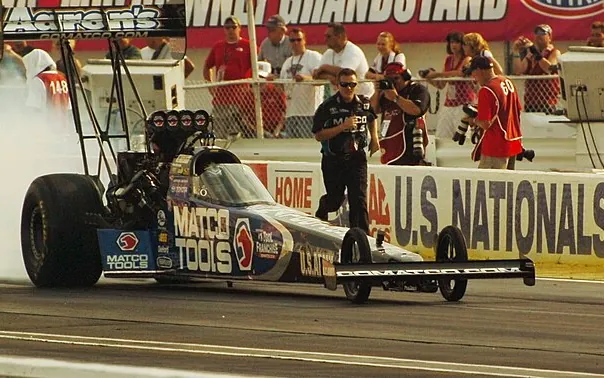
A family car takes about 10 seconds to go from 0 to 100 km/h. A top-fuel dragster does it in well under one second, and its driver is pushed back into the seat with a force several times their own weight. The thing that's so different is not the speed, but how quickly the speed changes.
What is acceleration?
Acceleration is the rate at which velocity changes: how much the velocity changes each second.
acceleration = change in velocity ÷ time taken
a = (v − u) ÷ t where u = initial velocity and v = final velocity
Velocity is in m/s and time in s, so acceleration is in metres per second per second, written m/s². An acceleration of 3 m/s² means the velocity increases by 3 m/s every second: 0, 3, 6, 9 m/s...
Because velocity is a vector, so is acceleration. An object accelerates whenever its velocity changes, which can happen in three ways:
- it speeds up (acceleration in the same direction as the motion)
- it slows down (acceleration opposite to the motion, often called deceleration, and given a negative sign)
- it changes direction, even at a steady speed, as on a roundabout.
An object moving at constant velocity, in a straight line at a steady speed, has zero acceleration.
A train starts from rest and reaches 25 m/s in 50 s. a = (25 − 0) ÷ 50 = 0.5 m/s².
A car travelling at 20 m/s brakes to a stop in 4 s. a = (0 − 20) ÷ 4 = −5 m/s², a deceleration of 5 m/s².
An electric car goes from 0 to 100 km/h in 4.0 s. 100 km/h ÷ 3.6 = 27.8 m/s, so a = 27.8 ÷ 4.0 = 6.9 m/s².
A rocket accelerates at 10 m/s² for 12 s and reaches 800 m/s. Rearranging, u = v − a t = 800 − 10 × 12 = 680 m/s.
Acceleration on a speed–time graph
On a speed–time (or velocity–time) graph, the gradient (rise ÷ run) is the change in speed divided by the time: the acceleration. A steep line means a large acceleration, a flat line means constant speed, and a line sloping down means deceleration. You will use these graphs much more in 5D.
Acceleration due to gravity
Near the Earth's surface every falling object accelerates downwards at about 9.8 m/s², as long as air resistance is small. This value is called g. It is often rounded to 10 m/s² for quick calculations. Each second, a falling object's velocity increases by about 9.8 m/s.
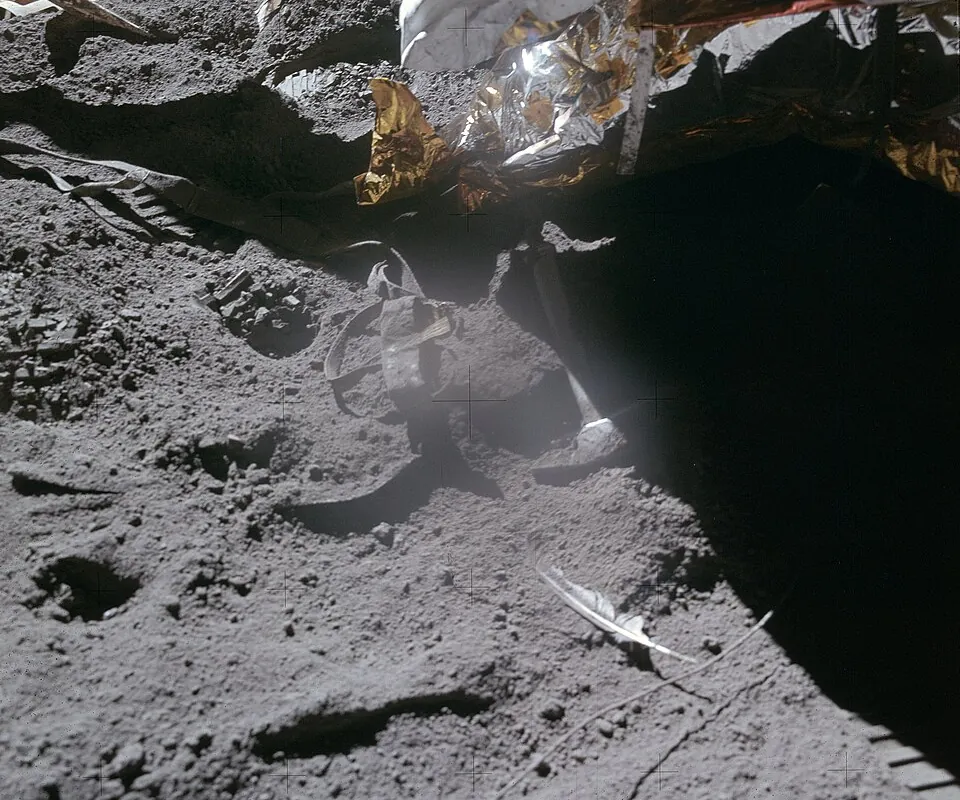
About 400 years ago Galileo argued that, without air, heavy and light objects fall with the same acceleration. In 1971 the Apollo 15 astronaut David Scott tested this on the Moon, where there is no air: a hammer and a falcon feather dropped together hit the ground at the same moment. On Earth a feather falls slowly because air resistance is large compared with its tiny weight.
If an object starts from rest and has a constant acceleration a, the distance it covers in time t is
d = ½ a t² which rearranges to a = 2d ÷ t²
so you can find g by timing a ball dropped from a measured height.
- Use the Steel ball and Light gates. Drop it from 5 m. The time should be 1.010 s; check that a = 2 × 5 ÷ 1.010² = 9.80 m/s².
- Drop it from 1 m and from 2 m. Does the acceleration depend on the height?
- Switch to the Stopwatch and drop from 1 m several times. Why do your results vary so much? Would a bigger height help?
- Choose the Ping-pong ball with light gates and drop it from 5 m. Why is the calculated acceleration less than 9.8 m/s²?
Feeling acceleration
You can't feel steady motion: in a plane cruising at 900 km/h, a cup of water sits perfectly still. You only feel acceleration. Your inner ear contains fluid-filled canals and tiny crystals resting on hair cells, which detect changes in motion and the tilt of your head.
An accelerometer measures acceleration. A simple one is a mass hanging on a thread inside a closed jar of water. When the jar accelerates, the mass lags behind and the thread tilts the opposite way to the acceleration. Phones, game controllers and car airbag systems use tiny electronic accelerometers etched into silicon chips.
Test yourself
A skateboarder speeds up from 2 m/s to 8 m/s in 3 s. The acceleration is
a = (8 − 2) ÷ 3 = 2 m/s².
Which object is NOT accelerating?
Only the train has constant velocity (constant speed and direction).
A stone is dropped from rest. Ignoring air resistance, its speed after 3 s is about
v = u + a t = 0 + 9.8 × 3 = 29.4 m/s.
A ball takes 0.64 s to fall from rest through 2.0 m. The acceleration calculated from a = 2d ÷ t² is
a = 2 × 2.0 ÷ 0.64² = 4.0 ÷ 0.41 = 9.8 m/s².
A hanging-mass accelerometer in a bus swings towards the front. The bus is
The mass swings the opposite way to the acceleration. Swinging forwards means the acceleration is backwards: the bus is slowing down.
Label the speed–time graph.
Is each object accelerating?
Acceleration is the rate of change of and is measured in . Slowing down is called . Near the Earth's surface, falling objects accelerate at about m/s². The gradient of a speed–time graph gives the .
A student drops a ping-pong ball and a steel ball of the same size from 5 m and times each fall with light gates. The steel ball takes 1.01 s and the ping-pong ball takes 1.11 s. Calculate the acceleration of each, and explain the difference. Suggest how the experiment shows that g does not depend on mass.
For a ball starting from rest, a = 2d ÷ t². Steel ball: a = 2 × 5 ÷ 1.01² = 10 ÷ 1.02 = 9.8 m/s². Ping-pong ball: a = 10 ÷ 1.11² = 10 ÷ 1.23 = 8.1 m/s². The steel ball's result matches g because air resistance on it is tiny compared with its weight. The ping-pong ball has almost the same air resistance (same size and shape) but a much smaller weight, so air resistance cancels a large part of its weight. The net force on it is smaller compared with its mass, so its acceleration is less, and it decreases further as the ball speeds up and air resistance grows. To show g does not depend on mass, the student could drop steel balls of different masses (where air resistance is negligible) and show they take the same time; on the Moon, with no air, even a hammer and a feather land together.