 Coaching Centre
Natural selection and allele frequency
Where variation comes from (mutation and sexual reproduction), gene pools and allele frequencies, evolution as a change in allele frequency, the peppered moth story with its modern evidence, and directional, stabilising and disruptive selection.
In 1848 a collector near Manchester caught a jet-black peppered moth. Normal peppered moths are pale and speckled. By 1895, about 98% of the peppered moths around Manchester were black. In 2016, geneticists finally found the change in the DNA that turns the moth black: a chunk of "jumping" DNA that landed inside one gene, probably around 1819.
Where variation comes from
Natural selection can only work if individuals differ in ways that are inherited. In Chapter 1 you saw that inherited differences come from genes, and that a gene can exist in different versions called alleles. Two processes create this variation:
- Mutation is a change in the DNA sequence. It is the only source of completely new alleles. Mutations happen by chance, mostly as copying errors when DNA is replicated, and more often after exposure to mutagens such as UV light or some chemicals. Most mutations are neutral (no effect), some are harmful, and a few are beneficial in a particular environment. Only mutations in cells that make gametes (sperm and eggs) can be passed to offspring.
- Sexual reproduction shuffles existing alleles into new combinations. Meiosis mixes up chromosomes, crossing over swaps pieces between them, and fertilisation joins alleles from two parents. Siblings are therefore all different (unless they are identical twins).
Mutations are random: they are not caused by what the organism needs. A bacterium does not mutate because it meets an antibiotic. But if a random mutation happens to help in the current environment, natural selection will make it more common.
Gene pools and allele frequency
A population is a group of the same species living in an area and breeding together. All the alleles of all the genes in the population make up its gene pool. The allele frequency is the proportion of all copies of a gene in the gene pool that are a particular allele. Biologists define evolution precisely as a change in the allele frequencies of a population over generations.
In peppered moths, the allele for dark wings (C) is dominant over the allele for pale wings (c). A sample of 100 moths contains 36 CC, 48 Cc and 16 cc moths. Find the frequency of the C allele and the percentage of dark moths.
Natural selection is one way allele frequencies change, but not the only one. Gene flow (individuals moving in or out of a population) brings alleles in or carries them away. Genetic drift is change by pure chance: in a small population, a few lucky individuals may leave more offspring for reasons that have nothing to do with their alleles. Drift is why small, isolated populations such as island species can change quickly, and why they lose variation.
The peppered moth
Peppered moths (Biston betularia) fly at night and rest by day on tree trunks and branches, where birds hunt them. Before the Industrial Revolution, British tree trunks were covered in pale lichens, and the speckled pale form (called typica) was almost invisible. The black form (carbonaria) appeared around Manchester in 1848. Coal smoke was killing the lichens and coating the trees with soot. On blackened bark the pale moths stood out and the black moths were hidden.
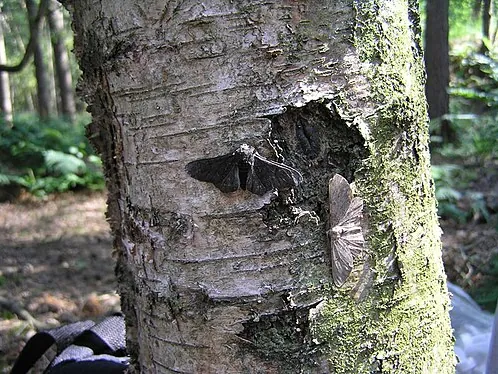
In the 1950s Bernard Kettlewell released marked moths of both forms in a polluted wood near Birmingham and a clean wood in Dorset, and recaptured more of the camouflaged form in each. His methods were later criticised (for example, he released moths in daylight at high densities). So between 2001 and 2007 the British biologist Michael Majerus repeated the work far more carefully, releasing 4864 moths one by one at natural densities and watching birds eat them. In unpolluted countryside, birds ate the dark form noticeably more often, confirming that bird predation drives the change.
After the UK's Clean Air Act of 1956 cut smoke pollution, lichens returned, trees became paler, and the dark form became rare again. Near Liverpool it fell from over 90% in the 1950s and 1960s to below 10% by the early 2000s, and it is now almost gone. In 2016, scientists found that the carbonaria mutation is a transposable element (a piece of DNA that can copy itself into new places) inserted into a gene called cortex, which controls wing patterns. The peppered moth is now one of the best understood examples of natural selection.
- Start again with Sooty bark (1% of moths are dark). Run one generation at a time. How many generations until more than 90% of moths are dark? (Peppered moths have one generation a year.)
- Keep going until about 98% are dark. Compare your number of generations with the real story: 1848 to 1895.
- Now choose Clean again and run 10 generations. Why does the percentage of dark moths hardly fall at first? (Hint: the dark allele is dominant, so most pale-allele copies are hidden in dark Cc moths.)
- Choose a bark and press Be the bird. Tap the first 10 moths you notice. Did you catch mainly the camouflaged moths or the ones that stood out?
Three patterns of selection
Natural selection can push a population's features in different ways, depending on which individuals do best:
| Type | Which individuals do best | Effect on the population | Example |
|---|---|---|---|
| Directional | One extreme | The average shifts in one direction | Dark peppered moths in sooty areas; bacteria resistant to an antibiotic |
| Stabilising | The average | Extremes are removed; variation shrinks | Human birth mass: very small and very large babies historically had lower survival |
| Disruptive | Both extremes | The population may split into two groups | African seedcracker finches: small-beaked and large-beaked birds each specialise in different seeds; medium beaks do worse |
Directional selection drives most of the examples in this chapter. Stabilising selection is very common too: it is why most features stay much the same for long periods when the environment is steady. Disruptive selection can be the first step towards one species splitting into two.
Test yourself
- The only source of completely new alleles is
Sexual reproduction shuffles alleles that already exist; mutation creates new ones.
- Which mutation could be passed on to a person's children?
Only mutations in cells that make gametes are inherited.
- A population of 50 plants has 18 RR, 24 Rr and 8 rr individuals. The frequency of allele R is
(18 × 2 + 24) ÷ 100 = 60 ÷ 100 = 0.6
- Biologists define evolution as
Speciation is one possible result, but even small changes in allele frequency count as evolution.
- Michael Majerus's experiments (2001–2007) were important because they
They answered criticisms of the 1950s work with a large, careful study.
- Very small and very large human babies historically had lower survival, so birth mass stays near the average. This is
Selection against both extremes keeps the average steady.
Name each stage in this model of natural selection.
Sort the processes.
All the alleles in a population make up its . A change in the DNA sequence is a . Movement of alleles between populations is called gene . Change in allele frequency by chance alone is genetic . The dark peppered moth allele became common through selection.
Explain the rise and fall of the dark form of the peppered moth between 1848 and 2000, referring to mutation, allele frequency and natural selection.
The dark (carbonaria) allele arose by a random mutation, and was rare while trees were covered in pale lichen, because dark moths were easy for birds to see and were eaten more. From the 1800s, coal smoke killed the lichen and blackened the bark around industrial cities. Now pale moths stood out, so birds ate more of them, while dark moths were camouflaged, survived and reproduced more, passing the dark allele to their offspring. Over about 50 generations the frequency of the dark allele in the gene pool rose until about 98% of moths near Manchester were dark. After the Clean Air Act of 1956 reduced pollution, lichens returned and the bark became paler. Selection then favoured pale moths, so the frequency of the dark allele fell, and by 2000 the dark form was rare. No individual moth changed colour: the proportions of the two forms changed because of which moths survived to breed.