 Coaching Centre
Electrochemical cells
Oxidation and reduction as loss and gain of electrons, metal extraction as reduction, building galvanic cells from two metals and a salt bridge, predicting cell voltage, electrolysis and electroplating, smelting aluminium, and how lithium-ion batteries work and are recycled.
In 1800 Alessandro Volta stacked discs of zinc and copper with cardboard soaked in salty water between them and made the first battery. Two hundred years later, the battery in your phone does the same job: it lets a chemical reaction push electrons through a wire instead of releasing its energy as heat. The unit of voltage, the volt, is named after him.
Oxidation and reduction
Many reactions involve electrons moving from one substance to another. Chemists call these redox reactions (reduction and oxidation):
- Oxidation is the loss of electrons. When zinc reacts, Zn → Zn²⁺ + 2e⁻.
- Reduction is the gain of electrons. When copper ions become copper metal, Cu²⁺ + 2e⁻ → Cu.
A useful memory aid is OIL RIG: Oxidation Is Loss, Reduction Is Gain. The two always happen together, because electrons lost by one substance must be gained by another. The words first meant gaining and losing oxygen: when iron rusts it is oxidised, and when oxygen is removed from iron ore it is reduced.
You can now see the blast furnace (3G) in a new way. In Fe₂O₃ + 3CO → 2Fe + 3CO₂, the iron(III) ions each gain three electrons and become iron atoms, so the ore is reduced, while carbon monoxide is oxidised to carbon dioxide. In green steel the hydrogen is oxidised instead (Fe₂O₃ + 3H₂ → 2Fe + 3H₂O). Every way of extracting a metal from its ore is a reduction; what changes is what supplies the electrons: carbon, hydrogen or, for the most reactive metals, an electric current.
Galvanic cells: chemical energy to electrical energy
If you put zinc into copper(II) sulfate solution, zinc atoms give electrons straight to copper ions. Copper coats the zinc, the blue colour fades and the solution warms up: the energy is lost as heat. A galvanic cell (also called a voltaic cell) separates the two halves of the reaction so the electrons have to travel through a wire, where they can do useful work.
- The anode is where oxidation happens. In a galvanic cell it is the negative electrode, made of the more reactive metal. It slowly dissolves as atoms become ions.
- The cathode is where reduction happens. In a galvanic cell it is the positive electrode. Metal ions from the solution gain electrons and coat it.
- Electrons flow through the external circuit (the wire) from anode to cathode.
- The salt bridge (paper or a tube soaked in a salt solution such as potassium nitrate) completes the circuit. Negative ions drift towards the anode and positive ions towards the cathode, so charge doesn't build up. Take it away and the current stops instantly.
The further apart two metals are in reactivity, the bigger the voltage. Chemists measure each metal's tendency to lose electrons as a standard electrode potential. The cell voltage is the difference between the two values.
| Metal | Electrode potential (V) | |
|---|---|---|
| Magnesium, Mg | −2.37 | most reactive: loses electrons most easily |
| Aluminium, Al | −1.66 | |
| Zinc, Zn | −0.76 | |
| Iron, Fe | −0.44 | |
| Nickel, Ni | −0.25 | |
| Lead, Pb | −0.13 | |
| Copper, Cu | +0.34 | |
| Silver, Ag | +0.80 | least reactive: its ions gain electrons most easily |
For zinc and copper: 0.34 − (−0.76) = 1.10 V. The metal with the more negative value is the anode. These values apply when the solutions have a standard concentration at 25 °C; real cells give a little less.
- Build a zinc–copper cell and connect it. Check the voltage is 1.10 V. Which electrode loses mass, and which way do the electrons flow?
- Remove the salt bridge. What happens to the voltage, and why?
- Find the pair of metals that gives the biggest voltage. Why is it not used for everyday batteries? (Think about how magnesium reacts with water.)
- Swap the metals so copper is on the left. Does the anode change sides?
- A phone battery needs about 3.7 V. How many zinc–copper cells in series would you need?
Electrolytic cells: electrical energy to chemical energy
An electrolytic cell runs the other way. A power supply pushes electrons to force a reaction that would not happen by itself, storing energy in the products. This is electrolysis.
In an electrolytic cell, the anode is connected to the positive terminal and the cathode to the negative terminal, the opposite of a galvanic cell. But the rule doesn't change: oxidation always happens at the anode and reduction at the cathode.
| Galvanic cell | Electrolytic cell | |
|---|---|---|
| Energy change | Chemical → electrical | Electrical → chemical |
| Reaction | Happens by itself | Forced by a power supply |
| Anode (oxidation) | Negative | Positive |
| Cathode (reduction) | Positive | Negative |
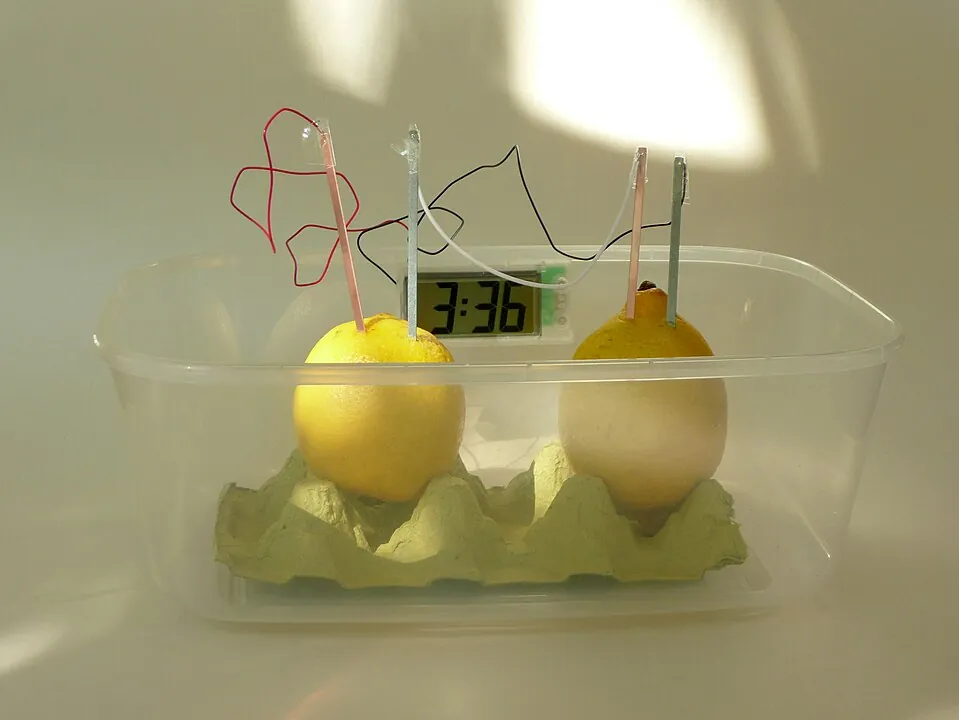
| Examples | Batteries discharging, fruit cells | Electroplating, smelting aluminium, charging a battery, splitting water into hydrogen |
Electroplating uses electrolysis to coat an object with a thin layer of metal, such as chromium on taps or gold on electrical connectors. The object is made the cathode in a solution of the plating metal's ions.
Aluminium is too reactive to be extracted with carbon, so it is made by electrolysis. Australia is one of the world's two biggest bauxite producers, with mines at Weipa in Queensland, Gove in the Northern Territory and in the Darling Range of Western Australia. Bauxite is refined into pure aluminium oxide (alumina), which is dissolved in molten cryolite and split by a huge current.
Smelting uses enormous amounts of electricity: about 14 kWh for every kilogram of aluminium. The Tomago smelter near Newcastle uses about a tenth of all the electricity in NSW. Recycling an aluminium can uses only about 5% of the energy needed to make new aluminium, which is why cans are worth collecting.
Batteries and recycling
A rechargeable battery is a galvanic cell when it is being used and an electrolytic cell when it is being charged. In a lithium-ion cell, lithium is stored between the layers of graphite at the anode. When the phone is on, lithium atoms lose electrons, the electrons flow through the phone and lithium ions travel through the electrolyte into the metal oxide cathode. A charger pushes everything back. Each cell gives about 3.7 V.
Australia produces more lithium than any other country, mostly as the mineral spodumene from Western Australia, and is starting to refine it into battery chemicals onshore. Other battery metals mined here include nickel, cobalt and manganese. As demand grows, chemists are developing batteries that use more common elements, such as sodium-ion and lithium iron phosphate cells, which avoid cobalt.
Used batteries should never go in household bins. Crushed lithium batteries can short-circuit and catch fire, and they cause thousands of fires in garbage trucks and recycling plants each year. The national B-cycle scheme collects batteries at supermarkets and hardware stores so their metals can be recovered.
Test yourself
In the reaction Zn → Zn²⁺ + 2e⁻, zinc is
Oxidation Is Loss of electrons.
In a galvanic cell made from magnesium and copper, the anode is
Magnesium is more reactive, so it is oxidised and supplies electrons: the negative anode.
The voltage of a nickel–silver cell is (Ni −0.25 V, Ag +0.80 V)
0.80 − (−0.25) = 1.05 V.
Which process uses an electrolytic cell?
Electroplating needs a power supply to force the metal onto the object.
Aluminium is extracted by electrolysis rather than by heating with carbon because
Carbon can only remove oxygen from metals less reactive than itself.
Label the zinc–copper cell.
Put the events in a zinc–copper cell in order, starting at the zinc.
Which kind of cell does each describe?
Reduction is the gain of . In every cell, oxidation happens at the . The bridge lets ions move between the two half-cells. Using electricity to coat an object with metal is called . Australia is the world's largest producer of .
A student builds a cell from an iron electrode in iron(II) sulfate solution and a copper electrode in copper(II) sulfate solution, joined by a salt bridge (Fe −0.44 V, Cu +0.34 V). Predict the voltage, identify the anode and cathode, describe the reactions at each, and explain the role of the salt bridge.
The voltage should be about 0.34 − (−0.44) = 0.78 V. Iron is more reactive, so it is the anode, the negative electrode. Iron atoms are oxidised, Fe → Fe²⁺ + 2e⁻, so the iron electrode slowly dissolves. The electrons flow through the wire to the copper electrode, which is the cathode, the positive electrode. There, copper ions from the solution are reduced, Cu²⁺ + 2e⁻ → Cu, and copper is deposited, so the cathode gains mass and the blue solution fades. The salt bridge contains ions that move into the two solutions: negative ions towards the iron half-cell, which is gaining positive Fe²⁺ ions, and positive ions towards the copper half-cell, which is losing Cu²⁺ ions. This keeps both solutions electrically neutral and completes the circuit, so current can keep flowing.