 Coaching Centre
Darwin, Wallace and natural selection
Early ideas about change in living things, Lamarck's rejected theory, Darwin's Beagle voyage and the Galápagos, artificial selection, Malthus, Wallace's Line, and the four conditions for evolution by natural selection.
In June 1858 a parcel reached Charles Darwin's house in Kent. Inside was an essay from Alfred Russel Wallace, a collector working on the island of Ternate in what is now Indonesia. Wallace had worked out, while lying sick with fever, exactly the theory Darwin had been quietly building for 20 years. Within a month both men's ideas were read aloud together in London.
Before Darwin: species that change?
For centuries most Europeans believed each species had been created in its present form and never changed. Two kinds of evidence slowly undermined that idea. Fossils showed animals that no longer exist anywhere: in 1796 the French naturalist Georges Cuvier showed that mammoth bones belonged to an extinct species. And rock layers showed that different living things had lived at different times.
In the early 1800s another French naturalist, Jean-Baptiste Lamarck, proposed that species gradually change. His explanation was the inheritance of acquired characteristics: body parts that are used a lot grow stronger, parts that are not used shrink, and these changes are passed to the offspring. A giraffe stretching for leaves would get a slightly longer neck and pass it on.
Lamarck deserves credit for arguing that species change, but his mechanism is wrong. Changes to your body cells during your lifetime are not written into the DNA of your sperm or egg cells, so they cannot be inherited. A weightlifter's children are not born with big muscles. In the 1880s August Weismann cut the tails off mice for five generations, and every new generation was still born with a full tail. (Scientists now know that some chemical tags on DNA, called epigenetic marks, can occasionally pass to offspring for a generation or two, but they do not build lasting new features like long necks.)
The voyage of the Beagle
In 1831, 22-year-old Charles Darwin joined HMS Beagle as a naturalist on a voyage to map the coast of South America. The voyage lasted almost five years. Darwin collected thousands of specimens, found fossils of giant extinct mammals in Argentina that looked like bigger versions of living armadillos and sloths, and saw that a huge earthquake in Chile had lifted mussel beds on the shore out of the sea, so land can rise over time.
In September 1835 the ship reached the Galápagos Islands, volcanic islands about 1000 km west of Ecuador. Darwin noticed that:
- the giant tortoises differed from island to island: on wetter islands with low plants they had domed shells, but on dry islands, where they reach up to eat cactus, their shells were saddle-shaped, lifted at the front;
- mockingbirds on different islands were different, though clearly related to mainland South American mockingbirds;
- a group of small brown birds had beaks of very different shapes. Back in London the bird expert John Gould showed they were all finches: 13 new species found nowhere else.
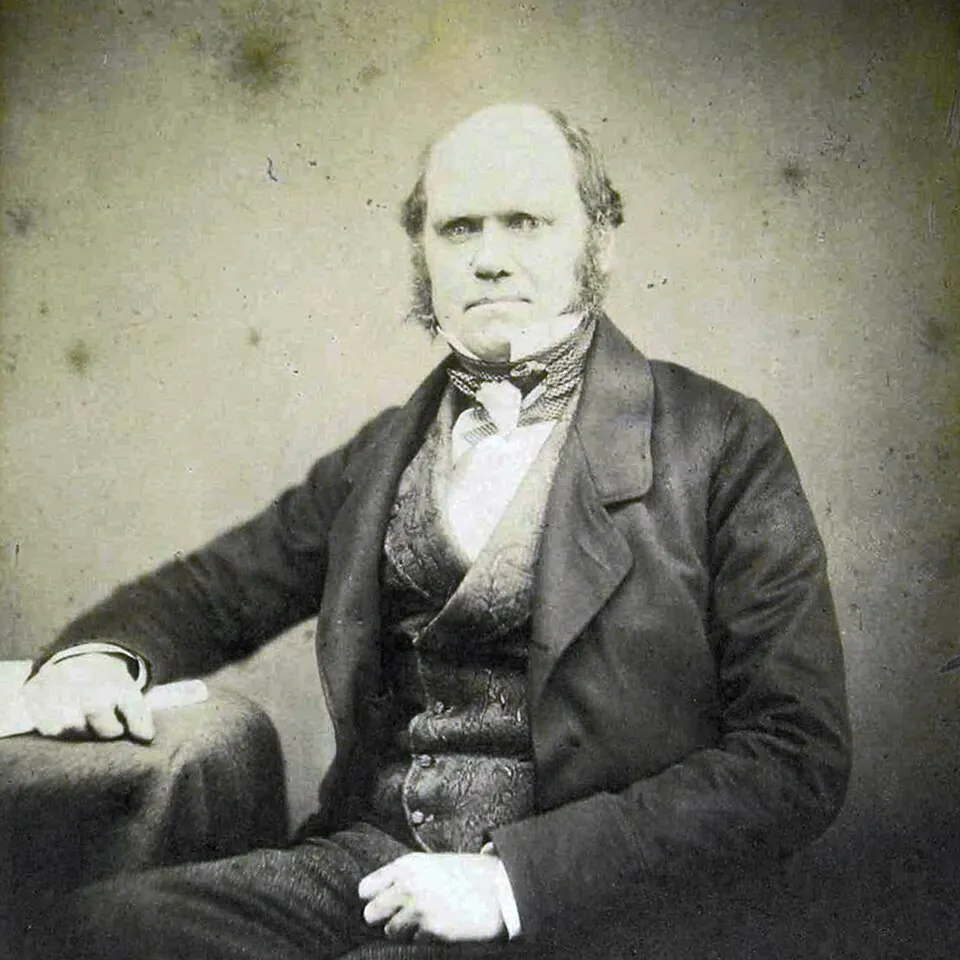
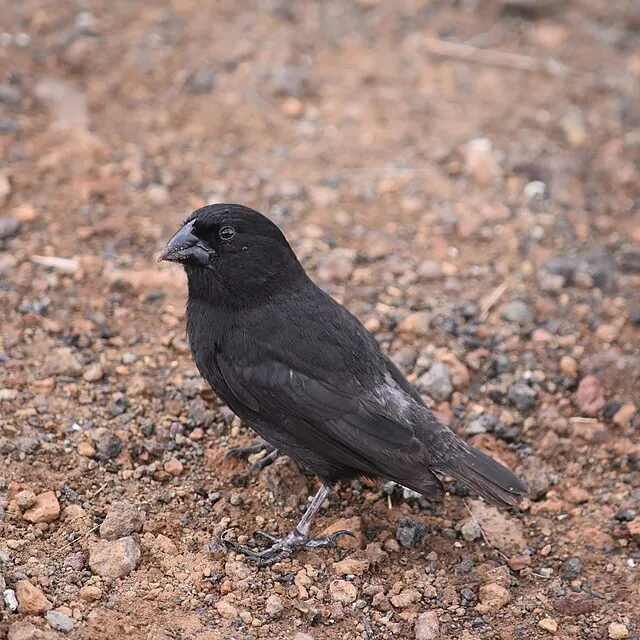
Why would a creator place slightly different, but closely related, species on islands a few kilometres apart, all resembling animals on the nearest mainland? Darwin began to suspect that a few birds and tortoises had arrived from South America long ago, and that their descendants had changed differently on each island.
On the way home the Beagle visited Australia. In January 1836, near Wallerawang on Wiradjuri Country west of the Blue Mountains, Darwin watched platypuses in a creek and saw a rat-kangaroo. In his diary he wondered whether "two distinct Creators" had been at work, because Australian animals filled the same roles as animals elsewhere but were built so differently.
Clues from farms and from Malthus
Back in England, Darwin bred fancy pigeons and talked to farmers and plant breeders. Breeders choose which animals or plants are allowed to reproduce, keeping only those with the features they want. Over many generations this artificial selection produces huge changes. Every breed of pigeon descends from the wild rock dove; every breed of dog descends from wolves.
In 1838 Darwin read an essay by Thomas Malthus, who argued that human populations grow faster than their food supply, so there is always a struggle to survive. Darwin realised the same must be true of all living things. Most young animals and seeds die before they can breed. If the survivors are not just lucky but are, on average, those best suited to their surroundings, then nature itself is doing the choosing. He called this natural selection.
- Choose Leaves (kale), keep the top 20% and breed 10 generations. The wild plant's leaves average 12 cm. About how long are they now, and how many times bigger is that?
- Start again and set the slider to 100%, so every plant breeds. Breed 10 generations. What happens to the average, and why?
- Turn off Feature is inherited, keep the top 5% and breed 10 generations. Explain why this is like Lamarck's idea, and why it fails.
- Compare keeping the top 5% with the top 50%. Which changes the plant faster? What would a breeder lose by keeping only 5%?
Evolution by natural selection
Darwin spent the next 20 years gathering evidence. His theory explains how populations change over many generations when four conditions are met:
The result is that a population becomes better adapted to its environment. If the environment changes, different features are favoured, and the population changes again. Over very long periods, these small changes add up to new species and the enormous diversity of life. The phrase "survival of the fittest" was coined by the philosopher Herbert Spencer. In biology, fitness means how well an organism survives and leaves offspring in its environment, not how strong or athletic it is.
Notice what natural selection does not do. It acts on variation that already exists; it cannot produce a feature just because it is needed. Individuals do not evolve during their lifetimes: populations evolve over generations.
Wallace and the line across Indonesia
Alfred Russel Wallace earned his living collecting animals to sell to museums and collectors. Between 1854 and 1862 he travelled about 22 000 km through the islands between Asia and Australia, collecting more than 125 000 specimens. He did not work alone. A young man from Sarawak named Ali joined him as a cook and became his most skilled collector and assistant for seven years, finding many of the specimens later credited to Wallace, including a bird of paradise named after Wallace.
Wallace noticed something astonishing. Bali and Lombok are only about 35 km apart, yet the birds on Bali are mostly Asian types (barbets, woodpeckers), while those on Lombok include cockatoos and honeyeaters, which are Australian types. The same sharp boundary runs between Borneo and Sulawesi. This boundary is now called Wallace's Line.
Wallace could not explain why the line existed. Plate tectonics now does: the islands west of the line sit on the shallow Sunda shelf, part of the Asian plate, and were joined to Asia by land whenever sea levels fell during ice ages. The islands to the east were carried north on the Australian plate, which separated from Gondwana carrying marsupials, monotremes and their relatives. The deep Lombok Strait was never dry land, so most land animals could not cross it. The study of where species live and why is called biogeography, and it is one of the strongest lines of evidence for evolution.
Wallace's 1858 essay pushed Darwin into action. Their ideas were presented together to the Linnean Society of London on 1 July 1858, and in November 1859 Darwin published On the Origin of Species, packed with evidence. Wallace always generously called the theory "Darwinism", but today both men are recognised as its discoverers.
Test yourself
- According to Lamarck, giraffes have long necks because
Inheritance of acquired characteristics. Changes made to body cells are not inherited, so this mechanism is rejected.
- Which observation in the Galápagos most suggested to Darwin that species can change?
Related species on each island suggested that one ancestral population had changed differently in each place.
- What did Darwin take from Malthus's essay?
Competition means only some individuals survive to reproduce.
- Kale, broccoli and cabbage were all bred from wild cabbage. This is an example of
People chose which plants could breed. They are still one species.
- Wallace's Line exists mainly because
Islands to the west were joined to Asia when sea levels fell; islands to the east came north with the Australian plate.
- In evolution, "fitness" means
Leaving offspring is what counts.
Name each of Darwin's finches.
Put the steps of natural selection in order.
Whose explanation is each statement?
Darwin sailed on HMS and visited the Islands. Breeders use selection to change crops and animals. The boundary between Asian and Australian animals is called Line. The study of where species live is called .
Wild rabbits were released in Victoria in 1859 and spread across most of Australia. Use the four conditions for natural selection to explain how rabbits in the hot, dry interior could evolve to have larger ears than rabbits in cool Tasmania. (Large ears help an animal lose heat.)
Rabbits vary in ear size, and ear size is at least partly inherited. Rabbits produce far more young than can survive, so they compete for food, water and shelter, and many die from heat stress. In the hot, dry interior, rabbits with larger ears can lose more heat through the blood vessels in their ears, so they are more likely to survive the summer and reproduce. They pass the genes for larger ears to their offspring. Rabbits with small ears overheat more often and leave fewer young. Over many generations, the proportion of large-eared rabbits in the interior population increases, so the average ear size rises. In cool Tasmania large ears give no advantage and may lose too much heat in winter, so ear size there stays smaller. Individual rabbits do not grow bigger ears because they need them; the population changes because of which rabbits survive to breed.