 Coaching Centre
Earth’s spheres as one system
The atmosphere, hydrosphere, lithosphere and biosphere as one connected system; the layers of the atmosphere and why temperature falls then rises with height; how photosynthesis built today's oxygen-rich air; and thinking about Earth in terms of stores, flows and feedbacks.
In 1991 eight people sealed themselves inside Biosphere 2, a glass-and-steel world in the Arizona desert with its own rainforest, ocean, desert and farm. The plan was to live there for two years on nothing but sunlight. Within 16 months the oxygen in the air had dropped from 21% to about 14.5%, the level on a mountain 4 km high, and engineers had to pump oxygen in. Bacteria in the rich soil were using up oxygen faster than the plants made it, and the new concrete was quietly soaking up carbon dioxide. Building a small Earth turned out to be much harder than anyone expected, because every part of a planet affects every other part.
Four spheres, one system
Scientists divide Earth into four overlapping "spheres". You met them briefly in Year 7; here we treat them as parts of a single system.
- The atmosphere is the thin layer of gases around the planet: mostly nitrogen (78%) and oxygen (21%), with argon, water vapour and carbon dioxide (about 0.04%).
- The hydrosphere is all of Earth's water: oceans, ice, rivers, lakes, groundwater and water vapour. About 97% of it is salty sea water. Frozen water is sometimes called the cryosphere.
- The lithosphere is the rigid outer shell of rock: the crust plus the very top of the mantle, broken into tectonic plates (Year 9). Soil forms at its surface.
- The biosphere is every living thing and the places they live, from bacteria 3 km down in rock to birds flying over Everest.
The spheres are not separate places. A raindrop falling on a mountain is the hydrosphere acting on the lithosphere; the rock it dissolves becomes nutrients for the biosphere; the plants growing there change the carbon dioxide in the atmosphere. The energy that drives almost all of this comes from the Sun, with a small extra flow of heat from Earth's hot interior. (Your textbook gives the inner core as nearly 10 000 °C; current measurements put it at about 5200 °C, roughly as hot as the surface of the Sun.)
The atmosphere in layers
If Earth were the size of a basketball, the atmosphere would be thinner than a sheet of paper wrapped around it. Pressure falls quickly with height: half of all the air is below 5.5 km, and 99% is below about 30 km. There is no top edge; the air just thins out into space.
- Troposphere (0 to about 8–17 km). All weather happens here and it holds about 75% of the air. It is heated from the ground up, so temperature falls by about 6.5 °C for every kilometre you climb. The top, the tropopause, is highest over the equator, where warm air rises most strongly, and lowest over the poles.
- Stratosphere (to about 50 km). Temperature stops falling and then rises, because the ozone layer absorbs ultraviolet light and warms the air. Warm air sitting on cool air is stable, so the stratosphere barely mixes; volcanic dust and gases that reach it can stay up for a year or more.
- Mesosphere (to about 85 km). The coldest layer, down to about −90 °C. Most meteors burn up here.
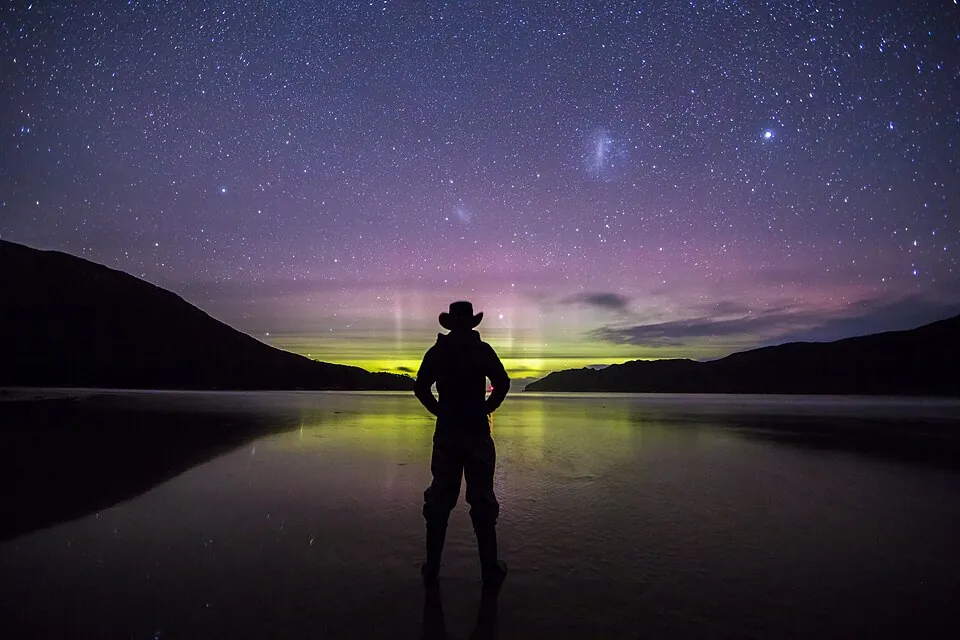
- Thermosphere (above 85 km). The few gas particles absorb X-rays and high-energy UV, so they move very fast (a "temperature" of over 1000 °C), even though there is so little air you would freeze. Auroras glow here, and the International Space Station orbits at about 410 km.
- Launch from Sydney. At what height does the temperature stop falling? What is the air pressure there compared with the ground?
- Launch from Darwin and from Casey station. Compare the height of the tropopause at each site and explain the difference.
- Why does the balloon get bigger as it rises, and why does it eventually burst?
- When the balloon bursts, what percentage of the atmosphere's air is below it?
The Bureau of Meteorology launches weather balloons every day from dozens of sites, from Willis Island in the Coral Sea to Macquarie Island and Antarctica; many are now launched by robots. Their readings feed the computer models behind every weather forecast.
Where today's air came from
Earth's early atmosphere had almost no oxygen. It was mostly nitrogen, carbon dioxide and water vapour from volcanoes. About 3.5 billion years ago, cyanobacteria began photosynthesising and releasing oxygen, but for hundreds of millions of years the oxygen reacted with dissolved iron in the oceans as fast as it was made, settling as rusty layers on the sea floor. Those layers are now the banded iron formations of the Pilbara in Western Australia, where most of Australia's iron ore is mined. Once the iron was used up, about 2.4 billion years ago, oxygen began building up in the air: the Great Oxidation Event.
You can still see the living descendants of those early oxygen-makers. At Shark Bay (Gathaagudu, meaning "two waters", in the Malgana language) on the WA coast, mats of cyanobacteria trap sediment and build domed stromatolites, much as they did 3.5 billion years ago. This is a perfect example of spheres interacting: living things (biosphere) changed the air (atmosphere), which changed the oceans (hydrosphere) and left new rocks behind (lithosphere).
Thinking in systems
Earth scientists describe the planet in terms of:
- Stores (also called reservoirs or sinks): places where matter or energy is held, such as carbon in limestone or water in the Antarctic ice sheet.
- Flows (fluxes): the processes that move matter or energy between stores, such as evaporation, photosynthesis or erosion, and how fast they go.
- Feedbacks: when a change causes effects that loop back and change the original change. A positive feedback amplifies it; a negative feedback damps it down. You will meet some important climate feedbacks in 7F.
Matter on Earth is (almost) fixed in amount, so it cycles between stores. Energy arrives as sunlight and leaves as heat radiated to space, so it flows through. Many First Nations knowledge systems have long described Country this way: land, water, sky, plants, animals and people as one connected system, with obligations to keep it in balance. Yolŋu people of Arnhem Land use the idea of ganma, the place where salt water from the sea and fresh water from the land meet and mix in a lagoon, to describe how different systems of knowledge can meet and strengthen each other.
Test yourself
In which layer of the atmosphere does almost all weather occur?
The troposphere holds most of the air and nearly all the water vapour.
The temperature rises with height in the stratosphere because
The ozone layer absorbs UV and turns it into heat.
Banded iron formations in the Pilbara are evidence that
The oxygen made iron oxides that settled as layers.
Which is an example of the hydrosphere interacting with the lithosphere?
Water (hydrosphere) wearing away rock (lithosphere).
Label the layers of the atmosphere.
Which sphere does each belong to?
The boundary between the troposphere and the stratosphere is the . The gas that makes up 21% of the air is . A place where matter is held, such as limestone, is called a . A change that is amplified by its own effects is a feedback. Matter cycles, but energy through the Earth system.
Biosphere 2 lost oxygen because soil bacteria used it faster than plants produced it. Use the idea of Earth's spheres as a connected system to explain why it is so difficult to build a small, sealed copy of Earth.
On Earth the atmosphere, hydrosphere, lithosphere and biosphere constantly exchange matter. Plants take in carbon dioxide and release oxygen, while bacteria, animals and fires use oxygen and release carbon dioxide; rocks and oceans absorb carbon dioxide too. On the real Earth these flows are small compared with the enormous stores of air and sea water, so a small imbalance takes thousands of years to change the air noticeably. In Biosphere 2 the stores were tiny. Bacteria in the very rich soil respired faster than the plants photosynthesised, and fresh concrete reacted with carbon dioxide, so the oxygen dropped within months. Because every sphere affects the others, unexpected interactions like these are almost impossible to predict and balance in a small sealed system.