 Coaching Centre
The circulatory system
Blood and its four components, the structure of the heart and its valves, the double circulation through lungs and body, arteries, veins and capillaries, heart rate, and how a heart dissection is done.
Your heart beats about 100,000 times a day without you ever asking it to. Over a lifetime that's around 3 billion beats. Each minute it pushes your entire blood supply, about 5 litres, all the way around your body and back. If you laid out all your blood vessels end to end they would stretch roughly 100,000 km, enough to wrap around the Earth more than twice, although most of that length is capillaries thinner than a hair.
The body's transport system
The digestive system gets nutrients into the blood and the respiratory system gets oxygen into it. Neither would be any use without a way to deliver them to 30 trillion or so cells and carry the wastes away. That's the job of the circulatory system: the heart, the blood vessels and the blood itself.
What's in blood?
Blood looks like a simple red liquid, but spin a sample in a centrifuge and it separates into layers. Just over half is a straw-coloured liquid called plasma. The rest is cells.
| Component | What it's like | Job |
|---|---|---|
| Plasma (about 55%) | Mostly water, with dissolved substances | Carries dissolved nutrients (glucose, amino acids), wastes (urea, most carbon dioxide), hormones and heat around the body. |
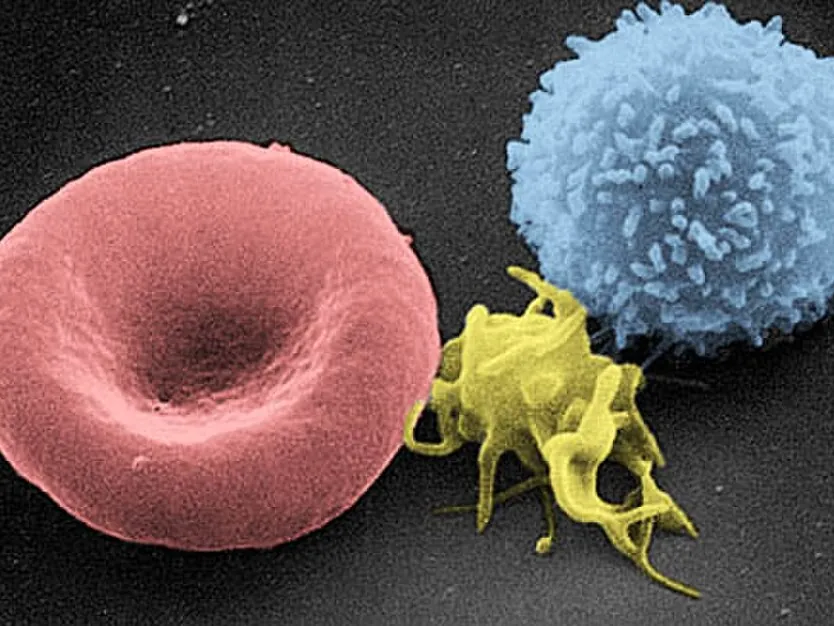
| Red blood cells | Biconcave discs with no nucleus, packed with the red protein haemoglobin | Carry oxygen from the lungs to the cells. Having no nucleus leaves more room for haemoglobin; the dimpled shape gives a large surface area. |
| White blood cells | Larger, with a nucleus; several types | Fight infection: some engulf germs, others make antibodies. They can squeeze out of capillaries to reach an infection. |
| Platelets | Tiny fragments of cells | Help blood clot, plugging cuts so you don't bleed too much and germs can't get in. |
Red blood cells are by far the most numerous cells in your body. Of your roughly 30 trillion human cells, about 25 trillion are red blood cells. Each lives for around 120 days, so your bone marrow has to make about 2 million new ones every second.
The heart: a double pump
The heart is a muscular organ about the size of your fist, sitting slightly left of the middle of your chest. Its walls are made of cardiac muscle, which contracts rhythmically your whole life without tiring.
Inside, it has four chambers. The two upper chambers, the atria (one is an atrium), receive blood coming back to the heart. The two lower chambers, the ventricles, pump blood out. A wall of muscle called the septum keeps the left and right sides apart, so oxygen-rich and oxygen-poor blood never mix.
Valves between the atria and ventricles, and where blood leaves the ventricles, act like one-way doors. They snap shut to stop blood flowing backwards. The "lub-dub" sound of your heartbeat is the noise of the valves closing.
The left ventricle has a much thicker wall than the right. The right ventricle only needs to push blood a short distance to the lungs, while the left ventricle has to push blood to every part of the body, from your brain to your toes.
Double circulation
Humans, like all mammals and birds, have a double circulation: blood passes through the heart twice on every complete trip.
- Lung circuit (pulmonary circulation). The right side of the heart pumps oxygen-poor blood along the pulmonary artery to the lungs. There it drops off carbon dioxide and picks up oxygen, then returns along the pulmonary veins to the left atrium.
- Body circuit (systemic circulation). The left ventricle pumps oxygen-rich blood out through the aorta, the biggest artery. Arteries branch to every organ. Blood gives up oxygen and nutrients to cells, collects carbon dioxide and wastes, and returns through the veins and the vena cava to the right atrium.
- In watch mode, follow one drop all the way around. How many times does it pass through the heart?
- Switch to trace mode and click the stops in the right order, starting from the body cells.
- Raise the heart rate as if you were running. What happens to the volume of blood pumped each minute? Why do your muscles need that?
A double circulation is efficient. Blood loses pressure as it squeezes through the tiny capillaries of the lungs, so sending it back to the heart for a second push means the body gets blood at high pressure. Fish have a single circulation (heart → gills → body → heart), and their blood moves around their body much more slowly.
Arteries, veins and capillaries
Blood travels in three main types of blood vessel, each built for its job.
| Arteries | Capillaries | Veins | |
|---|---|---|---|
| Direction | Away from the heart | Link arteries to veins, inside tissues | Back to the heart |
| Pressure | High, in pulses | Low | Low, steady |
| Wall | Thick, muscular and elastic | One cell thick | Thinner, less muscle |
| Space inside | Narrow | Just wide enough for one red blood cell | Wide |
| Valves | No (except leaving the heart) | No | Yes, to stop backflow |
Capillaries are where the real work happens. Their walls are so thin that oxygen, glucose and other nutrients diffuse out to the cells, and carbon dioxide and wastes diffuse in. No cell in your body is more than a few cells away from a capillary.
Veins have low pressure, so how does blood in your feet get back up to your heart? When you walk, your leg muscles squeeze the veins, and the valves make sure the blood can only go one way: up. That's why standing perfectly still for a long time can make people faint.
Test yourself
Which part of the blood carries oxygen?
Haemoglobin in red blood cells picks up oxygen in the lungs.
Which chamber pumps blood to the whole body?
The left ventricle pumps into the aorta, which is why it has the thickest wall.
What is the job of the valves in the heart?
Valves are one-way doors. The septum separates the sides.
Why are capillary walls only one cell thick?
A short distance makes exchange with cells fast.
Which vessel carries oxygen-poor blood?
The pulmonary artery carries blood from the right ventricle to the lungs to pick up oxygen.
Veins have valves because
Valves keep low-pressure blood moving towards the heart.
Label the heart.
Put these in order for one complete trip, starting in the right atrium.
Arteries, veins or capillaries?
Blood leaves the heart in and returns in . The side of the heart pumps blood to the lungs, where it picks up and drops off . Oxygen is carried by in red blood cells.
The wall of the left ventricle is about three times thicker than the wall of the right ventricle. Explain why, using your knowledge of the double circulation.
Humans have a double circulation. The right ventricle only pumps blood a short distance, to the lungs next to the heart. The left ventricle pumps blood out through the aorta to every part of the body, a much longer route through many more vessels.
A thicker wall has more cardiac muscle, so it can contract more strongly and produce a higher pressure. The left ventricle needs that high pressure to push blood all the way to the head and feet and back. The right ventricle needs less pressure, which also protects the thin, delicate capillaries in the lungs from damage.