 Coaching Centre
How plants take in water
The root and shoot systems of flowering plants, plant cells, osmosis and root hairs, xylem and phloem, the transpiration stream, stomata, and what speeds up or slows down transpiration.
A big river red gum can lift a few hundred litres of water a day from the soil to its highest leaves, more than ten storeys up. It has no heart, no pump and no moving parts. The trick is that the leaves are constantly losing water to the air, and every molecule that escapes pulls the next one up behind it.
Two systems working together
Like all living things, a plant has to take in water and nutrients, get rid of wastes, exchange gases, grow, respond to its surroundings and reproduce. A flowering plant does this with two organ systems:
- The shoot system: the stem, leaves, buds, flowers and fruits above the ground. The stem holds the leaves up to the light and the flowers where pollinators can find them. The leaves are where most photosynthesis, gas exchange and water loss happen.
- The root system: the roots under the ground. Roots anchor the plant, absorb water and minerals, and in many plants store food (think of a carrot or a sweet potato).
Neither system can survive alone. The roots can't make food, because there's no light underground, so they depend on sugar sent down from the leaves. The leaves can't get water or minerals, so they depend on the roots. Tubes called vascular bundles run through both systems and connect them.
What a plant cell needs
All of this exists to keep individual cells alive. A plant cell has a few features that animal cells don't:
- A stiff cell wall made of cellulose, outside the cell membrane. When the cell is full of water it presses against the wall like a pumped-up tyre, which is what holds a non-woody plant upright. Plants don't need a skeleton.
- Chloroplasts in the green parts of the shoot, where photosynthesis happens. Plants make their own food, so they don't need to catch it.
- A large central vacuole filled with watery cell sap. It can take up to 90% of the cell's volume.
When a plant runs short of water, its vacuoles shrink, the cells go soft and the plant wilts.
Getting water in: osmosis
You've met diffusion: particles spreading from where they're concentrated to where they're less concentrated. Osmosis is a special case of diffusion. It's the movement of water through a semipermeable membrane, one that lets small water particles through but blocks bigger dissolved particles like sugars and salts.
In osmosis, water moves from where there's more water (a weak, dilute solution) to where there's less water (a strong, concentrated solution). The cytoplasm of a root cell is full of dissolved substances, so it's more concentrated than the water in damp soil. Water therefore moves into the root by osmosis.
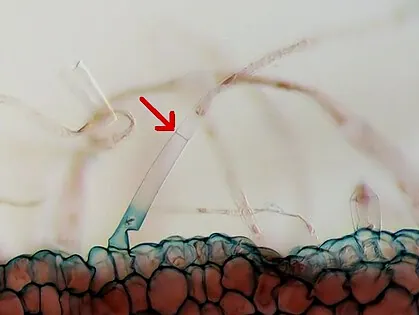
Root hairs make this fast. Each one is a single, long, thin outgrowth of a cell on the root surface. A rye plant was once measured with about 14 billion root hairs, giving a surface area bigger than a tennis court. More surface touching the soil means more water can cross into the plant every second.
Up the stem: xylem and phloem
Vascular bundles contain two kinds of transport tissue:
| Xylem | Phloem | |
|---|---|---|
| Carries | Water and dissolved minerals | Sugar (glucose and sucrose) dissolved in water |
| Direction | Up only: roots → stem → leaves | Up and down: from leaves to wherever it's needed or stored |
| Cells | Dead, hollow tubes joined end to end; walls strengthened with lignin | Living cells with holes in their end walls |
| Also does | Supports the plant (wood is mostly xylem) | Feeds roots, flowers, fruits and growing tips |
Most of the force that lifts water up the xylem comes from the leaves. Water evaporates from cells inside the leaf and escapes through tiny pores called stomata. This loss of water vapour is called transpiration. Water particles cling to each other, so as some evaporate at the top, they pull a continuous column of water up the xylem behind them, a bit like drinking through a very long, very thin straw. This flow from roots to leaves is the transpiration stream.
Surprisingly, less than 1% of the water a plant takes up is used for photosynthesis or growth. The rest is transpired. That sounds wasteful, but the transpiration stream also delivers minerals to every leaf and cools the leaves on hot days, the same way sweating cools you.
What changes the rate of transpiration?
Scientists measure transpiration with a potometer: a leafy shoot sealed into a tube of water, with an air bubble in a thin side tube. As the shoot takes up water, the bubble moves. The faster it moves, the faster the plant is transpiring.
- Start with bright light, still dry air at 25 °C. Record the result. Then switch the lamp off. What happens to the stoma, and why?
- Test wind, humidity and temperature one at a time, recording each. Which change has the biggest effect?
- Set up the worst possible day for a thirsty plant. What does the result tell you about hot, dry, windy summer days?
- Why must you change only one thing at a time?
- Light: stomata open in the light so carbon dioxide can get in for photosynthesis. Open stomata also let water vapour out.
- Temperature: warmer water evaporates faster.
- Wind: moving air carries away the water vapour around the leaf, so more can evaporate.
- Humidity: in moist air, water evaporates slowly because the air already holds a lot of water vapour.
Stomata: a balancing act
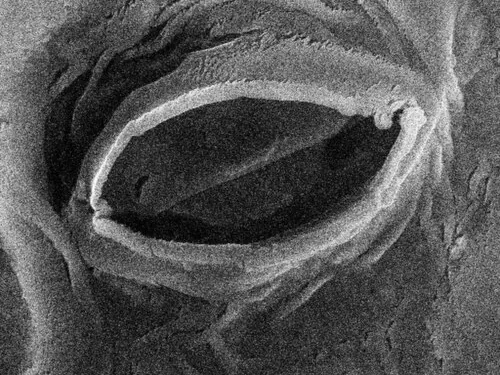
Each stoma (plural stomata) is a gap between two sausage-shaped guard cells. When the guard cells take in water they swell and bend apart, opening the stoma. When they lose water they go limp and the stoma closes. Most stomata are on the underside of the leaf, away from direct sun, which reduces water loss.
Every plant faces the same dilemma: to photosynthesise it needs stomata open to let carbon dioxide in, but open stomata lose water. On a hot day with dry soil, the plant closes its stomata to avoid wilting, and photosynthesis slows down. Australian plants have many ways to save water:
- The adult leaves of most eucalypts hang downwards, edge-on to the midday sun, so they heat up less.
- Spinifex rolls its leaves into tight tubes with the stomata on the inside, trapping humid air.
- Saltbush and many desert plants have a thick waxy cuticle or a coat of fine hairs that slows evaporation.
- Casuarinas (she-oaks) have tiny scale leaves, and the green "needles" are actually stems with stomata hidden in grooves.
Test yourself
Water enters a root hair cell by
Water moves through the cell membrane from the dilute soil water into the more concentrated cytoplasm.
Why do root hairs make a root better at absorbing water?
More surface area means more water can cross into the plant at once.
Which tissue carries sugar from the leaves to the roots?
Phloem moves dissolved sugars in both directions.
On which day would a potted plant lose water fastest?
Light opens the stomata, and heat, wind and dry air all speed up evaporation.
What opens and closes a stoma?
Guard cells swell to open the pore and go limp to close it.
About how much of the water taken up by a plant is used in photosynthesis?
Almost all of it evaporates from the leaves in transpiration.
Label the path of water through the plant.
Xylem or phloem?
Put the journey of a water particle in order.
Water enters roots by , which is the movement of water through a membrane. It travels up the stem in the and evaporates from the leaves in a process called . The water leaves through pores called , which are mostly on the surface of the leaf and are opened and closed by cells.
On a hot, windy afternoon a tomato plant in dry soil starts to wilt. Explain why it wilts, and explain how closing its stomata helps it survive but also slows its growth.
Heat and wind both speed up transpiration: warm water evaporates faster, and the wind carries away the water vapour around the leaves. The soil is dry, so the roots can't take up water by osmosis fast enough to replace what is lost. The leaf cells lose water, their vacuoles shrink, and they can no longer press firmly against their cell walls, so the plant wilts.
The guard cells lose water too, so they go limp and close the stomata. This greatly reduces the water escaping and helps the plant survive until evening. However, closed stomata also stop carbon dioxide getting into the leaf. Without carbon dioxide, photosynthesis slows down, so the plant makes less glucose and grows more slowly.