 Coaching Centre
Sedimentary and metamorphic rocks
How sediments are deposited, compacted and cemented into sandstone, shale, conglomerate, limestone, coal and rock salt, and how heat and pressure change rocks into slate, schist, gneiss, marble, quartzite and hornfels.
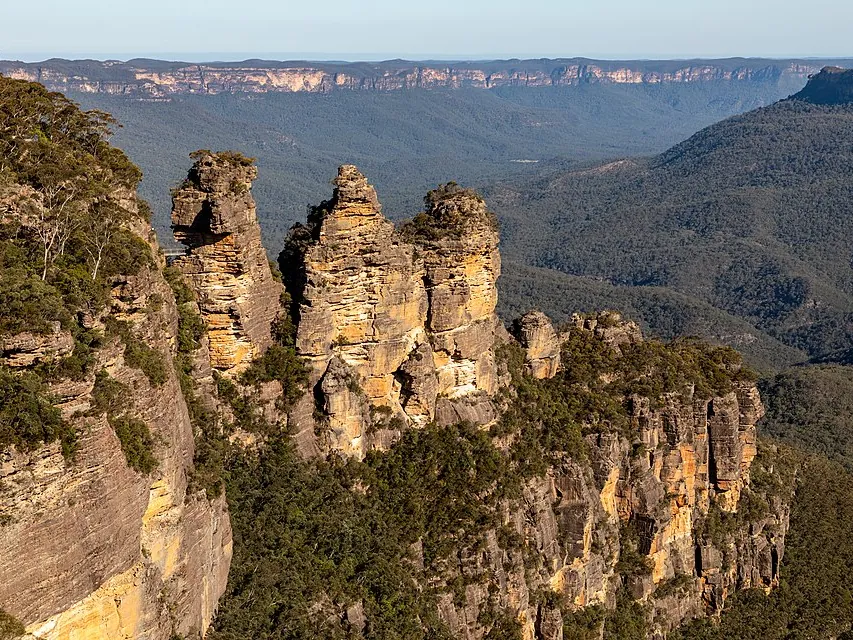
The golden sandstone cliffs around Sydney Harbour were once sand on the bed of a huge braided river, about 230 million years ago. Look closely at a cliff and you can still see the sloping layers where ripples and sandbars moved downstream.
Sedimentary rocks
Sediment is loose material that settles out of water, ice or wind: pieces of broken rock (boulders, pebbles, sand, silt and clay), the shells and skeletons of living things, plant remains, and minerals left behind when water evaporates. Sedimentary rocks form from sediment in three steps:
- Deposition. Sediment settles in layers, called beds, usually at the bottom of a river, lake or sea. New layers settle on top of older ones.
- Compaction. As more layers pile up, their weight squeezes the sediment below, pressing the grains closer and pushing out water.
- Cementation. Minerals dissolved in the water, such as calcite, silica and iron oxides, crystallise in the gaps between grains and glue them together.
This usually happens at or near the Earth's surface, where water, wind and ice deliver sediment, and it takes thousands to millions of years. Because sedimentary rocks form in layers at the surface, they are the only rocks that commonly contain fossils.
Kinds of sedimentary rock
| Rock | Made from | Where the sediment collected |
|---|---|---|
| Conglomerate | Rounded pebbles and gravel in finer sand | Fast rivers, floods, beaches; Kata Tjuṯa (the Olgas) is conglomerate |
| Sandstone | Sand grains, mostly quartz | Rivers, beaches, deserts; Hawkesbury sandstone (Sydney), Uluṟu (a feldspar-rich sandstone) |
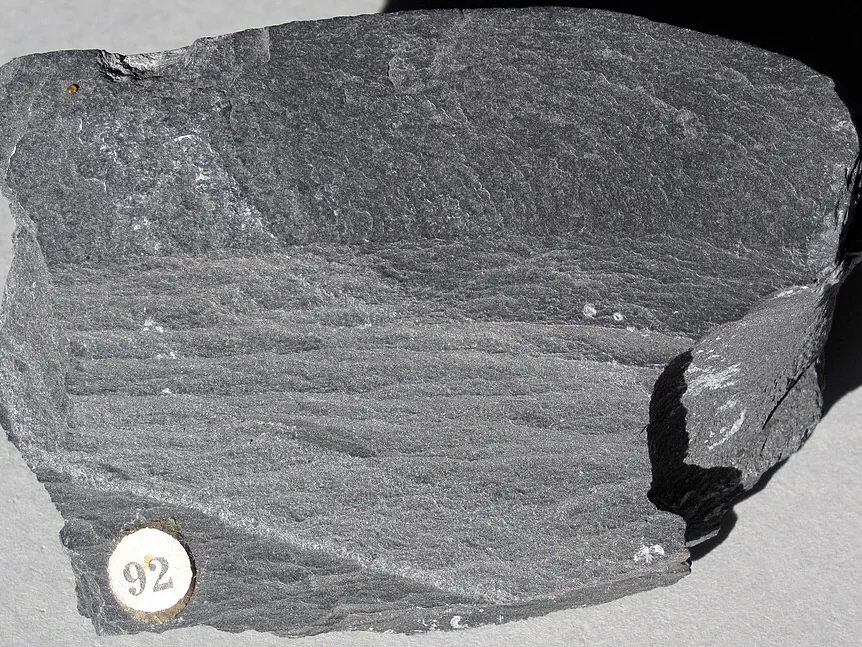
| Shale and mudstone | Silt and clay; shale splits into thin layers | Calm lakes, lagoons, deep sea floor. Shale is the most common sedimentary rock |
| Limestone | Shells, coral and skeletons (calcium carbonate) | Warm, shallow seas; the Nullarbor Plain is a huge slab of limestone |
| Coal | Plant remains buried before they could rot | Swampy forests; most NSW coal formed 250–300 million years ago |
| Rock salt | Salt left when salty water evaporated | Drying seas and salt lakes, such as Kati Thanda–Lake Eyre today |
Conglomerate, sandstone and shale are made of broken rock and are named by grain size. Limestone and coal come from living things. Rock salt is a chemical sedimentary rock, formed when dissolved minerals come out of solution. Coal forms from land plants; oil and natural gas mostly come from tiny sea plankton buried in mud and slowly heated.
- Lay down a sequence that tells a story: for example a river, then the sea rising over the land.
- Bury your pile. Which layer shrinks the most, and why?
- Which layer is the oldest? How do you know?
Metamorphic rocks
Metamorphic means "changed form". When rocks are buried deep in the crust, squeezed where plates collide, or baked next to hot magma, the minerals in them become unstable. Without melting, their atoms slowly rearrange into new, often larger crystals and sometimes new minerals. The rock becomes a metamorphic rock: usually harder and denser than the rock it came from.
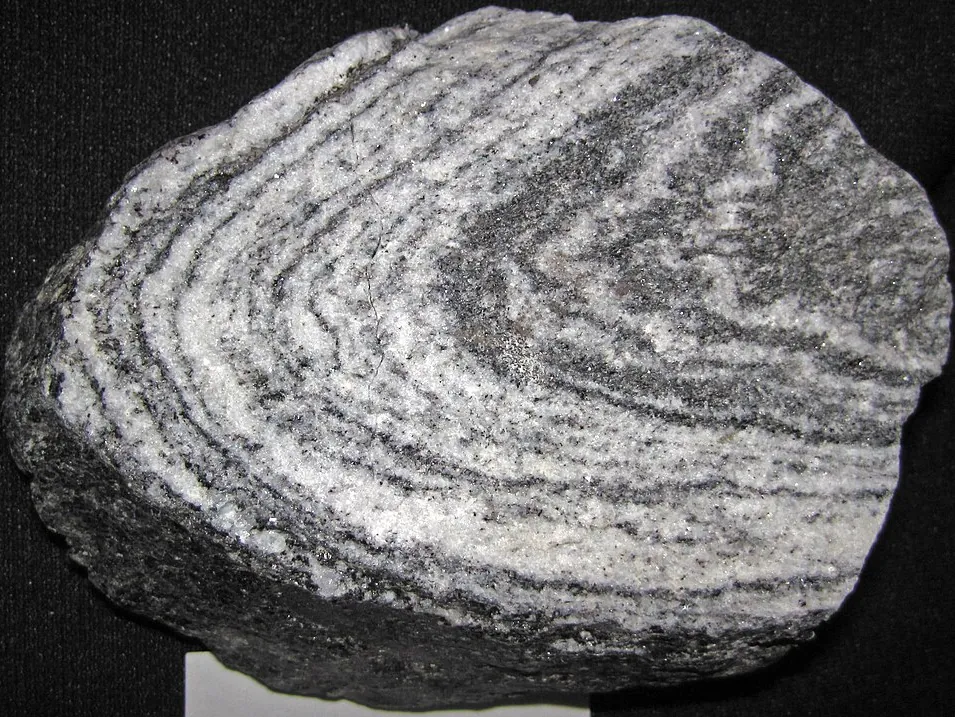
- Regional metamorphism happens over huge areas when rocks are buried deep and squeezed during mountain building. Both heat and pressure act. The pressure lines up flat minerals such as mica, so these rocks often have layers or bands, called foliation.
- Contact metamorphism happens where hot magma touches cooler rock. The rock is baked but not strongly squeezed, so it usually has no bands.
| Original rock | Metamorphic rock | What changes |
|---|---|---|
| Shale | Slate → schist → gneiss (more heat and pressure each time) | Clay turns to mica; slate splits into thin sheets; schist sparkles; gneiss has light and dark bands |
| Limestone | Marble | Calcite recrystallises into larger interlocking crystals; fossils are destroyed |
| Sandstone | Quartzite | Quartz grains fuse together; very hard |
| Granite | Gneiss | Minerals separate into bands |
| Shale or basalt near magma | Hornfels | Baked into a hard, fine-grained rock with no bands |
- Choose shale. Raise the temperature and depth step by step. List the rocks you make in order.
- Make hornfels. Where on the chart is it, and what does that mean about how it formed?
- Turn limestone into marble. Does marble still react with acid? Why?
- How hot can shale get before it stops being a metamorphic rock?
Forces and energy in rock formation
Every rock type depends on forces and energy. Igneous rocks need thermal energy from the Earth's interior to melt rock. Sedimentary rocks need the force of gravity, which makes sediment settle and makes the layers above compact the layers below, and energy from the Sun, which drives the wind, rain and rivers that carry sediment. Metamorphic rocks need heat and the pressure of rock above them or of plates pushing together.
Test yourself
The correct order for forming sedimentary rock is
Sediment settles, is squeezed, then glued.
A rock made of rounded pebbles cemented in sand is
Named for its large, mixed grains.
Limestone usually forms from
These are made of calcium carbonate.
When limestone is heated and squeezed it becomes
Calcite recrystallises.
Which rock is most likely to contain fossils?
Fossils form in sedimentary rocks.
Rock baked by nearby magma without being squeezed has undergone
It forms hornfels.
Name each step in forming a sedimentary rock.
Sort the rocks.
Put the rocks in order from least changed to most changed.
Layers of sediment are called . Minerals that glue grains together act as a natural . Coal forms from the remains of . Metamorphic rocks are changed by heat and . Sandstone changes into .
Explain the role of forces and energy in forming (a) a sedimentary rock and (b) a metamorphic rock. Use a named example of each.
(a) Sandstone. Energy from the Sun drives the water cycle and the wind, which weather rocks and carry sand down rivers. When the river slows, gravity makes the sand settle in layers (deposition). Over time more layers build up on top, and their weight is a force that compacts the sand below and squeezes out water. Dissolved minerals then crystallise between the grains and cement them into sandstone.
(b) Slate, which forms from shale. When plates collide, shale is buried deep in the crust. Heat energy from the Earth's interior raises its temperature, and the pressure from the rock above and from the plates squeezing together pushes on it. The clay minerals become unstable and recrystallise, without melting, into tiny flat mica crystals. The pressure lines them up in one direction, so slate splits into thin sheets.