 Coaching Centre
Mining and mineral resources
Ores and the metals they contain, Australia's mineral resources, how geologists find ore deposits, open-cut, underground and in-situ mining, processing, recycling, rehabilitation, First Nations heritage, and science careers in the minerals industry.
In 2013, CSIRO scientists found tiny particles of gold inside the leaves of eucalyptus trees in Western Australia. The trees' roots reach tens of metres down to groundwater that has passed over buried gold deposits. Leaves are now one of the clues explorers use to find gold.
Ores
Most useful metals aren't found pure in the ground. They are locked up in minerals, joined chemically to other elements such as oxygen or sulfur. An ore is rock that contains enough of a valuable mineral to be mined and processed at a profit. Whether a rock counts as ore depends on the price of the metal and the cost of getting it out: a copper deposit that wasn't worth mining 30 years ago might be ore today.
| Ore mineral | Metal | Uses |
|---|---|---|
| Haematite, magnetite | Iron | Steel for buildings, cars, bridges |
| Bauxite (a rock rich in aluminium minerals) | Aluminium | Cans, aircraft, window frames |
| Chalcopyrite | Copper | Electrical wiring, motors, water pipes |
| Galena | Lead (often with silver) | Car batteries, radiation shielding |
| Sphalerite | Zinc | Galvanising steel so it doesn't rust |
| Spodumene | Lithium | Rechargeable batteries in phones and electric cars |
| Rutile, ilmenite | Titanium | White paint pigment, aircraft parts, joint replacements |
| Pentlandite | Nickel | Stainless steel, batteries |
Gold is unusual: it is so unreactive that it is usually found as the pure metal, as grains and nuggets in rock and in river gravels.
Australia's mineral wealth
Australia is an old continent with a huge variety of rocks, and it is one of the world's great mining nations. It is the world's largest producer of iron ore (mostly from the Pilbara in WA) and lithium, and one of the largest producers of bauxite, gold, zinc, lead, rutile, zircon, nickel and uranium. Mining earns more export income than any other Australian industry.
Minerals have shaped Australian history. Gold was found near Bathurst, NSW, in 1851, starting the gold rushes that more than doubled the colonies' population in ten years. Silver, lead and zinc were found at Broken Hill in 1883; the company formed to mine it, BHP, became one of the biggest companies in the world. Today there is a rush for critical minerals such as lithium, rare earth elements, cobalt and nickel, needed for batteries, wind turbines and electric motors.
Finding ore
Ore deposits are usually buried, so explorers use physics, chemistry, biology and maths to "see" underground before spending millions of dollars drilling:
- Geological mapping: studying rock types, folds and faults at the surface and from satellite images to find the kinds of rock where ore forms.
- Magnetic surveys: an aircraft or drone tows a magnetometer that detects small changes in the Earth's magnetic field caused by magnetic minerals.
- Gravity surveys: a gravimeter detects tiny increases in gravity over dense rock, such as an ore body.
- Seismic and electrical surveys: sound waves or electric currents are sent into the ground and the echoes or resistance are measured.
- Geochemical surveys: chemists test soil, stream sediment, termite mounds and even plant leaves for traces of metals.
- Drilling: finally, holes are drilled to bring up a cylinder of rock (a drill core) to test how much metal it really contains, and how deep and big the ore body is.
- Fly the magnetic survey first. Is the strongest signal definitely ore? Why not?
- Add the gravity survey. Where do both surveys agree?
- Find at least three ore hits, then choose a mining method. What decided your choice?
- Try a new area. How much money did you spend this time?
Mining and processing
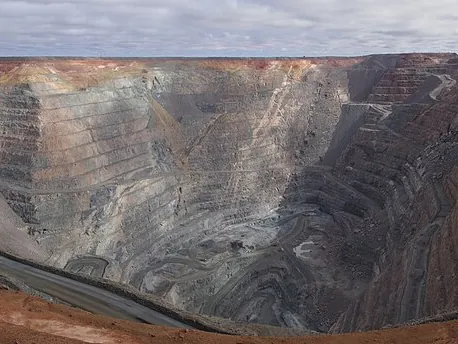
- Open-cut mining is used when ore is near the surface. Rock is drilled, blasted and carried out by enormous trucks, many of which in the Pilbara now drive themselves, controlled from operations centres in Perth. The Super Pit at Kalgoorlie is about 3.5 km long and 600 m deep.
- Underground mining reaches deeper ore through vertical shafts or spiral ramps, with tunnels into the ore body. It moves much less waste rock but is more expensive per tonne.
- In-situ leaching pumps a solution down drill holes to dissolve the mineral (for example uranium) and pumps it back up, without digging the rock out.
Ore is then processed: crushed and ground to powder, concentrated (for example, by froth flotation, where ore particles stick to bubbles and float off), then the metal is extracted by heating (smelting), by electricity, or by chemical reactions. The leftover crushed rock, called tailings, must be stored safely so it can't pollute water.
Science careers in mining
Mining depends on people with skills from many sciences:
- Exploration geologists (earth science) map rocks and choose where to drill.
- Geophysicists (physics, maths) run and interpret magnetic, gravity and seismic surveys.
- Geochemists and assayers (chemistry) measure how much metal is in samples.
- Mining engineers (physics, maths) design pits and tunnels and plan blasting.
- Metallurgists (chemistry, physics) design the processes that extract metal from ore.
- Geotechnical engineers make sure pit walls and tunnels are stable.
- Environmental scientists (biology, chemistry) monitor water, air and wildlife and plan rehabilitation.
- Data scientists and automation engineers run self-driving trucks, drones and computer models of ore bodies.
Responsible mining
Mines provide jobs, materials and income, but they also clear land, use lots of water and energy, create dust and noise, and can pollute rivers if tailings leak. Mining companies must now plan, before they start, how they will rehabilitate the land when the mine closes: reshaping it, replacing topsoil and replanting native vegetation.
Mineral resources are non-renewable: once mined, they're gone. Recycling metals saves resources and energy. Recycling aluminium uses only about 5% of the energy needed to make new aluminium from bauxite, and aluminium can be recycled again and again without losing quality.
Test yourself
An ore is
It depends on the price and the cost of extraction.
Bauxite is the ore of
It contains aluminium minerals.
A gravity survey finds ore by detecting
Dense rock pulls slightly harder.
Open-cut mining is best when the ore is
Less waste rock must be removed.
The scientist who designs the process to extract metal from ore is a
Metallurgy is the science of metals.
Recycling aluminium uses about what fraction of the energy needed to make it from bauxite?
A 95% energy saving.
Name the two kinds of mine.
Which stage of the industry?
Australia is the world's largest producer of iron ore and . Crushed waste rock left after processing is called . Restoring the land after mining is called . Minerals cannot be replaced on human timescales, so they are . Gold rushes began near Bathurst in .
A company wants to open a new copper mine. Describe how scientists from at least three different fields of science would be involved, from exploration through to closing the mine.
During exploration, geologists map the rocks at the surface and use their knowledge of how copper deposits form to choose promising areas. Geophysicists, using physics, fly magnetic and gravity surveys to detect buried bodies of dense or magnetic rock. Chemists analyse soil samples and drill cores to measure how much copper is present and where.
During mining and processing, mining engineers use physics and maths to design the pit or tunnels and keep them stable, and metallurgists use chemistry to design the crushing, flotation and smelting processes that extract the copper from chalcopyrite.
Throughout the mine's life, environmental scientists use biology and chemistry to monitor water quality, dust and wildlife, make sure tailings don't leak, and plan rehabilitation. When the mine closes, they oversee reshaping the land, replacing topsoil and replanting native species.