 Coaching Centre
Renewable energy and Australia’s power
Renewable and non-renewable energy sources, the problems with fossil fuels, how solar panels and wind turbines work, how efficient they are, storing energy with batteries and pumped hydro, and how Australia's electricity supply is changing.
On some sunny spring days, South Australia's rooftop solar panels produce more electricity than the whole state is using. (South Australia's last coal power station closed in 2016.) Twenty years ago almost none of Australia's electricity came from the sun. The change has been one of the fastest technology shifts the country has ever seen.
Renewable and non-renewable
Non-renewable energy sources will run out, because they took millions of years to form or exist only in fixed amounts. They include the fossil fuels (coal, oil and natural gas) and uranium. Renewable sources are replaced naturally as fast as we use them: sunlight, wind, flowing water, waves and tides, geothermal heat and biomass (as long as it is regrown).
Fossil fuels have powered industry for 200 years because they store a lot of energy, are easy to transport and can be burned whenever needed. But burning them releases carbon dioxide, a greenhouse gas that traps heat in the atmosphere and is the main cause of climate change. Coal power stations also release fine particles and other gases that cause air pollution.
Solar panels
A solar panel is made of many photovoltaic cells: thin slices of silicon treated so that when light hits them, electrons are knocked loose and pushed around a circuit. The output is DC, so an inverter converts it to AC for the house and grid.
The first practical silicon solar cell, made in 1954, was about 6% efficient. Typical panels on Australian roofs today are 20% to 23% efficient, and researchers have built cells over 30% efficient in the laboratory. The University of New South Wales has been a world leader: a technology developed there in the 1980s (the PERC cell) went on to be used in most of the solar panels made worldwide.
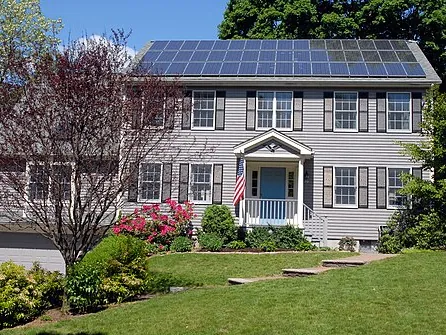
Australia has the highest rate of rooftop solar in the world, with panels on more than one in three houses.
Wind and water
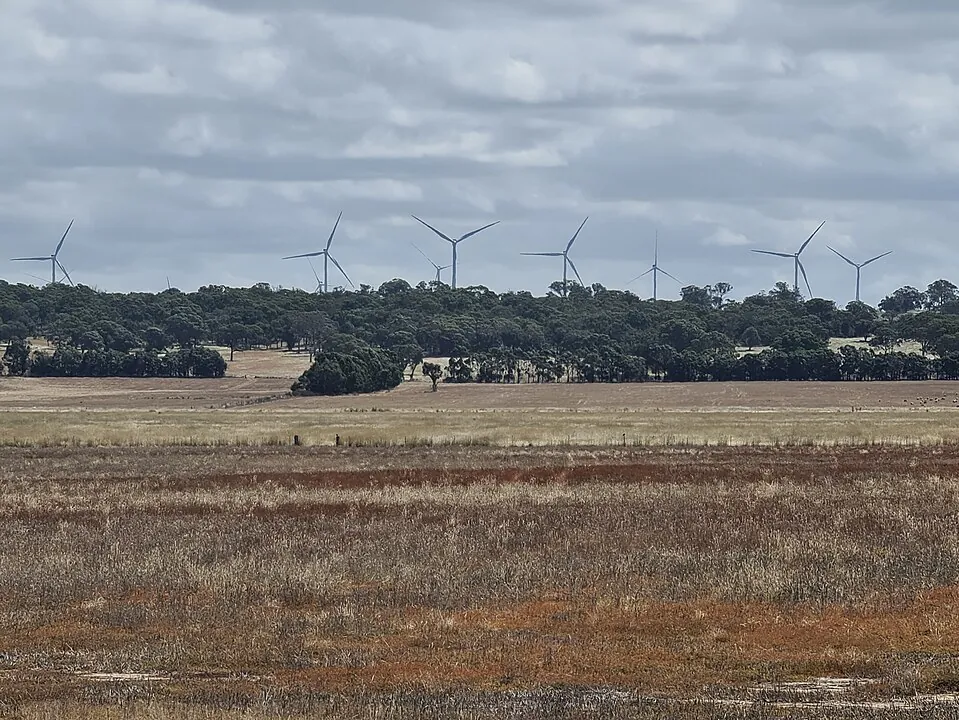
A wind turbine uses long blades to catch the kinetic energy of moving air and turn a generator. Even the best turbines can capture only about half of the wind's energy, because the air must keep moving past the blades. Modern turbines stand more than 150 m tall, and each one can power thousands of homes. Wind farms now supply more than a tenth of Australia's electricity.
Hydroelectricity uses falling water. It is highly efficient (often over 90%) and can be switched on within minutes, which makes it valuable when demand suddenly rises. Tasmania gets most of its electricity from hydro.
The storage problem
The sun sets every night and the wind doesn't always blow, but people still want electricity at 7 pm on a still winter evening. So a renewable grid needs ways to store energy:
- Batteries: big grid batteries, such as the Hornsdale Power Reserve in South Australia (switched on in 2017, and at the time the largest lithium-ion battery in the world), and home batteries charged by rooftop solar.
- Pumped hydro: when there's spare electricity, water is pumped uphill into a reservoir. When it's needed, the water runs back down through turbines. Snowy 2.0, under construction in the Snowy Mountains, works this way. It stores energy as gravitational potential energy.
- Spreading wind and solar farms across the country, and linking states with transmission lines, so that it is usually sunny or windy somewhere.
- With 6.6 kW of panels and no battery, when is the house buying electricity from the grid? Why at those times?
- Add a 10 kWh battery. What happens to the evening demand and to the amount exported?
- Switch to winter and turn on clouds. How many panels would you need to stay mostly self-powered?
- Can you reach 100% self-powered? What would that cost, and is it worth it?
Australia's changing grid
In 2005 about 90% of Australia's electricity came from fossil fuels, mostly coal. By the mid-2020s renewables (mainly solar, wind and hydro) supplied around 40% of the electricity on the main east-coast grid, and South Australia regularly ran on about 70% wind and solar over a whole year. The federal government has a target of 82% renewable electricity by 2030. Old coal power stations are closing as they reach the end of their lives; Liddell in the Hunter Valley shut in 2023.
Every energy source has trade-offs. Wind farms and transmission lines change landscapes and need land. Solar panels and batteries need mined materials, and old panels need recycling. Hydro dams flood valleys. Nuclear power produces almost no carbon dioxide while running, but it is banned in Australia and leaves radioactive waste that must be stored safely for thousands of years. Deciding the best mix is a question for science, engineering, economics and the community together.
| Source | Renewable? | Advantages | Disadvantages |
|---|---|---|---|
| Coal | No | Reliable, available day and night; Australia has large reserves | Highest carbon dioxide emissions; air pollution; mining damages land |
| Natural gas | No | Can start quickly to fill gaps; about half the CO₂ of coal | Still a fossil fuel; prices can change sharply |
| Solar | Yes | No fuel cost; works on rooftops; no emissions while running | Nothing at night; less in winter and cloud |
| Wind | Yes | No fuel cost; works day and night | Varies with weather; visual and noise concerns; bird and bat deaths |
| Hydro | Yes | Very efficient; can store energy; quick to start | Few suitable sites; floods valleys; drought reduces output |
Test yourself
Which energy source is non-renewable?
Natural gas is a fossil fuel that took millions of years to form.
What does an inverter do in a solar power system?
Homes and the grid use AC.
Pumped hydro stores energy as
Water is pumped uphill and released later.
Typical rooftop solar panels today are about
Most of the light energy becomes heat or is reflected.
The main reason for reducing fossil fuel use is that burning them
CO₂ is a greenhouse gas.
Why does a solar-powered home often buy electricity from the grid in the evening?
Demand peaks just as solar output drops, which is why batteries help.
Sort the energy sources.
Solar panels are made of cells, usually made of . Burning fossil fuels releases . Because sunlight and wind vary, a renewable grid needs energy , such as batteries or pumped .
A town is deciding whether to replace its old coal power station with a wind and solar farm. Evaluate this proposal, giving at least two advantages and two disadvantages, and suggest how one disadvantage could be overcome.
Replacing the coal station with wind and solar has major advantages. Wind and sunlight are renewable, so they won't run out, and there is no fuel to buy. They produce no carbon dioxide while running, so the town would cut its contribution to climate change, and residents would breathe cleaner air without coal smoke and dust.
There are disadvantages. Solar produces nothing at night and less in winter, and wind varies with the weather, so supply won't always match demand. The farms also need a lot of land, and some people object to the look of turbines.
The variability problem can be overcome with storage. A large battery could store spare solar energy during the day and supply it in the evening, and the town could stay connected to the wider grid for backup. Overall, if storage is included, the proposal is a good one because the long-term environmental and health benefits outweigh the costs.