 Coaching Centre
Managing natural events
Regular and irregular changes in ecosystems, how Australian plants survive fire, cool burns and crown fires, fire regimes, hazard reduction and Aboriginal cultural burning, the Black Summer fires, recovery after fire, and managing floods, droughts, cyclones and earthquakes.
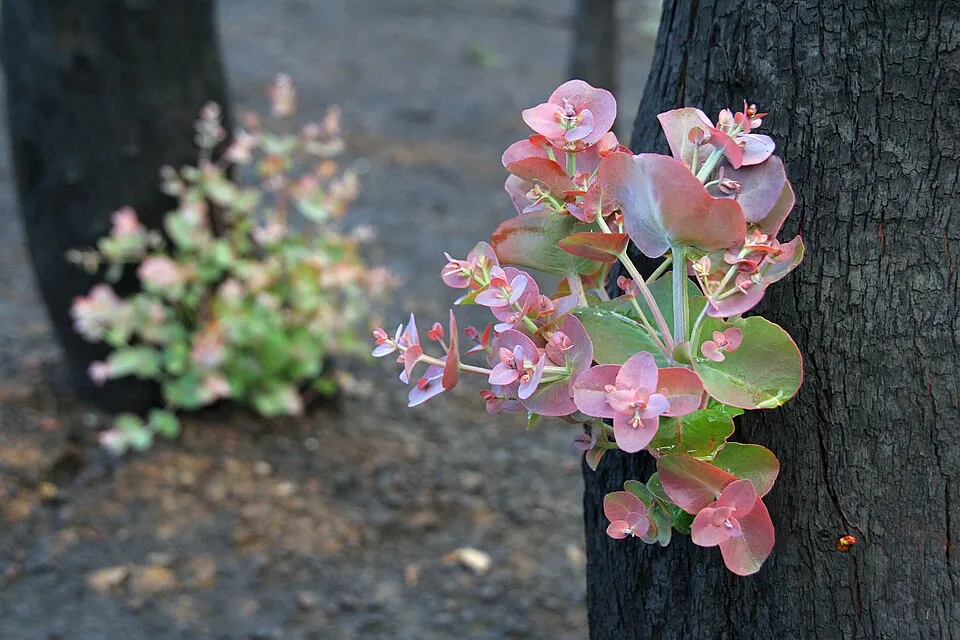
Within weeks of the Black Summer bushfires of 2019–20, photos went around the world of blackened gum trunks sprouting fuzzy green leaves straight out of the charcoal. Many Australian plants don't just survive fire. Some of them need it.
Change is normal
Ecosystems are always changing. Some changes are regular and cyclical: day and night, the tides, the seasons, the wet and dry seasons in the north. Living things are adapted to these. Others are irregular natural events such as bushfires, floods, droughts, cyclones and earthquakes. These are hard to predict: we don't know exactly when they'll happen, how long they'll last or how severe they'll be. Some changes, like shifts in climate, happen over thousands of years.
Ecologists study how these events affect ecosystems so that we can manage them, protect people and property, and help ecosystems recover. If events become too frequent or too intense, ecosystems can lose biodiversity faster than they can recover.
Living with fire
Fire has shaped Australian ecosystems for millions of years, and many plants are adapted to it:
- Thick bark insulates the living tissue underneath.
- Epicormic buds, hidden under the bark of many eucalypts, sprout new shoots up the trunk after a fire.
- Lignotubers, woody swellings at the base of mallees and some other eucalypts, store food and buds underground, so the plant can regrow even if everything above ground burns.
- Seeds that need fire. Banksia cones and some hakea fruits only open after fire, and smoke triggers many seeds to germinate. The ash makes a nutrient-rich seedbed.
Cool fires and hot fires
Fire intensity describes how much heat a fire releases, and it decides how much damage the fire does. The plants are the fuel, so the amount and type of fuel matters most:
- Sparse, short undergrowth burns quickly in a fast-moving, low-intensity fire. It scorches the bottom of tree trunks but leaves the canopy green. The ash adds nutrients and the gaps give seedlings room to grow.
- Thick, tall, dry undergrowth that hasn't burnt for many years can fuel a slow, high-intensity fire. Flames climb into the treetops (a crown fire), stripping every leaf. Very hot fires can kill the epicormic buds and even the seeds in the soil. Eucalyptus oil and sap turn to flammable gas, making things worse.
Weather matters too: hot, dry, windy days make any fire more intense. Most bushfires are started by lightning, but many are started by people, by accident (sparks from machinery, power lines, campfires, cigarettes) or deliberately, which is a serious crime.
Managing fire
A fire regime is the pattern of fires in an area: how often, how intense, in which season and how big. Getting the regime right protects people and biodiversity at the same time.
- Hazard reduction burns (sometimes called back burns or controlled burns) are lit on purpose in cooler, calmer weather, usually autumn, winter or spring, to burn off fuel in patches. Recently burnt patches act as firebreaks and slow down bushfires.
- Burning patches at different times creates a mosaic of areas at different stages of recovery, which supports the most plants and animals.
- Too often is harmful: plants that need several years to grow and set seed can't reproduce before the next fire, and disappear. Open ground then gets taken over by introduced grasses, which grow taller and denser than native grasses and burn hotter.
- Too rarely lets fuel build up until a fire is catastrophic.
- Run 30 years with no planned burns. How big does the worst bushfire get?
- Reset and run with cool mosaic burns. Compare the worst fire and the plant variety.
- Try burning everything every 2 years. Why is this bad for plant variety, even though the bushfires are small?
Cultural burning
Aboriginal and Torres Strait Islander peoples managed Country with fire for tens of thousands of years. Cultural burning uses small, cool, slow fires lit at the right time of year for each type of country, often in the cool early morning, so they creep through the grass without scorching the canopy, and animals can move away. Burning is guided by knowledge of the plants, animals, soil and seasons that is passed down through generations. Early European settlers described open, park-like woodlands that were the result of this care. Today, cultural burning programs run with Aboriginal rangers in national parks and across NSW, and fire agencies are learning from them.
Other natural events
| Event | Common impacts | Ways of managing them |
|---|---|---|
| Flood | Erosion, polluted water, damage to homes and habitat, drowning of animals that can't escape | Weather stations and computer models to predict rainfall and water levels; levees and dams; restoring wetlands, which soak up floodwater like a sponge; not building on flood plains |
| Drought | Crops and pasture fail, animals and plants die, waterways dry up, dust storms | Dams and pipelines to store and move water; water restrictions; desalination plants (Sydney has one at Kurnell); drought-tolerant crops; reducing stock numbers early |
| Cyclone | Wind damage, flooding, storm surges, erosion | Satellite tracking; early warnings and evacuation; building codes for cyclone-resistant homes in the north |
| Earthquake | Damage to buildings and roads, injury and death, changes to soil and groundwater | Seismic monitoring; building standards that make buildings resist shaking |
Floods and droughts aren't only bad for ecosystems. River red gums along the Murray need a flood every few years to water their roots, and many waterbirds only breed when floods fill inland lakes. When Kati Thanda–Lake Eyre fills, which happens only a few times a century, fish, shrimp and huge flocks of pelicans appear in the middle of the desert.
Learning from disasters improves management. On 28 December 1989 a magnitude 5.6 earthquake hit Newcastle. It was only moderate, but it killed 13 people, injured about 160 and damaged around 50 000 buildings, because many were old, unreinforced brick buildings standing on soft river sediment. Australia's building standards were changed afterwards to make new buildings resist earthquakes.
Test yourself
Epicormic buds help eucalypts recover from fire by
The buds are protected by bark and sprout when the leaves are lost.
Which would most likely produce a high-intensity crown fire?
Lots of fuel plus hot, dry, windy weather gives the most intense fires.
Hazard reduction burns are usually done in cooler months because
Cooler, calmer weather keeps planned fires low and manageable.
Burning an area every two years would most likely
Plants need time between fires to mature and set seed.
Why did the 1989 Newcastle earthquake cause so much damage for its size?
Collapsing buildings, not the shaking itself, cause most injuries.
Label the features of the two fires.
Put the stages of eucalypt forest recovery after a fire in order.
Regular or irregular?
The pattern of how often, how hot and in what season fires burn is called the fire . Planned burns remove fuel in patches, creating a of areas burnt at different times. Small, cool fires lit by Aboriginal people to care for Country are called burning.
Explain how a well-planned fire regime can both reduce the danger of bushfires and maintain biodiversity.
A good fire regime uses small, cool, planned burns, lit in cooler and calmer weather, to burn off fuel such as dead leaves and undergrowth. With less fuel, a bushfire that starts later will be less intense and easier to control, and recently burnt patches act as firebreaks that can stop it spreading. If different patches are burnt in different years, the area becomes a mosaic of patches at different stages of recovery, which provides habitat for many different plants and animals. Burning not too often gives plants time to grow and produce seed between fires, while burning not too rarely stops fuel building up to dangerous levels.