 Coaching Centre
Microorganisms
What microorganisms are, how small they are, stromatolites and the first life on Earth, bacteria, archaea and extremophiles, protists, microscopic fungi such as yeasts and moulds, why viruses are not counted as living, and making results reliable by repeating trials and averaging.
There are more bacteria in your mouth right now than there are people on Earth. You can't see a single one of them, but together the microbes in and on your body weigh about as much as a small apple, and they are doing jobs your body can't do without them.
What is a microorganism?
A microorganism (or microbe) is a living thing too small to see clearly without a microscope. Most are a single cell, and most are between about 0.1 mm and 0.001 mm (1 micrometre, or 1 µm) across. Microorganisms live everywhere: in soil, water and air, on your skin and in your gut, in Antarctic ice, in boiling hot springs and kilometres down in solid rock.
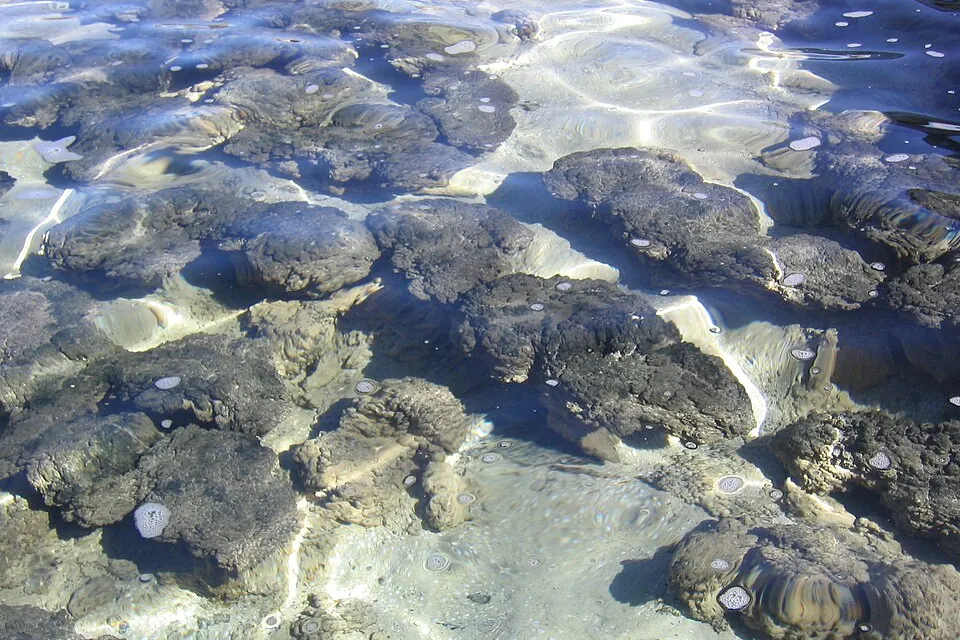
They have been around far longer than anything else. Some of the oldest evidence of life on Earth is about 3.5 billion years old: layered rocks built by cyanobacteria (once called blue-green algae). Cyanobacteria photosynthesise. Over hundreds of millions of years they filled the air with oxygen, making animal life possible. Living colonies still build these rocky mounds, called stromatolites, at Hamelin Pool in Shark Bay, Western Australia, growing as little as 0.3 mm a year.
- Zoom in slowly from the naked-eye view. What is the smallest thing you could see with just your eyes?
- How many E. coli bacteria would fit across one red blood cell?
- At what point do you need an electron microscope? Which object is the first to need one?
The main groups
Microorganisms aren't one group of related living things. They come from several very different branches of the tree of life (you met the domains and kingdoms in Year 7).
Bacteria
Bacteria are single cells, usually 1 to 5 µm long. They are prokaryotes: their DNA floats in the cytoplasm instead of being wrapped in a nucleus, and they have no membrane-bound organelles such as mitochondria. They come in three main shapes: spheres (cocci), rods (bacilli) and spirals.
- A cell wall gives shape and protection (made of a different chemical from a plant's cell wall).
- The DNA is one long loop, with extra small rings called plasmids. Bacteria can swap plasmids, which is one way resistance to antibiotics spreads.
- Many have a whip-like flagellum for swimming and short hairs called pili for sticking to surfaces.
Archaea
Archaea look like bacteria under a microscope, but their chemistry is so different that they're placed in a domain of their own. Many are extremophiles that thrive where almost nothing else can: in boiling springs (thermophiles), very salty lakes (halophiles), acid (acidophiles), or places with no oxygen. Others are common and harmless, including in your gut and in the stomachs of cows.
Protists
Protists are mostly single-celled but much bigger and more complex than bacteria, up to about 1 mm. They are eukaryotes, with a nucleus and organelles. Some, like amoebas and Paramecium, hunt smaller cells. Others, like algae and diatoms, photosynthesise. Some, like Euglena, can do both. Protists can be producers, consumers, parasites or decomposers.
Fungi
Mushrooms are fungi, but many fungi are microscopic. Yeasts are single-celled fungi. Moulds grow as a tangle of fine threads called hyphae. The fuzzy patch you see on old bread is millions of hyphae, and the black dots are spore cases full of spores. Fungi are eukaryotes with cell walls made of chitin (the same tough material as an insect's skeleton). They can't photosynthesise. Instead they release digestive chemicals onto their food and absorb what dissolves, which makes them excellent decomposers.
What about viruses?
Viruses are about 100 times smaller than a typical bacterium, so you need an electron microscope to see them. A virus is just genetic material inside a protein coat. It has no cell, doesn't feed or respire, and can only reproduce by hijacking a living cell. For these reasons most scientists don't count viruses as living organisms, so they are not microorganisms, even though they are studied alongside them.
Science skills: making results reliable
Microbes are unpredictable, so one agar plate on its own can easily give a misleading result. Results are reliable if you get similar results each time you repeat the experiment. To make results more reliable:
- control all the variables except the one you are testing
- run several trials (for example 10 plates for each condition, not one), and compare with other groups
- calculate the mean (average) and use that to draw conclusions
A microbiologist grew fungus on 10 plates in each of three conditions and counted the colonies after 5 days. Condition A: 5, 6, 4, 7, 4, 5, 6, 4, 5, 4. Find the mean.
Test yourself
A cell has a cell wall and DNA but no nucleus. It is most likely a
Bacteria are prokaryotes: they have no nucleus. Viruses have no cell at all.
Stromatolites are built by
Colonies of photosynthetic cyanobacteria trap sediment layer by layer.
Bacteria that live in boiling hot springs are examples of
Organisms that thrive in extreme conditions are called extremophiles; many are archaea.
Why are viruses usually not counted as living things?
On their own they don't feed, respire or reproduce.
A student counts colonies on 5 plates: 3, 5, 4, 6, 2. What is the mean?
(3 + 5 + 4 + 6 + 2) ÷ 5 = 20 ÷ 5 = 4.
Label the parts of the bacterium.
Which group does each belong to?
Order from largest to smallest.
Moulds grow as fine threads called . Single-celled fungi used to make bread rise are called . Bacteria are because they have no nucleus. A thin whip that helps a cell swim is called a .
A microbe seen under a microscope has a cell wall, a nucleus, mitochondria and no chloroplasts, and it grows as long threads. Identify which group of microorganisms it belongs to and justify your answer.
It is a fungus, most likely a mould. It has a nucleus and mitochondria, so it is a eukaryote and can't be a bacterium. It has a cell wall but no chloroplasts, so it can't photosynthesise like a plant or an alga. Its long threads are hyphae, which are typical of moulds.