 Coaching Centre
Fuels, plastics and fabrics
Fossil fuels and petrochemicals, separating crude oil by fractional distillation, how monomers join to make polymers, plastics and synthetic fabrics, thermoplastics and thermosets, bioplastics and recycling.
Australia was the first country in the world to make all its banknotes from plastic. The notes are made of polypropylene, a polymer developed into banknote film by the CSIRO and the Reserve Bank. They last several times longer than paper notes and are much harder to forge.
Fossil fuels and petrochemicals
Coal, crude oil and natural gas are fossil fuels. They formed over millions of years from the remains of ancient plants and sea creatures that were buried and squeezed by heat and pressure. They are non-renewable: we use them far faster than they form.
Oil and gas are mostly hydrocarbons, compounds made only of hydrogen and carbon. Australia extracts natural gas mainly from offshore fields off Western Australia and the Northern Territory and from coal seams in Queensland, and smaller amounts of oil from places such as Bass Strait and the Cooper Basin.
Most crude oil (more than three-quarters) ends up as fuel. Some of the rest is used to make petrochemicals: substances made from oil and gas, including plastics, synthetic fabrics, paints, detergents, medicines and fertilisers.
Separating crude oil
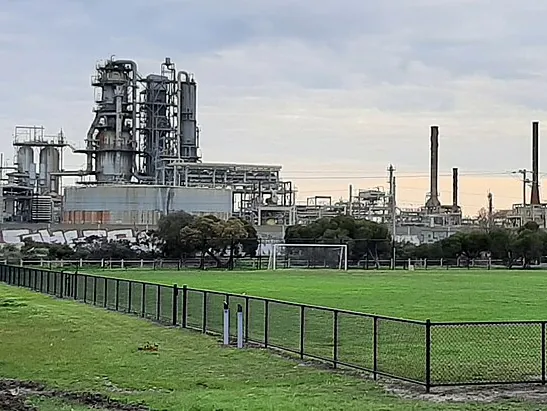
Crude oil (petroleum) is a thick, dark mixture of thousands of hydrocarbons with molecules of different lengths. It is separated at a refinery by fractional distillation, which you met in Year 7. The oil is heated until most of it turns to vapour, which rises up a tall column that is hot at the bottom and cooler at the top. Each part, or fraction, condenses at a different height according to its boiling point.
Separating the fractions is a physical change. But refineries also use chemical reactions: cracking breaks large, less useful molecules into smaller ones such as petrol and ethene, the starting material for many plastics.
Polymers
A polymer is a very long molecule made by joining thousands of small molecules called monomers into a chain ("poly" means many; "mono" means one). Joining them is a chemical reaction called polymerisation.
Polymers aren't only made in factories. Many natural polymers exist: cellulose in wood and cotton, starch in potatoes, proteins such as wool, silk and hair, and DNA. Synthetic polymers such as polyethylene, PVC and nylon are made by chemists, mostly from petrochemicals.
"Plastic" really describes a property: a material that can be moulded into shape. All plastics are polymers, but not all polymers are plastics (wool and silk, for example).
Polymers come in two main types:
- Thermoplastics are made of separate chains that can slide past each other when heated, so they soften and can be remoulded and recycled. Examples: polyethylene, polypropylene, PVC, PET.
- Thermosets have strong cross-links that tie the chains together into a network, so they stay hard when heated and char rather than melt. Examples: the hard plastic in saucepan handles and electrical fittings, and the epoxy resin in surfboards.
- Start with chains of 1 or 2 monomers, then lengthen them to 60. How do the properties change?
- Switch on Heat it with and without cross-links. Which kind could be recycled by melting?
- Compare the four monomers. What is different about each one, and what is each polymer used for?
Fabrics
Natural fibres such as cotton, wool and silk are natural polymers. Since the 1930s chemists have made synthetic fibres:
- Nylon (1935) is strong and stretchy: stockings, ropes, fishing line and sportswear.
- Polyester is the same polymer (PET) used to make drink bottles. It is strong, resists creasing and dries quickly, and is often blended with cotton. Polar fleece is 100% polyester, and is often made from recycled bottles.
- Rayon (including viscose) is "semi-synthetic": natural cellulose from wood pulp is chemically treated and spun into soft, silky fibres.
Sportswear designers and materials scientists work together to design fabrics that are light, stretchy and that draw sweat away from the skin.
The plastic problem
The properties that make plastics useful, being cheap, light, waterproof and long-lasting, also make them a problem. Most plastics take hundreds of years to break down, and they break into microplastics that are now found in oceans, soil and even in our bodies. Solutions include using less, reusing, recycling (the number in the triangle tells recyclers which polymer it is) and developing bioplastics such as PLA (polylactic acid), which is made from plant starch and can be composted in industrial facilities.
Test yourself
Crude oil is separated into fractions according to their
Fractions condense at different heights in the column.
A polymer is
"Poly" means many.
Which is a natural polymer?
Plants make cellulose; the rest are synthetic.
A saucepan handle is made of a plastic that doesn't soften when hot. It is most likely
Cross-links stop the chains sliding when heated.
Polyester clothing is made from the same polymer as
Polyethylene terephthalate.
Which fraction of crude oil has the smallest molecules?
Smallest molecules, lowest boiling points, top of the column.
Label the fractions of crude oil.
Classify each substance.
Coal, oil and gas are fuels. Compounds of only hydrogen and carbon are called . The small molecules that join to make a polymer are . Plastics that soften when heated are . Tiny pieces of broken-down plastic in the environment are called .
Plastics have improved our lives but also cause problems. Evaluate the development of plastics, giving at least two benefits and two problems, and suggest how chemistry can help reduce the problems.
Plastics have many benefits. They are light, strong and waterproof, so they make good packaging that keeps food fresh and reduces food waste. They can be moulded into almost any shape cheaply, and they are used in life-saving medical equipment such as syringes, tubing and blood bags. Polymer banknotes last much longer than paper ones.
However, most plastics are made from crude oil, a non-renewable resource. Their durability means they can last hundreds of years in landfill or the ocean, where they break into microplastics that are eaten by fish and seabirds and enter food chains.
Chemistry can help. Chemists have developed bioplastics such as PLA, made from renewable plant starch, that break down in industrial composting. Thermoplastics such as PET can be melted and recycled into new bottles or polyester fabric, and chemists are developing ways to break plastics back down into monomers. Overall, plastics are too useful to give up, but we need to use less, recycle more and switch to plastics that can break down safely.