 Coaching Centre
Metals, non-metals and allotropes
The typical properties of metals and non-metals, how a lattice of positive particles in a sea of electrons explains metals, monatomic and diatomic non-metals, the allotropes of carbon (diamond, graphite and graphene), and the uses of elements such as gold, iodine, helium, sulfur and oxygen.
Diamond is the hardest natural substance on Earth. The soft grey "lead" in your pencil is graphite, so soft it rubs off onto paper. Both are made of exactly the same thing: pure carbon atoms. The only difference is how the atoms are arranged.
Metals and non-metals
More than three-quarters of the elements are metals. Most metals share a set of properties; non-metals vary much more.
| Property | Most metals | Most non-metals |
|---|---|---|
| State at room temperature | Solid (except mercury) | Many are gases; some are solids; bromine is a liquid |
| Appearance | Shiny (lustrous), usually silver-grey | Usually dull; many colours; gases often colourless |
| Conduct heat and electricity? | Yes, well | No (graphite is an exception) |
| Malleable and ductile? | Yes: they bend, flatten and stretch | No: solids are brittle and crumble or shatter |
| Melting point | Usually high | Usually low |
Metalloids, such as silicon, germanium and arsenic, sit in between. Silicon looks shiny like a metal but is brittle, and it conducts electricity only a little. That "in between" conductivity is exactly what makes it the perfect material for computer chips and solar cells.
Why metals behave like metals
In a solid metal, the atoms are packed tightly in a regular pattern called a lattice, like oranges stacked in a box. Each atom lets go of one or more of its outer electrons. These free electrons wander through the whole lattice, so a metal is often described as a lattice of positive particles in a sea of electrons. This one idea explains most metal properties:
- Conductivity: the free electrons can flow through the metal, carrying electric current and heat.
- Malleability and ductility: layers of positive particles can slide over one another without breaking apart, because the sea of electrons keeps holding them together.
- Lustre: free electrons absorb and re-emit light at the surface, making metals shiny.
In non-metals, the electrons are held tightly in bonds between particular atoms. With no free electrons, non-metals can't carry a current. Some non-metals exist as single atoms (monatomic), such as helium, neon and argon. Others are diatomic, made of pairs of atoms: oxygen (O2), nitrogen (N2), hydrogen (H2) and chlorine (Cl2). Solid sulfur is made of rings of eight atoms (S8), which is why its formula is sometimes written that way.
- Hit the copper with the hammer. What happens to the layers? Do they come apart?
- Now try the sulfur. Why does it behave differently?
- Connect the battery to each one. What moves in copper? Why does nothing move in sulfur?
Allotropes of carbon
Some elements exist in more than one form, with the same atoms arranged in different ways. These forms are called allotropes.
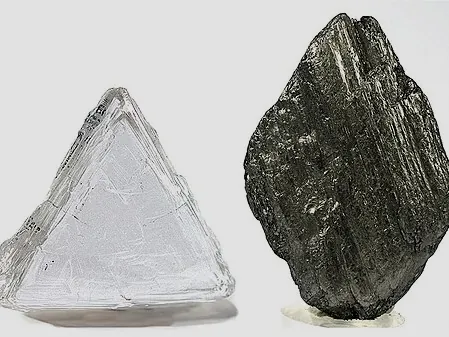
- Diamond: every carbon atom is strongly bonded to four others in a rigid 3D network. This makes diamond the hardest natural material. Most diamonds mined are used in industry, coating drill bits and saw blades that cut rock and steel. Western Australia's Argyle mine produced most of the world's rare pink diamonds until it closed in 2020.
- Graphite: carbon atoms are bonded in flat sheets of hexagons. The sheets are only weakly held to each other, so they slide apart easily, which is why pencils write and graphite is used as a dry lubricant. Each atom has one spare electron that can move along the sheet, so graphite conducts electricity, unlike any other non-metal. It is used in batteries and electric motor brushes.
- Graphene: a single sheet of graphite, just one atom thick. In 2004 two scientists in Manchester peeled it off graphite using sticky tape, and won a Nobel Prize for it in 2010. Graphene is incredibly strong for its weight, flexible, almost transparent and an excellent conductor.
Oxygen also has allotropes. Ordinary oxygen gas is O2. Ozone, O3, has three atoms per molecule. High in the atmosphere, the ozone layer absorbs harmful ultraviolet rays from the sun.
Elements and their uses
| Element | Properties | Uses |
|---|---|---|
| Gold (Au) | Unreactive, never tarnishes, attractive yellow lustre, very malleable, good conductor | Jewellery, coins, tiny connecting wires and contacts in phones and computers |
| Copper (Cu) | Excellent conductor, ductile, resists corrosion | Electrical wiring, water pipes, coins |
| Helium (He) | Much less dense than air, non-flammable, unreactive | Party and weather balloons, airships, cooling MRI scanner magnets |
| Iodine (I) | Kills bacteria; needed by the body in small amounts | Antiseptics such as Betadine; added to salt. Since 2009, Australian bread has been made with iodised salt to prevent iodine deficiency. |
| Sulfur (S) | Yellow, brittle, reactive when heated | Making sulfuric acid and fertilisers, vulcanising rubber for tyres |
| Oxygen (O) | Needed for burning and respiration | Hospital oxygen, rocket fuel (as a liquid), steelmaking |
Silver is actually the best electrical conductor of all, with copper second and gold third. Copper is used for nearly all wiring because it is almost as good as silver and far cheaper. Gold is used only where tiny amounts are needed and corrosion must be avoided.
Test yourself
Metals conduct electricity because
The sea of free electrons carries the current.
Diamond and graphite are
Same element, different arrangements.
Why does graphite rub off onto paper?
Layers slide off and stay on the paper.
Which gas is diatomic?
Nitrogen exists as N₂ molecules; the others are monatomic noble gases.
Helium is used in airships instead of hydrogen because helium
Hydrogen is highly flammable, as the Hindenburg disaster in 1937 showed.
Silicon is used in computer chips because it
It is a semiconductor (a metalloid).
Sort the properties.
In a metal, positive particles are arranged in a surrounded by a sea of . Different forms of the same element are called . A single sheet of graphite is called . Elements such as neon that exist as single atoms are .
Explain why copper can be bent into a wire but a crystal of sulfur shatters when you hit it. Refer to the particles in each substance.
Copper is a metal. Its particles are arranged in a lattice of positive copper particles surrounded by a sea of free electrons. When copper is pulled or bent, layers of particles slide over each other, but the sea of electrons moves with them and keeps holding the particles together, so the copper changes shape without breaking. This makes it ductile.
Sulfur is a non-metal made of separate S₈ ring molecules. The electrons are held tightly in the bonds within each ring, and the rings are attracted to each other only weakly. When the crystal is hit, the molecules are knocked apart from each other, so it cracks and crumbles instead of bending.