 Coaching Centre
Signs of chemical change
The evidence that a chemical reaction has happened: gas, permanent colour change, a precipitate, temperature change and light, with tests for common gases, how airbags work and what makes iron rust.
A car airbag inflates in about 30 thousandths of a second, faster than you can blink. It isn't blown up by a pump. A chemical reaction inside the steering wheel makes a big puff of nitrogen gas almost instantly.
Looking for evidence
You can't see atoms rearranging, so how do you know a chemical reaction has happened? Chemists look for evidence that a new substance has formed. The common signs are:
- A gas is given off. You see bubbles or fizzing, or notice a new smell. Vinegar and baking soda fizz because carbon dioxide is made.
- A permanent colour change. Iron turns orange-brown when it rusts; a cut apple turns brown; copper roofs turn green.
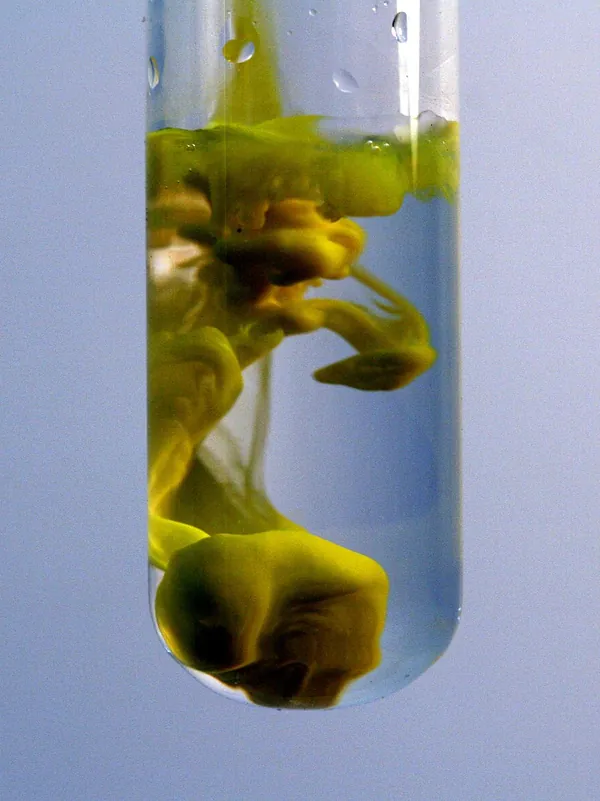
- A precipitate forms. A precipitate is a solid that suddenly appears when two solutions are mixed. Clear copper sulfate and sodium hydroxide solutions mixed together make a pale blue jelly-like solid.
- A temperature change. The mixture gets hotter or colder by itself.
- Light (or sound) is given off. Fireworks, sparklers, burning magnesium and glow sticks all give out light.
Another clue is that a starting substance disappears: a piece of magnesium ribbon fizzing away to nothing in acid, or a candle getting shorter.
Be careful with the evidence
None of these signs is proof on its own, because some physical changes look similar:
- Opening a can of soft drink makes bubbles, but the carbon dioxide was already dissolved in the drink. Boiling water also bubbles. Neither makes a new substance.
- A steel nail glows red when heated in a flame, but it returns to grey when it cools. A colour change has to be permanent to count.
- Dissolving some substances changes temperature. An instant ice pack goes cold because ammonium nitrate dissolves in water, which is a physical change.
- Sand settling in water isn't a precipitate: the solid was there all along.
The more signs you see together, the stronger the evidence. The best evidence is testing the products to show they have new properties.
Testing for gases
| Gas | Test | Positive result |
|---|---|---|
| Hydrogen | Hold a lit splint at the mouth of the test tube | A squeaky "pop" (the hydrogen burns) |
| Oxygen | Put a glowing splint into the gas | The splint relights |
| Carbon dioxide | Bubble the gas through limewater | Limewater turns milky. (A lit splint also goes out, but so it would in nitrogen.) |
- Add magnesium ribbon to dilute hydrochloric acid. List every sign of a reaction. Test the gas.
- Add sodium hydroxide to vinegar. What is the only clue that a reaction happened?
- Mix copper sulfate with sodium hydroxide. What is the solid that appears called?
- Add salt to each liquid. Is there ever a reaction?
- Try all 20 pairs. How many did you classify correctly first time?
Rusting: a slow chemical change
Rusting is a reaction between iron, oxygen and water: iron + oxygen + water → hydrated iron(III) oxide (rust). It is slow, but it is a chemical change: the grey, strong, magnetic metal becomes an orange-brown, flaky powder. Scrape off the rust and there is a pit where metal used to be.
Test yourself
Which observation is the strongest evidence of a chemical change?
A precipitate means a new substance has formed.
A gas makes a lit splint burn with a squeaky pop. The gas is
Hydrogen burns rapidly with a pop.
Limewater turning milky shows the presence of
This is the standard test for CO₂.
A precipitate is
It appears as a result of the reaction.
In the rusty nail experiment, the nail in boiled water covered with oil doesn't rust because
Boiling removes dissolved air and the oil stops more getting in.
Why is a red-hot nail not evidence of a chemical change?
No new substance formed.
Name each sign of a chemical reaction.
Label the conditions in each tube.
Is it good evidence?
A solid that forms when two solutions are mixed is a . Oxygen a glowing splint. Rusting needs both water and . Salt water makes rusting . Airbags fill with gas made by a chemical reaction.
A student drops a piece of chalk into vinegar and sees bubbles. The student says this proves a chemical reaction has happened. Evaluate this claim and describe how the student could get stronger evidence.
The bubbles are good evidence, but not proof by themselves. Bubbles mean a gas is being released, which suggests a new substance is forming, but bubbles can also come from air trapped in the porous chalk or from a physical change such as boiling.
The student could collect the gas and bubble it through limewater. If the limewater turns milky, the gas is carbon dioxide, a new substance that wasn't there before, which shows a chemical reaction. The student could also watch whether the chalk slowly gets smaller and disappears, and measure whether the temperature changes. Several signs together, plus a positive test for a new product, would convince me that a chemical reaction has happened (calcium carbonate + acetic acid → calcium acetate + water + carbon dioxide).