 Coaching Centre
Moving plates
Continental drift and Gondwana, tectonic plates and why they move, divergent, convergent and transform boundaries, and how plate movement causes earthquakes, volcanoes and mountains, including in Australia.
The same fossil fern, Glossopteris, is found in Australia, Antarctica, India, Africa and South America. Its seeds were far too heavy to float across oceans. So how did it get to all five?
Continents on the move
In 1912 the German scientist Alfred Wegener pointed out that the continents fit together like jigsaw pieces, especially South America and Africa. He collected more clues: matching rock layers and mountain belts on opposite sides of oceans, the same fossils (such as Glossopteris and the small freshwater reptile Mesosaurus) on continents now far apart, and scratches left by ancient glaciers in places that are now hot, such as central Australia and India.
Wegener proposed that all the continents were once joined in one supercontinent, which he called Pangaea, and that they had slowly drifted apart. Its southern half, called Gondwana, included Australia, Antarctica, South America, Africa, India and New Zealand. Most geologists rejected his idea of continental drift because he couldn't explain what force could move whole continents. He died in 1930 on an expedition in Greenland, decades before he was proved right.
The breakthrough came in the 1950s and 1960s, when ships mapped the ocean floor. They found a chain of underwater mountains, the mid-ocean ridges, running around the world like the seam on a tennis ball. Rock near the ridges is young and rock far from them is old, and the magnetism of the rock forms matching stripes on either side. The sea floor was spreading. Wegener's continents were riding on moving plates, and the theory of plate tectonics was born.
Why plates move
The Earth's lithosphere is broken into about 15 large plates and many smaller ones. Australia sits on the Australian plate (sometimes called the Indo-Australian plate). Plates are moved by the Earth's internal heat:
- Heat from the core and from radioactive decay makes the mantle churn in slow convection currents: hot rock rises, spreads and cools, then sinks again. The plates are dragged along on top.
- At ocean trenches, old, cold, dense ocean plate sinks into the mantle and pulls the rest of the plate behind it, like a tablecloth sliding off a table. This "slab pull" is thought to be the biggest force.
- At mid-ocean ridges, the raised, hot rock helps push the plates apart.
What happens at plate boundaries
Most earthquakes, volcanoes and young mountain ranges are found along the edges of plates, where plates meet. There are three kinds of boundary:
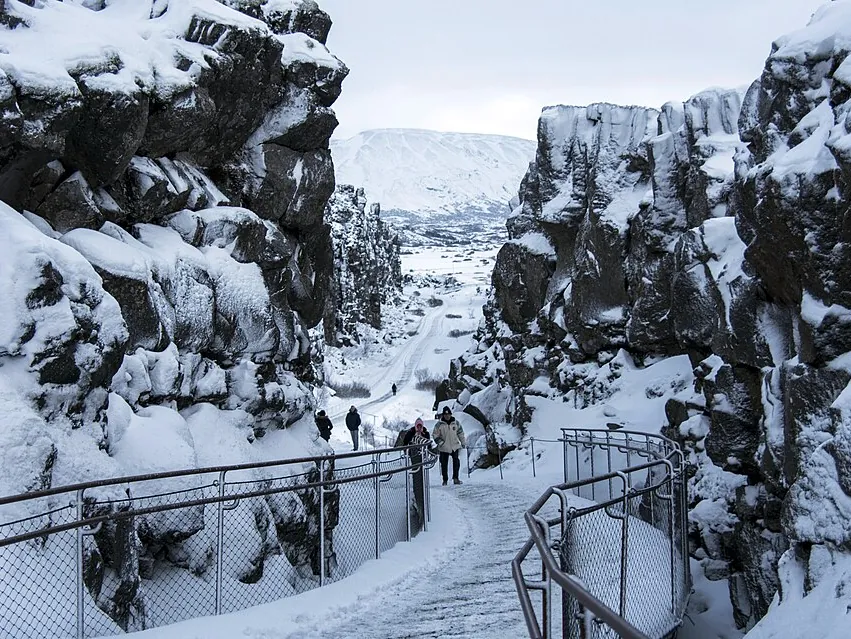
- Divergent boundaries: plates move apart. Magma rises into the gap and cools to make new crust. Under the sea this builds mid-ocean ridges; on land it opens rift valleys, such as Iceland's Þingvellir and the East African Rift, where Africa is slowly splitting in two.
- Convergent boundaries: plates move towards each other. If an ocean plate meets a continent, the denser ocean plate sinks under it (subduction), making a deep trench, strong earthquakes and a chain of volcanoes, as in the Andes, Japan and Indonesia. If two continents collide, neither sinks far, so the crust crumples into huge fold mountains: the Himalayas formed when India crashed into Asia.
- Transform boundaries: plates slide past each other. No crust is made or destroyed, but the plates lock together, build up stress and then suddenly slip, causing earthquakes. New Zealand's Alpine Fault and California's San Andreas Fault are examples.
- Watch the divergent boundary. Why are the magnetic stripes the same on both sides of the ridge?
- At the ocean–continent boundary, where do the earthquakes happen? Why does the volcano grow on the continent, not the ocean plate?
- On the transform fault, what happens to the stress just before an earthquake?
- Set the speed to 7 cm a year, Australia's speed. How far does it move in 10 million years?
Plates and Australia
Australia is in the middle of its plate, a long way from the nearest boundary, so it has no active plate-boundary volcanoes and fewer big earthquakes than New Zealand or Indonesia. But it isn't quiet:
- Australia broke away from Antarctica, finally separating near Tasmania about 35 million years ago, and has been moving north ever since. It is heading towards Asia and will collide with it in tens of millions of years.
- The plate is being squeezed as it pushes north, so stress builds up in the crust and is released in earthquakes. The 1989 Newcastle earthquake (magnitude 5.6) killed 13 people, and a magnitude 5.9 earthquake near Woods Point in Victoria in 2021 was felt in Melbourne and Sydney.
- Eastern Australia has a line of old volcanoes that get younger towards the south, including Wollumbin (Mount Warning) about 23 million years old, the Warrumbungles about 17 million years and Mount Canobolas near Orange about 13 million years. As the plate moved north over a hot spot in the mantle, a new volcano formed and the old ones were carried away, like a sheet of paper being pulled over a candle.
Test yourself
Which was not part of Wegener's evidence for continental drift?
The magnetic stripes were discovered in the 1960s, after Wegener died.
At a mid-ocean ridge, plates
It is a divergent boundary.
The Himalayas formed when
India crashed into Asia.
In subduction, the plate that sinks is usually
Oceanic crust is dense basalt.
New Zealand's Alpine Fault is a
The plates slide past each other.
The volcanoes of eastern Australia get younger towards the south because
New volcanoes formed over the hot spot as the plate moved.
Name each kind of plate boundary.
Which kind of boundary?
Wegener called the southern supercontinent . Plates are moved by currents in the mantle. When an ocean plate sinks beneath another plate it is called . When continents collide they form fold . Australia moves about 7 cm a year towards the .
Describe what happens at a convergent boundary where an ocean plate meets a continental plate. Explain why earthquakes and volcanoes both occur there, and name a place where this is happening.
When an ocean plate converges with a continental plate, the ocean plate is denser (made of basalt), so it bends down and sinks beneath the continent into the mantle. This is called subduction, and it forms a deep trench in the sea floor where the plate bends down.
The two plates don't slide smoothly. They lock together, stress builds up, and then they suddenly slip, causing earthquakes, often very large ones, along the sinking plate. As the ocean plate sinks deeper it heats up and releases water from its minerals. The water lowers the melting temperature of the hot mantle rock above it, so some of the rock melts. This magma is less dense than the solid rock around it, so it rises and erupts, building a line of volcanoes on the continent parallel to the trench. This is happening along the west coast of South America, where the Nazca plate is subducting under South America to form the Andes.