 Coaching Centre
Igneous rocks
Magma and lava, intrusive and extrusive igneous rocks, why cooling rate controls crystal size, and common igneous rocks such as granite, basalt, pumice, scoria and obsidian.
The four huge pylons at the ends of the Sydney Harbour Bridge are faced with granite quarried at Moruya on the NSW south coast. That granite started as molten rock deep underground and took hundreds of thousands of years to cool.
Three families of rock
Geologists sort rocks into three groups by how they formed, not by what they look like:
- Igneous rocks form when molten rock cools and hardens.
- Sedimentary rocks form when particles of sediment are pressed and cemented together.
- Metamorphic rocks form when existing rocks are changed by heat and pressure, without melting.
All three are made of minerals: naturally formed solid substances with a particular chemical make-up and crystal structure. Granite, for example, is a mixture of the minerals quartz, feldspar and mica. This topic is about igneous rocks; the next is about the other two.
Magma and lava
Igneous comes from the Latin ignis, fire. Deep in the crust and upper mantle, rock can partly melt where it is very hot, where pressure drops (as at a mid-ocean ridge) or where water is added (as above a subducting plate). Molten rock underground is called magma. Because it is less dense than the solid rock around it, magma rises. If it reaches the surface and erupts, it is called lava.
Intrusive and extrusive rocks
Intrusive igneous rocks form from magma that never reaches the surface. It is trapped underground and surrounded by rock that acts like insulation, so it cools slowly, sometimes over a million years. Granite and gabbro are intrusive. We only see them at the surface after the rock above has been worn away by erosion, or pushed up by plate movements.
Extrusive igneous rocks form from lava. Lava loses heat quickly to the air, the ground or the sea, and can cool in hours to weeks. Basalt, scoria, pumice, rhyolite and obsidian are extrusive.
Why crystal size depends on cooling
In hot magma, the atoms move about freely. As it cools, atoms begin to lock together into neat repeating patterns: crystals of different minerals. If cooling is slow, only a few crystals start and atoms have time to travel to them, so the crystals grow large. If cooling is fast, crystals start everywhere at once and run out of time and space, so they stay tiny. If cooling is almost instant, the atoms are frozen in a jumble with no crystals at all: a volcanic glass.
So you can read a rock's history from its crystals: large crystals = cooled slowly, underground; tiny crystals = cooled quickly, at the surface.
- Cool silica-rich magma deep underground, then as lava. Compare the size and number of crystals.
- What happens when lava cools almost instantly? Why are there no crystals?
- Turn on the gas. Which rock floats on water, and why?
- Granite and rhyolite are made of the same minerals. What is different about them?
Common igneous rocks
| Rock | How it formed | What it looks like | Uses and places |
|---|---|---|---|
| Granite | Intrusive, slow cooling of silica-rich magma | Light, speckled; large crystals of quartz (grey, glassy), feldspar (white or pink) and mica (black) | Benchtops, buildings, monuments; New England tablelands, Moruya, Granite Belt (Qld) |
| Gabbro | Intrusive, slow cooling of silica-poor magma | Dark, large crystals | Crushed for road gravel |
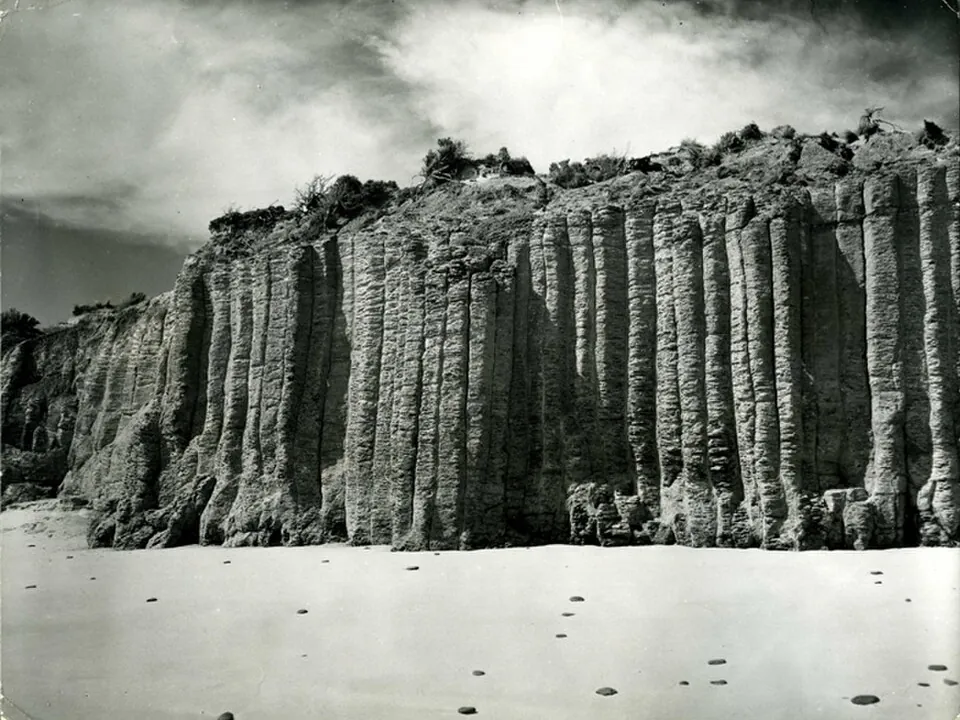
| Basalt | Extrusive, fast cooling of runny, silica-poor lava | Dark grey to black, very fine-grained | Most of the ocean floor; Melbourne's "bluestone" buildings and kerbs; Organ Pipes (Vic) |
| Scoria | Extrusive, gassy basalt lava | Red-brown to black, full of holes, quite light | Garden paths, drainage |
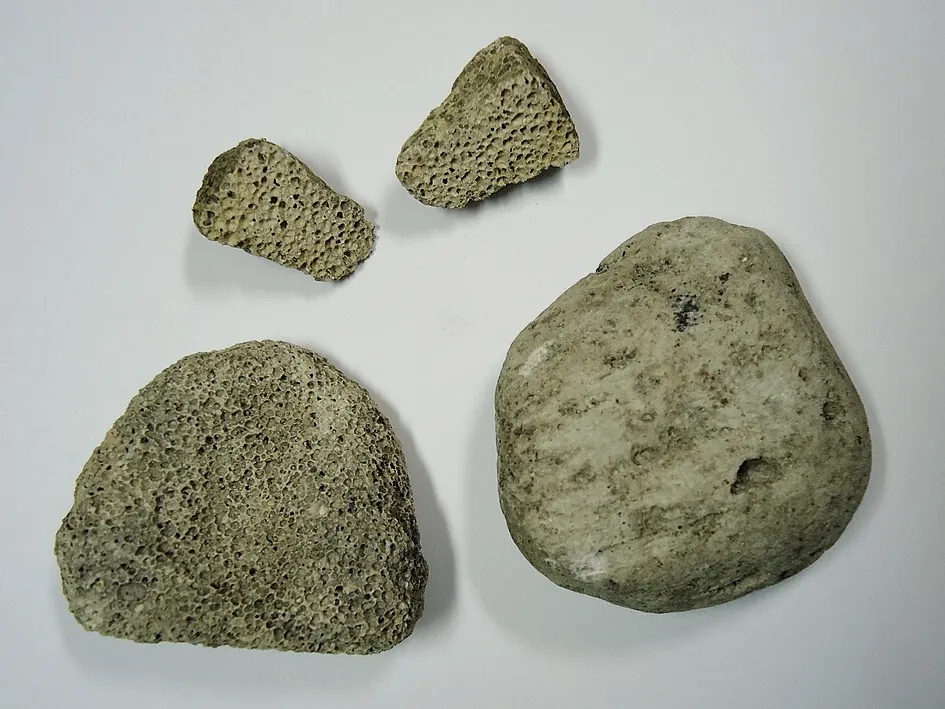
| Pumice | Extrusive, frothy silica-rich lava cooled very fast | Pale, so full of gas holes it floats | Foot scrubbers, abrasives, "stonewashed" jeans |
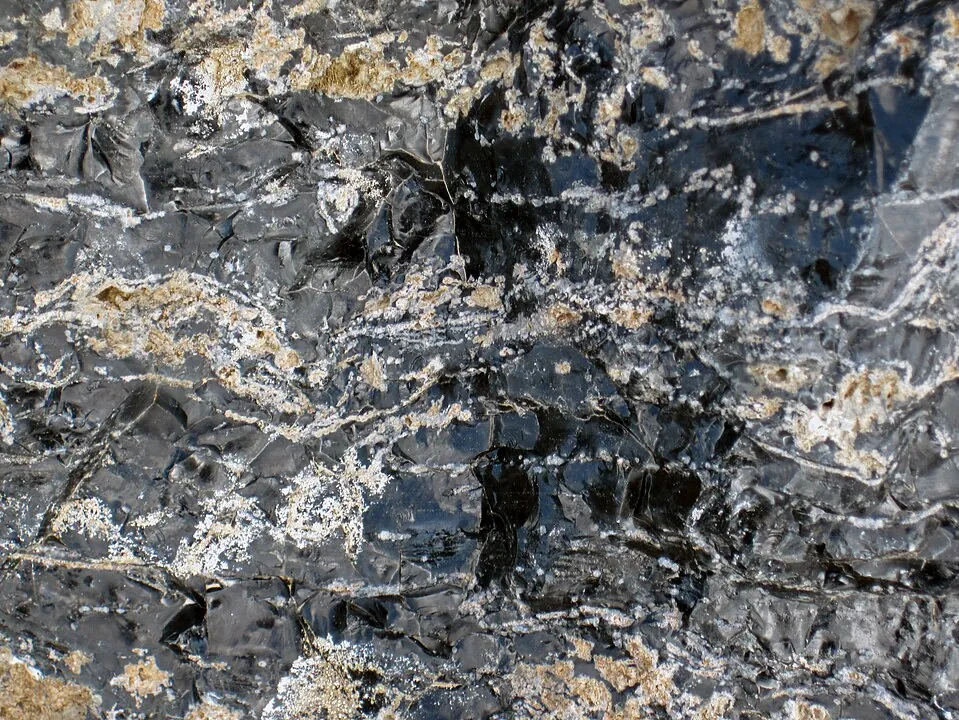
| Obsidian | Extrusive, silica-rich lava cooled almost instantly | Black, shiny glass with curved fracture surfaces | Ancient blades and arrowheads; some surgical scalpels |
Test yourself
Molten rock that reaches the Earth's surface is called
Underground it is magma.
Granite has large crystals because it
Slow cooling lets crystals grow big.
Which rock can float on water?
It is full of gas holes.
Obsidian has no crystals because
Atoms had no time to arrange into crystals.
Most of the ocean floor is made of
Formed from lava at mid-ocean ridges.
Granite and rhyolite contain the same minerals. The main difference is that rhyolite
Rhyolite is the extrusive version of granite.
Label the diagram.
Sort the igneous rocks and features.
Igneous rocks form when molten rock cools and . The word igneous comes from the Latin for . Rocks are made of naturally formed substances called . Slow cooling gives crystals. Gas bubbles trapped in cooling lava make in scoria and pumice.
A geologist finds two dark igneous rocks with the same minerals. Rock X has crystals about 5 mm across; rock Y has crystals too small to see without a microscope. Explain where and how each rock probably formed.
Both rocks formed from the same kind of magma, so the difference in crystal size must come from how fast they cooled. Rock X, with large crystals, is an intrusive igneous rock such as gabbro. It formed from magma trapped deep underground, where the surrounding rock insulated it so it cooled very slowly. Only a few crystals started to grow, and atoms had plenty of time to join them, so they grew large.
Rock Y, with microscopic crystals, is an extrusive igneous rock such as basalt. It formed from lava that erupted at the surface and lost heat quickly to the air or water. Many tiny crystals started at the same time and there was no time for them to grow, so the rock is fine-grained.