 Coaching Centre
Generating and using electricity
How generators turn movement into electricity, how power stations work, how the grid uses transformers to carry electricity to homes, batteries and direct current, and how lighting and electronics have changed.
In 1831 Michael Faraday moved a magnet in and out of a coil of wire and saw the needle on a meter flicker. That tiny flicker is the reason you can charge your phone. Almost every power station on Earth, whether it burns coal or is turned by wind or water, still uses Faraday's idea: move a magnet near a coil of wire and electricity flows.
How a generator works
A generator transforms kinetic energy into electrical energy. Inside is a magnet and a coil of copper wire. When one of them spins, the magnetic field sweeping through the coil pushes electrons along the wire. Because the magnet's north and south poles take turns passing the coil, the current flows one way, then the other, many times a second. This is alternating current (AC). In Australia the mains supply changes direction 50 times each second (50 hertz).
You get more voltage from a generator by:
- spinning it faster;
- using more turns of wire in the coil;
- using a stronger magnet.
A motor is a generator run in reverse: electrical energy in, kinetic energy out. Electric cars use this cleverly. When the driver brakes, the motor works as a generator, turning the car's kinetic energy back into electrical energy to recharge the battery. This is called regenerative braking.
- Leave the speed at 0. Does a still magnet make any electricity?
- Slowly increase the speed. What happens to the voltage graph and the lamp?
- Try 200 turns with a strong magnet. How slowly can you spin it and still light the lamp well?
- Why does the graph go above and below zero?
Power stations
Most power stations differ only in how they get the generator spinning.
- Coal and gas: burn fuel to boil water; high-pressure steam spins a turbine (a shaft with many angled blades) connected to the generator. Chemical → heat → kinetic → electrical.
- Hydroelectric: water from a dam falls through pipes and spins the turbine. Gravitational potential → kinetic → electrical. The Snowy Mountains Scheme was built mostly by migrant workers from over 30 countries between 1949 and 1974.
- Wind: moving air spins the blades. Kinetic → electrical.
- Solar panels are the odd one out: they have no moving parts and no generator. Light is transformed directly into electrical energy.
The electricity grid
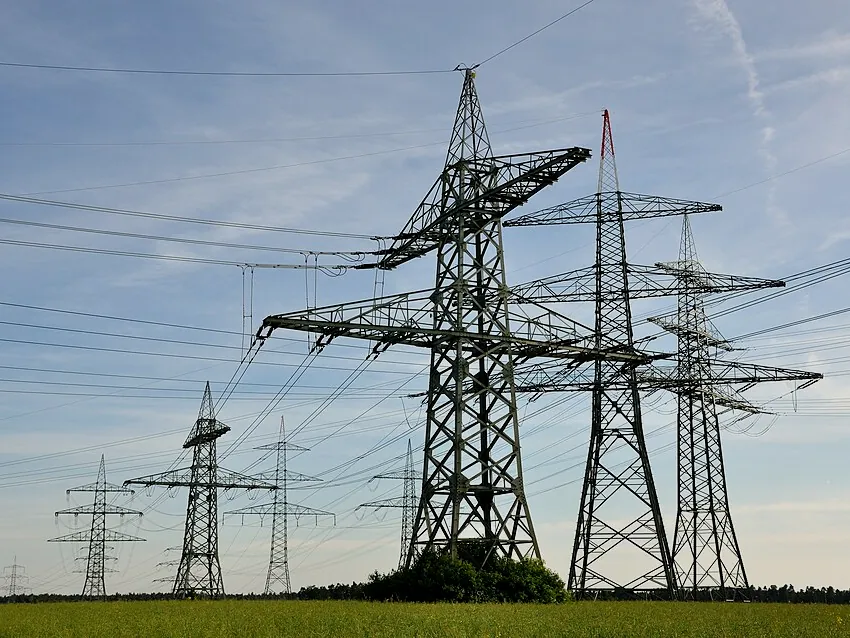
The network of power lines that links power stations to homes and businesses is called the grid. Wires heat up when current flows through them, wasting energy. The bigger the current, the bigger the loss. To keep current low, electricity is sent long distances at very high voltage.
Transformers change the voltage of AC electricity. A step-up transformer at the power station raises the voltage to between 132 000 V and 500 000 V for the transmission lines. Substations step it down to 11 000 V for the streets, and transformers on poles or in green ground boxes step it down again to 230 V for homes. Transformers only work with AC, which is one big reason why the grid uses AC rather than DC.
Batteries and DC
A battery stores chemical potential energy and transforms it into electrical energy when it's connected in a circuit. Batteries give direct current (DC), which flows in one direction only. Phones, laptops and cars run on DC, so phone chargers include a circuit that converts the mains AC to low-voltage DC.
Single-use batteries (such as alkaline AA cells) can't be recharged. Rechargeable batteries can be run backwards: a charger pushes current into them, rebuilding the chemicals. Most phones, laptops, electric cars and home batteries use lithium-ion cells, which store a lot of energy for their mass. Damaged lithium batteries can overheat and catch fire, which is why they must never go in household bins. Take them to a battery recycling drop-off point instead.
Lighting and electronics
For over a century homes were lit by incandescent globes, which pass current through a thin tungsten filament until it glows white hot (about 2500 °C). Australia was the first country to announce a ban on them, in 2007, and they were phased out from 2009. Compact fluorescent lamps (CFLs) replaced them for a while, but these contain a little mercury. Today almost all new lights are LEDs (light-emitting diodes), which make light directly from electrical energy in a tiny piece of semiconductor, with much less heat.
LEDs are one kind of semiconductor device. Another, the transistor, was invented in 1947 and acts as a tiny electronic switch. Transistors made radios pocket-sized, and then engineers learned to build thousands, then millions, then billions of them onto one small chip of silicon: an integrated circuit. A modern phone processor contains more than 15 billion transistors, each far smaller than a virus.
Test yourself
A generator transforms
A motor does the reverse.
Which change would not increase a generator's voltage?
A still magnet produces no current at all.
Electricity is transmitted at very high voltage because
Lower current means less heating of the wires.
The voltage of mains electricity in Australian homes is about
The Australian standard is 230 V (older books say 240 V).
Which power source has no turbine or generator?
Solar cells turn light straight into electricity.
Batteries produce
Batteries push current in one direction only.
Label the parts of the electricity grid.
Put the energy chain for a hydroelectric power station in order.
Mains electricity is current. A changes the voltage of AC electricity. In a power station, steam spins a , which turns the generator. Most phones use batteries. Modern lights are mostly .
Explain the energy transformations in an electric car that uses regenerative braking, both when it speeds up and when it brakes.
When the car speeds up, chemical potential energy stored in the battery is transformed into electrical energy, which the motor transforms into kinetic energy of the car. Some energy is wasted as heat in the battery, wires and motor.
When the driver brakes, the motor is run as a generator. The car's kinetic energy spins it, producing electrical energy, which recharges the battery and is stored as chemical potential energy again. This slows the car down. Not all the kinetic energy is recovered; some still becomes heat in the brakes and motor.