 Coaching Centre
Weathering, erosion and deposition
Physical, chemical and biological weathering, erosion by water, wind, ice and gravity, deposition, and the Australian landforms they create.
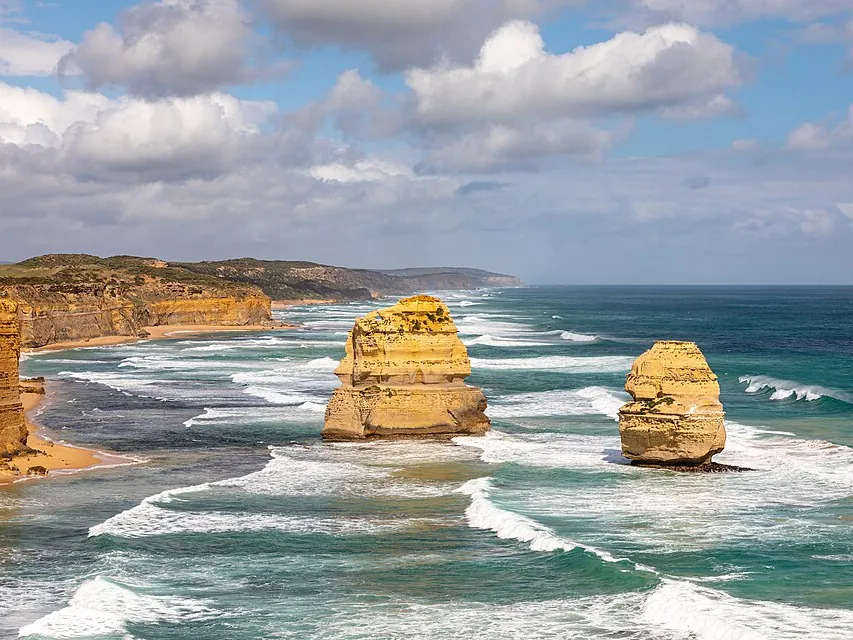
On 3 July 2005, one of the limestone stacks of the Twelve Apostles on Victoria's coast collapsed into the sea in a few seconds. It had taken the ocean thousands of years to get it to that point. (There were never twelve, by the way.)
Three different processes
These three words are easy to mix up, so learn them as a sequence:
- Weathering breaks rock down where it is.
- Erosion picks up the broken pieces and carries them away (transport).
- Deposition drops them somewhere else, when the water, wind or ice carrying them slows down.
Together they slowly wear down mountains and build up beaches, deltas, dunes and the sediment that becomes new sedimentary rock.
Physical weathering
Physical (or mechanical) weathering breaks rock into smaller pieces without changing the minerals it is made of.
- Frost wedging. Water seeps into cracks and freezes at night. Ice takes up about 9% more space than water, so it levers the crack wider. Repeated freezing and thawing splits off blocks, which pile up as scree below cliffs. It is common in alpine areas such as the Snowy Mountains.
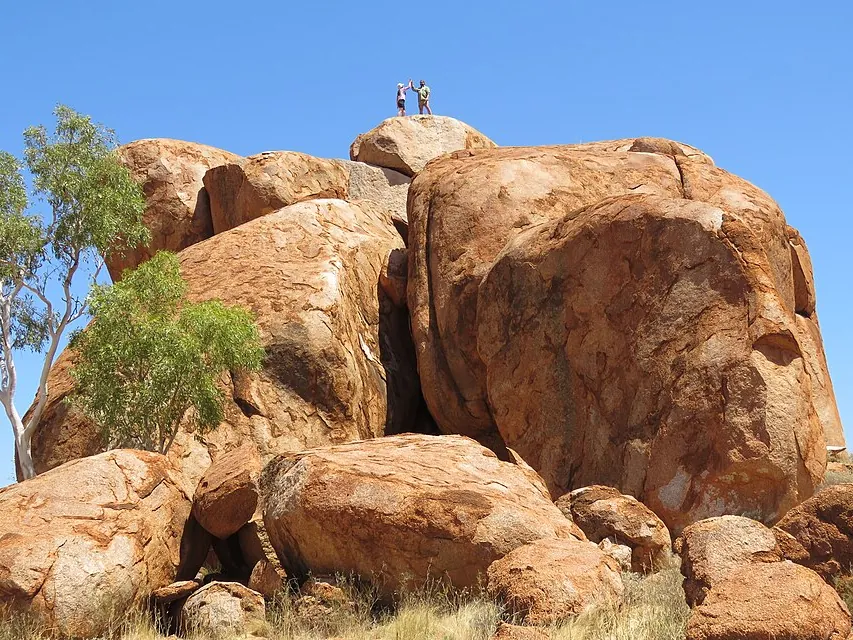
- Heating and cooling. In deserts, rock surfaces can heat to over 60 °C in the day and cool sharply at night. Rock conducts heat poorly, so the outside expands and contracts more than the inside, and thin sheets can peel off like onion skin. Moisture and salt crystals growing in tiny cracks help a lot.
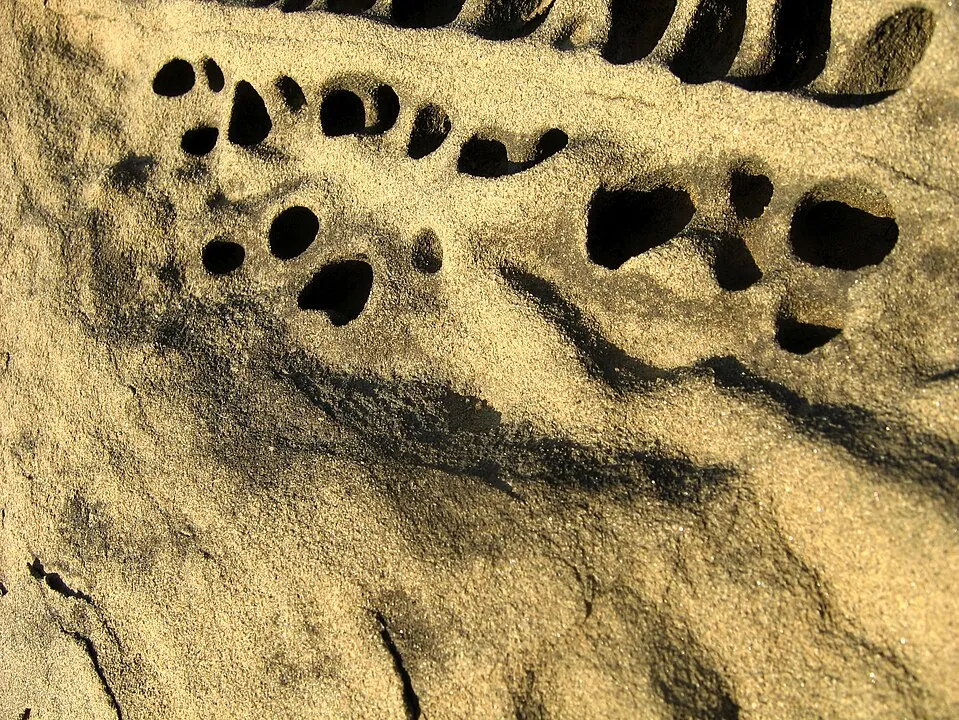
- Salt weathering. Salty water evaporates in pores in the rock and salt crystals grow, prising grains apart. It carves the honeycomb patterns in Sydney's sandstone sea cliffs.
- Abrasion. Rocks carried by wind, water or ice grind against other rocks and wear them away, like sandpaper.
Biological weathering is weathering caused by living things. Tree roots grow into cracks and force them apart; burrowing animals break up rock and soil; lichens release acids that slowly etch rock surfaces.
- Run frost wedging. How many freeze–thaw cycles does it take for the block to break off?
- Why does the crack only widen at night?
- Compare tree roots and heating and cooling. What do all three have in common?
Chemical weathering
Chemical weathering changes the minerals in rock into new substances, which are often softer or dissolve. You met it in Chapter 5:
- Acids: rainwater dissolves carbon dioxide to form weak carbonic acid, which dissolves limestone and marble. This is how limestone caves, such as the Jenolan Caves, form.
- Oxidation: iron in minerals reacts with oxygen and water to form iron oxides, which colour rock and soil red and weaken them.
- Water: some minerals react with water itself. Feldspar, the most common mineral in granite, slowly turns into soft clay, which is why weathered granite crumbles into sand (quartz grains) and clay.
Physical and chemical weathering help each other: breaking rock into smaller pieces gives a larger surface area for chemicals to attack, and chemical weathering weakens rock so it breaks more easily. Chemical weathering is fastest where it is warm and wet.
Erosion and deposition
The main agents of erosion are:
- Water. Rivers carry boulders, gravel, sand and mud downhill; waves erode coastlines. Running water is the most important agent of erosion on Earth.
- Wind. Picks up sand and dust in dry areas, sand-blasting rock and piling up dunes, like the long parallel dunes of the Simpson Desert.
- Ice. Glaciers are rivers of ice that scrape and carry huge amounts of rock. Australia had small glaciers in Tasmania and the Snowy Mountains during the last ice age, about 20 000 years ago.
- Gravity. Landslides, rockfalls and soil creeping slowly downhill all move material without water, wind or ice carrying it.
How much a river can carry depends on its speed. A fast mountain stream in flood can roll boulders; a slow lowland river carries only fine sand and mud. When water slows down, it deposits the largest, heaviest particles first, so rivers sort sediment by size. Where a river enters the sea it slows right down and drops its load, building a delta.
- Watch where each size of particle ends up. Which travels furthest?
- Switch to flood. What changes? Why do floods do so much damage?
- Build the dam. Where does the sediment go now, and what problems might that cause downstream?
How landforms are shaped
On a winding river, water flows fastest around the outside of each bend. It erodes the bank there into a steep cliff. On the inside of the bend the water is slow and shallow, so it deposits sand and gravel. Over time the bends grow and creep across the valley. Eventually a bend can be cut off to leave a curved oxbow lake, or billabong.
On coasts, waves attack weaknesses in cliffs, carving caves. Caves on both sides of a headland can join to make an arch; when the arch roof falls in, a sea stack is left standing. The Twelve Apostles and London Bridge (now London Arch, which lost its connection to the mainland in 1990) on Victoria's coast formed this way.
Test yourself
Erosion is
Weathering breaks; erosion moves.
Frost wedging works because
About 9% bigger.
Which is an example of chemical weathering?
A new substance forms.
On a river bend, deposition happens mostly
Slow, shallow water drops sediment.
As a river slows down, which particles are deposited first?
The heaviest settle first.
A sea stack forms when
Cave → arch → stack.
Where do erosion and deposition happen?
Classify each process.
Put the life of a sand grain in order.
Broken rock that piles up below a cliff is called . Rocks grinding against rocks is called . A river drops its load where it enters the sea, building a . A bend cut off from a river becomes an lake. The most important agent of erosion on Earth is running .
Old gravestones made of marble are often much harder to read than gravestones made of granite of the same age. Explain this, and describe one way physical weathering could also damage the gravestones.
Marble is made of calcite (calcium carbonate). Rainwater is naturally slightly acidic because it dissolves carbon dioxide to form carbonic acid, and polluted air can make it more acidic. The acid reacts with the calcium carbonate, dissolving the surface of the marble a little at a time. This chemical weathering slowly rounds off the edges of the carved letters until they are hard to read. Granite is made mainly of quartz and feldspar, which react with rainwater far more slowly, so its lettering stays sharp for much longer.
Physical weathering can also damage both kinds of gravestone. For example, water can seep into small cracks and freeze on cold nights. Because water expands about 9% when it freezes, the ice pushes the crack wider, and over many freeze–thaw cycles flakes of stone can break off.