 Coaching Centre
Conservation and sustainable farming
Why we conserve biodiversity, Australian ecologists such as Joe Benshemesh and Peter Newman, ecological footprints, green corridors and wedges, dryland salinity, soil organic carbon, no-till farming and organic fertilisers, dung beetles, and selective breeding.
In the 1950s, Australian paddocks were covered in cow pats that just sat there for months, smothering the grass and breeding swarms of bush flies. Australia's native dung beetles were used to small, dry kangaroo and wombat droppings and couldn't cope with sloppy cow pats. The fix came from a Hungarian-born scientist and a few dozen species of beetle from Africa and Europe.
Why conserve biodiversity?
Australia is one of about 17 "megadiverse" countries. More than 80% of our mammals, reptiles, frogs and flowering plants live nowhere else on Earth. If they disappear here, they're gone from the biosphere for good. There are several reasons to protect them:
- The biosphere holds the planet together. Healthy ecosystems keep the air, climate, water and soil in working order.
- Biological resources. Living things give us food, fibre such as cotton and wool, timber, and medicines. Aspirin was developed from a chemical in willow bark; penicillin comes from a mould. Searching for new useful chemicals in living things is called bioprospecting, and Australia's unique species are a rich source.
- Social and cultural value. People value the bush and the coast for bushwalking, fishing, tourism and art. For Aboriginal and Torres Strait Islander peoples, Country, including its plants and animals, is part of identity, kinship and law, and people are its custodians rather than its owners.
- Ethics. Many people believe other species have a right to exist whether or not they are useful to us.
Lifestyle and our ecological footprint
Australians have one of the highest standards of living in the world. We have large houses, own many goods and use a lot of energy. All of that comes from land, water and resources somewhere, often overseas. Your ecological footprint estimates how much productive land and sea is needed to supply everything you use and absorb your waste. If everyone on Earth lived like the average Australian, we would need about four Earths. Using less energy, wasting less food, buying less and reusing more all shrink your footprint.
Australian ecologists at work
Ecology is the study of how living things interact with each other and their environment. Two examples of Australian research:
- Dr Joe Benshemesh studies marsupial moles, blind, earless animals that "swim" through the sand dunes of central Australia and almost never come to the surface. They're so hard to find that nobody knew whether they were rare. By digging trenches across dunes and counting the backfilled tunnels in the sand, his team, working with Aboriginal rangers, found evidence that moles are widespread across the desert. Without this research, it was impossible to tell whether they needed protecting.
- Professor Peter Newman of Curtin University studies sustainable cities. He showed how spreading suburbs make people dependent on cars, and helped plan Perth's new railway lines in the 1990s and 2000s, which got many people out of cars. He promotes rainwater tanks, rooftop gardens, community gardens and walkable suburbs.
Green wedges and corridors
Conservation isn't only for scientists and governments. Any piece of land, even a backyard or school ground, can provide habitat. Planting local native species, building a frog pond or leaving logs on the ground all help.
- Green wedges are large non-urban areas of a city, such as parks, bushland and farmland, protected from development.
- Green corridors are strips of native vegetation that link patches of habitat, such as roadside reserves, creek banks or rows of trees across farms. Animals use them to move between patches to find food and mates, so small isolated populations don't die out. On farms, corridors also act as windbreaks, give stock shade, and house birds and insects that eat crop pests.
Community groups do a lot of this work. Thousands of volunteers in programs such as Landcare and Waterwatch plant trees, remove weeds and test the health of their local creeks.
Dryland salinity
A lot of Australian soil has salt stored deep underground, left from ancient seas and blown in from the ocean over millions of years. Native trees and shrubs, with their deep roots, used almost all the rain that fell, so the water table stayed deep and the salt stayed put.
When the land was cleared and replaced with shallow-rooted crops and pasture, more rainwater soaked past the roots. The water table rose, dissolving the salt and carrying it up to the surface. As the water evaporates, it leaves a white crust of salt called a salt scald, where almost nothing grows. Salt also washes into rivers. Western Australia's wheatbelt has been hit worst. The main fix is to plant deep-rooted trees and perennial plants, especially on the higher ground where rain soaks in, to lower the water table again.
Science and sustainable farming
Farmers need to feed a growing population without clearing more land. Ecological research has improved farming in several ways.
Soil organic carbon
Soil organic carbon (SOC) is the carbon in decaying plant and animal material mixed into the soil. Soil with more SOC holds more water, lets air in, is easier for roots to grow through, and feeds the microbes and worms that keep soil healthy. Decomposing material also releases nutrients such as nitrogen and phosphorus. Farmers can increase SOC by:
- No-till (conservation) farming. Instead of ploughing or burning the stubble left after harvest, farmers leave it on the ground and sow the next crop straight through it. The stubble protects the soil from erosion and rots into SOC. Most Australian grain farms now use no-till methods.
- Organic fertilisers such as compost and manure add SOC immediately. They release nutrients slowly, so less washes into rivers and causes algal blooms.
Storing more carbon in soil also takes carbon dioxide out of the air.
Dung beetles
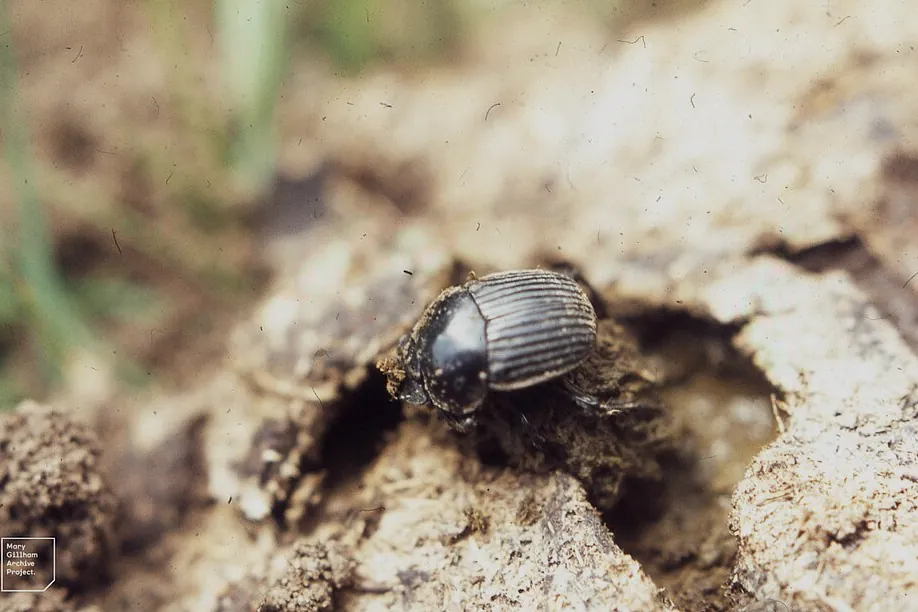
In 1951 the entomologist Dr George Bornemissza, who had arrived from Hungary, noticed the cow pat problem. He realised Australia had cattle but not the beetles that had evolved with cattle elsewhere. The CSIRO Dung Beetle Project followed. Between 1968 and 1984, 43 species of dung beetle from Africa and Europe were carefully tested, bred in quarantine to make sure no diseases came with them, and released. Twenty-three species became established. They bury dung within days, which returns nutrients to the soil, lets rain soak in, and removes the places where bush flies breed. Research continues today to fill gaps in regions and seasons where few beetles are active.
Selective breeding
For thousands of years, farmers have chosen which plants and animals to breed from. In selective breeding, individuals with useful features are bred together so their offspring are more likely to have those features: a cow that gives lots of milk is bred with a bull from a line of good milkers, or a frost-resistant wheat is crossed with a high-yielding one. William Farrer did this in NSW in the 1890s, breeding the wheat variety "Federation", which resisted drought and disease and helped turn Australia into a major wheat exporter. Breeders must avoid too much inbreeding (breeding close relatives), which makes rare genetic diseases more likely, as has happened in some dog breeds.
- Run 20 years of ordinary farming first. What happens to the soil?
- Switch on one practice at a time. Which one helps soil carbon most? Which reduces flies?
- Plant tree belts. Why does the crop yield dip at first? Is it worth it after 20 years?
- Which combination would you recommend to a farmer whose land has salt scalds?
Test yourself
The main purpose of a green corridor is to
Corridors link isolated patches so animals can find food and mates.
Dryland salinity is caused mainly by
The rising water table brings stored salt to the surface.
Leaving crop stubble on the ground instead of burning it
The stubble protects the soil and rots into organic matter.
Why were dung beetles from Africa and Europe introduced to Australia?
The introduced beetles had evolved alongside cattle.
Which is an example of bioprospecting?
Bioprospecting searches living things for useful chemicals.
Label how dryland salinity happens.
Does each practice improve or damage the soil?
Carbon from decaying plants and animals in the soil is called soil organic . Farming without ploughing is called farming. Breeding plants or animals with useful features together is called breeding. The area of land and sea needed to support a person's lifestyle is their ecological .
Evaluate two scientific developments that have made Australian farming more sustainable. For each, explain the problem it solves, how it works, and one advantage and one disadvantage or limitation.
Introduced dung beetles solved the problem of cow pats lying on paddocks for months, smothering grass and breeding bush flies, because native beetles were adapted only to small, dry marsupial dung. The introduced beetles, which evolved with cattle, bury the dung within days. An advantage is that nutrients are returned to the soil, water soaks in better and fly numbers fall. A disadvantage is that introducing any new species carries a risk; this was reduced by testing them and breeding them in quarantine, and beetles are less active in some seasons and regions, so the benefit is uneven. Overall it has been very successful.
No-till farming solves the problem of soil erosion and loss of soil carbon caused by ploughing and burning stubble. The stubble is left on the paddock and the next crop is sown straight through it. Advantages: the stubble protects the soil from wind and rain, holds moisture, and rots into soil organic carbon, which improves soil structure and stores carbon. A limitation is that without ploughing, weeds are often controlled with herbicides instead, and stubble can harbour some pests and diseases. On balance it has made grain farming far more sustainable.