 Coaching Centre
Radioactivity
Why some nuclei are unstable, alpha, beta and gamma radiation, their charge, penetrating power and ionising effect, background radiation, detecting radiation, and the discovery of radioactivity by Becquerel and the Curies.
Right now, a few thousand atoms in your body are breaking apart every second. Most come from potassium-40, a radioactive isotope found in bananas, potatoes and every cell you have. It is completely normal: you have been mildly radioactive all your life.
An accidental discovery
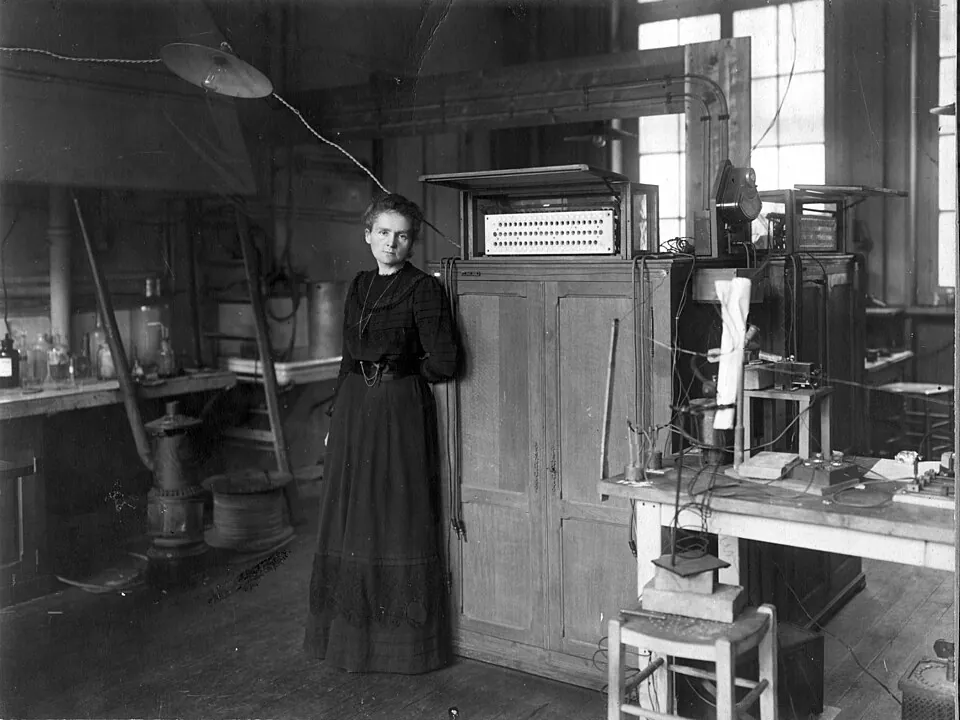
In 1896 the French physicist Henri Becquerel left some uranium salts on a wrapped photographic plate in a drawer. When he developed the plate, it was fogged, as if it had been exposed to light. The uranium was giving out invisible rays on its own, without any energy being put in. Marie Curie named this radioactivity. With Pierre Curie she showed it came from the atoms themselves, not from any chemical reaction, and she discovered two new radioactive elements, polonium and radium. She was the first woman to win a Nobel Prize, and is still the only person to win Nobel Prizes in two different sciences (Physics in 1903, Chemistry in 1911).
Nobody then knew radiation was dangerous. Curie carried radium in her pockets and kept it in her desk drawer, and she died in 1934 of a blood disease almost certainly caused by her long exposure. Her notebooks are still radioactive and are stored in lead-lined boxes.
Why some nuclei are unstable
A nucleus is held together by the strong nuclear force, which is pulling against the electric repulsion between protons. Only certain combinations of protons and neutrons are stable. A nucleus with too many neutrons, too few neutrons, or simply too many particles altogether is unstable. Sooner or later it changes into a more stable nucleus by throwing out a particle, energy, or both. This is called radioactive decay, and the particles and energy given out are nuclear radiation.
Decay happens inside the nucleus, so it is not affected by temperature, pressure or chemical reactions. Heating uranium or dissolving it in acid doesn't change how fast it decays. Isotopes that decay are called radioisotopes.
Alpha, beta and gamma
Rutherford found there were different kinds of radiation by seeing how far they travelled through materials and how they bent between charged plates. He named them after the first three letters of the Greek alphabet.
- Alpha (α) particles are 2 protons and 2 neutrons stuck together, the same as a helium nucleus. When a nucleus gives out an alpha particle, its atomic number goes down by 2 and its mass number by 4. Uranium-238 (92 protons) becomes thorium-234 (90 protons).
- Beta (β) particles are fast electrons made inside the nucleus when a neutron turns into a proton. The mass number stays the same but the atomic number goes up by 1. Carbon-14 (6 protons) becomes nitrogen-14 (7 protons).
- Gamma (γ) rays are not particles but high-energy electromagnetic waves, like X-rays but usually more energetic. A nucleus that is left with extra energy after alpha or beta decay gets rid of it as gamma. Gamma doesn't change the element.
So alpha and beta decay do something alchemists dreamed of: they turn one element into another. This is called transmutation.
Comparing the three types
| Alpha (α) | Beta (β) | Gamma (γ) | |
|---|---|---|---|
| What it is | 2 protons + 2 neutrons | Fast electron | Electromagnetic wave |
| Charge | +2 | −1 | 0 |
| Mass | 4 (heavy) | about 1/1840 (very light) | 0 |
| Ionising power | Very strong | Medium | Weak |
| Range in air | A few centimetres | Up to about a metre | Hundreds of metres, weakening with distance |
| Stopped by | A sheet of paper or the outer layer of skin | A few millimetres of aluminium | Reduced (never fully stopped) by thick lead or concrete |
| In an electric field | Bends towards − | Bends towards +, more strongly | Not bent |
All three are ionising radiation: they have enough energy to knock electrons out of atoms they hit, turning them into ions. In living cells this can break DNA. Alpha is the most ionising but can't get through skin, so alpha sources are most dangerous if they are swallowed or breathed in. Gamma is the least ionising but passes deep into the body.
- For each source, find the thinnest absorber that brings the count down to background.
- With the alpha source and no absorber, move the counter away. At what distance does the count drop to background?
- With the gamma source, double the distance. What happens to the count rate?
- Turn on the charged plates. Which way does each type bend, and why does beta bend more than alpha?
Background radiation
Radiation is all around us. This background radiation comes mainly from:
- Radon gas, which seeps out of rocks and soil containing uranium and can build up in poorly ventilated rooms
- Rocks and building materials, especially granite
- Cosmic rays from space (pilots and frequent flyers get more, because there is less air above them)
- Food and our own bodies: potassium-40 and carbon-14
- Medical procedures such as X-rays and CT scans
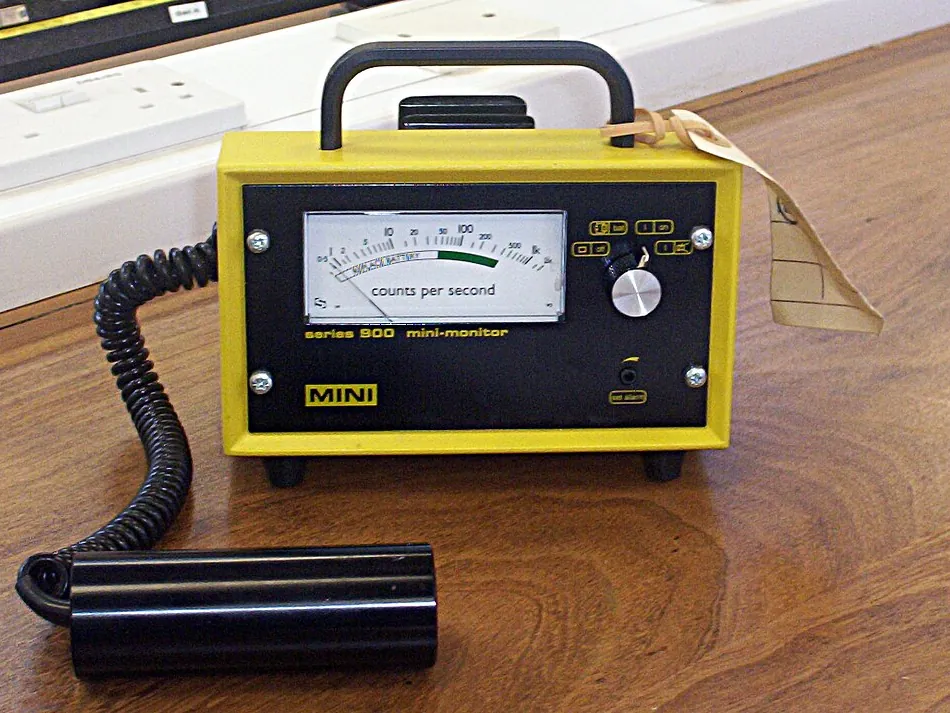
Radiation dose is measured in sieverts (Sv). The average Australian receives about 1.5 millisieverts a year from natural sources, which is lower than in many countries. Radiation is detected with a Geiger–Müller counter, which clicks each time radiation ionises the gas inside its tube, and people who work with radiation wear dosimeter badges to record their dose. In Australia, radiation safety is overseen by ARPANSA, the Australian Radiation Protection and Nuclear Safety Agency.
Test yourself
Which radiation is stopped by a sheet of paper?
Alpha particles are large and strongly ionising, so they lose energy fast.
When radium-226 (atomic number 88) gives out an alpha particle, it becomes
Mass number −4, atomic number −2.
In beta decay, inside the nucleus
So the atomic number goes up by 1.
Which radiation is not bent by an electric field?
Gamma has no charge.
Which is the largest source of natural background radiation for most people?
Phones, microwaves and power lines give out non-ionising radiation.
Label the penetration diagram.
Which type of radiation?
Radioactivity was discovered by in 1896. An unstable nucleus gives out radiation as it . Radiation that knocks electrons off atoms is called radiation. Radiation dose is measured in . Radiation is detected with a counter.
A school has an alpha source and a gamma source. Explain why the alpha source is stored in a thin plastic box but the gamma source is kept in a thick lead container, and why the alpha source would still be dangerous if it were swallowed.
Alpha particles have very low penetrating power: they are stopped by a sheet of paper or a few centimetres of air, so a thin plastic box is enough to absorb them. Gamma rays are highly penetrating electromagnetic waves that pass through plastic and even thin metal, so the source has to be kept in thick lead, which is dense enough to absorb most of the rays (though never all of them). If the alpha source were swallowed, there would be nothing between it and living cells. Alpha particles are the most strongly ionising type of radiation, so they would knock electrons off atoms in nearby cells, damaging DNA and possibly causing cancer.