 Coaching Centre
Reflection, refraction and lenses
The law of reflection, images in plane mirrors, concave and convex mirrors, why light bends when it changes speed, refractive index, total internal reflection and optic fibres, convex and concave lenses, the eye and glasses, and spearfishing in shallow water.
Look down at your legs in a swimming pool and they seem short and stumpy. A straw in a glass of water looks broken. A spearfisher who aims straight at the fish they can see will miss every time. Light bends when it crosses from water into air, and your brain is fooled because it assumes light always travels in straight lines.
The law of reflection
Light travels in straight lines called rays. When a ray hits a surface, we measure angles from the normal, an imaginary line at 90° to the surface where the ray strikes it.
angle of incidence = angle of reflection
The incident ray, the reflected ray and the normal all lie in the same flat plane. Smooth, shiny surfaces such as mirrors and still water give regular (specular) reflection: parallel rays stay parallel, so you see a clear image. Rough surfaces such as paper give diffuse reflection: every tiny bump has a different normal, so light scatters in all directions. The law still holds at every point, but no image forms.
The image in a plane (flat) mirror is:
- the same size as the object and upright
- the same distance behind the mirror as the object is in front
- laterally inverted (left and right are swapped), which is why AMBULANCE is printed backwards on the front of ambulances
- virtual: the light only seems to come from behind the mirror, so the image can't be caught on a screen.
Curved mirrors
Curved mirrors still obey the law of reflection at every point, but the normal points in a different direction across the surface.
- A concave mirror curves inwards like a cave. It converges parallel rays to a focal point. It is used in torches and car headlights (a bulb at the focus sends out a parallel beam), shaving and make-up mirrors (magnifying when close), reflecting telescopes, solar concentrators and satellite dishes (which focus microwaves, not light).
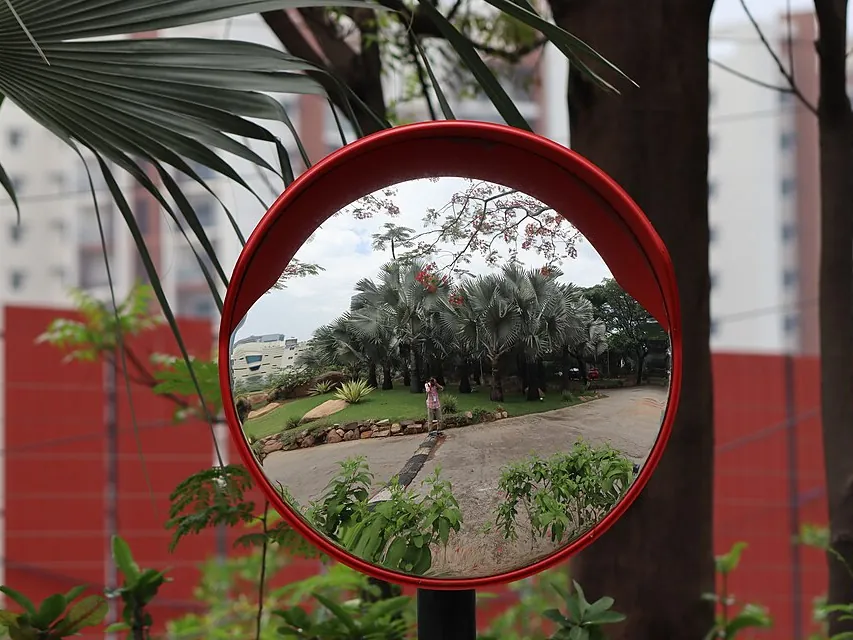
- A convex mirror bulges outwards. It diverges rays, giving a smaller image of a much wider area. It is used for blind corners on driveways, in shops and as car side mirrors ("objects in mirror are closer than they appear").
Refraction: light changes speed
Light travels at 300 000 km/s in a vacuum, but more slowly in transparent materials. When light crosses into a new material at an angle, the change in speed makes it change direction. This is refraction.
- Going into a material where light is slower (air to glass), the ray bends towards the normal.
- Going into a material where light is faster (glass to air), the ray bends away from the normal.
- A ray that hits the boundary along the normal (at 0°) changes speed but doesn't change direction.
Think of a shopping trolley rolling at an angle from smooth concrete onto grass. The wheel that hits the grass first slows down first, so the trolley swings round. A material in which light travels more slowly is said to be optically denser. This has nothing to do with how much light gets through it: diamond is optically much denser than water but just as clear.
The refractive index (n) tells you how many times slower light travels in a material than in a vacuum.
refractive index = speed of light in a vacuum ÷ speed of light in the material
n = c ÷ v
| Material | Refractive index | Speed of light (km/s) |
|---|---|---|
| Vacuum | 1 exactly | 300 000 |
| Air | 1.0003 | about 300 000 |
| Water | 1.33 | 226 000 |
| Perspex (acrylic) | 1.49 | 201 000 |
| Crown glass | 1.52 | 197 000 |
| Diamond | 2.42 | 124 000 |
The bigger the refractive index, the more the light bends. Different colours have slightly different refractive indices (violet bends most, red least), which is how a prism or raindrops separate white light into a rainbow. This is called dispersion.
Refraction is why water looks shallower than it is: light from the bottom bends away from the normal as it leaves the water, and your brain traces the ray straight back to a point that is too high. Spearfishers, including First Nations fishers in rivers, reefs and tidal flats around Australia who have practised the skill for thousands of years, learn to aim below the fish they see, and to stand as nearly above it as they can, where the bending is smallest.
Total internal reflection and optic fibres
When light passes from glass or water out into air, it bends away from the normal. As the angle of incidence increases, the refracted ray bends closer and closer to the surface. At the critical angle (about 41° for glass and 49° for water) it skims along the surface. At any angle bigger than that, no light escapes at all: it is all reflected back inside. This is total internal reflection (TIR). It only happens when light is going from a slower material into a faster one.
An optic fibre is a glass strand thinner than a hair, with a core surrounded by cladding of slightly lower refractive index. Light pulses hit the boundary at more than the critical angle and bounce along the core, even around gentle bends, losing very little energy over many kilometres. Infrared pulses in optic fibres carry nearly all the internet's data, including the undersea cables that link Australia to the rest of the world and the National Broadband Network. Doctors use bundles of fibres in endoscopes to see inside the body. Diamonds sparkle because their very high refractive index gives a small critical angle (about 24°), so light entering a cut diamond is reflected around inside many times before it escapes.
- Choose Plane mirror and change the angle of incidence. Check that the angle of reflection always matches.
- Choose Rectangular block. Does the ray bend towards or away from the normal on the way in? On the way out? Compare the incoming and outgoing rays.
- Switch the material from water to diamond at the same angle. Which bends the light most? Link this to the speed of light in each.
- Choose Semicircular block and slowly increase the angle until the ray no longer escapes. Record the critical angle for glass and for water. Which is smaller?
- Try the Convex lens and Concave lens, and change the focal length. Which lens brings the rays to a focus?
Perspex has a refractive index of 1.49. How fast does light travel through it?
n = c ÷ v, so v = c ÷ n.
v = 300 000 ÷ 1.49 = 201 000 km/s, about two-thirds of its speed in a vacuum.
A refractive index bigger than 1 must give a speed slower than in a vacuum. ✓
Lenses
A lens is a curved piece of transparent material that refracts light at both surfaces.
- A convex (converging) lens is thicker in the middle. It bends parallel rays inwards to meet at the focal point. The distance from the lens to this point is the focal length; a fatter, more curved lens has a shorter focal length. Convex lenses are used in magnifying glasses, cameras, projectors and your eye. Held far from an object, a convex lens forms a real, upside-down image that can be caught on a screen.
- A concave (diverging) lens is thinner in the middle. It spreads rays out as if they came from a focal point on the same side as the light. It always forms a smaller, upright, virtual image. It is used in glasses for short-sighted people and in door peepholes.
In your eye, most of the bending happens at the curved cornea; the flexible lens changes shape to fine-tune the focus so a sharp, upside-down image lands on the retina. Your brain turns it the right way up.
- Short-sighted (myopic) eyes focus light from distant objects in front of the retina. A concave lens spreads the light a little so it focuses further back. Short-sightedness is becoming much more common in children worldwide, and spending time outdoors in daylight appears to help protect against it.
- Long-sighted eyes focus light from near objects behind the retina. A convex lens adds extra bending.
Test yourself
A ray hits a plane mirror at 35° to the surface. The angle of reflection is
The angle of incidence is 90° − 35° = 55° from the normal, so the angle of reflection is also 55°.
Light passes from air into water at an angle. It
Water has a higher refractive index, so light slows and bends towards the normal.
Light travels at 124 000 km/s in diamond. Its refractive index is about
n = 300 000 ÷ 124 000 = 2.42.
The mirror used on a blind corner of a driveway is
A convex mirror diverges light and shows a smaller image of a wide area.
For total internal reflection to happen, light must
TIR needs a slower-to-faster boundary and an angle bigger than the critical angle.
Label the reflection diagram.
Sort each example by the main effect causing it.
Angles in optics are measured from the . Light bends when it changes . The image in a plane mirror is and laterally inverted. Short-sighted people wear lenses. Optic fibres use to carry light.
A student shines a ray of light into a semicircular glass block, aimed at the centre of the flat side. Describe and explain what happens to the ray leaving the flat side as the angle of incidence is increased from 0° to 60°. (The critical angle for glass is about 41°.)
The ray enters the curved side along a radius, so it meets that surface along the normal and does not bend going in. At the flat side it goes from glass into air. At 0° it passes straight out without bending. At small angles it bends away from the normal as it leaves, because light speeds up when it goes from glass (n = 1.52) into air, and a weak reflected ray is also seen inside. As the angle increases, the refracted ray bends closer and closer to the flat surface and the reflected ray gets brighter. At the critical angle of about 41° the refracted ray runs along the surface. Above 41° no light leaves at all: it is totally internally reflected back into the glass, with the angle of reflection equal to the angle of incidence.