 Coaching Centre
Heat transfer and insulation
A particle explanation of conduction, convection and radiation, why trapped air insulates, how heat escapes from a house, eaves, thermal mass and double glazing, heat pumps, and how First Nations peoples kept warm with possum-skin cloaks and stone houses.
On a cold night, about a third of the heat you pay for escapes through the ceiling, and a big share of the rest leaks out through windows and gaps around doors. A well-insulated house can stay comfortable using a quarter of the energy of a leaky one. Where does the heat go, and how do you stop it?
Heat flows from hot to cold
The particles in every object are always moving. The faster they move, the higher the temperature. Heat is thermal energy moving from a hotter place to a colder one, and it keeps flowing until both are at the same temperature. It never flows the other way by itself. "Cold" is not something that gets in; it is just heat getting out.
In Year 8 you met the three ways heat moves. Here is what the particles are doing in each.
- Conduction: hot, fast-vibrating particles bump into their neighbours and pass on energy, particle to particle, while staying in place. It works best in solids, where particles are packed tightly. Metals are by far the best conductors because they also have free electrons that zip through the metal carrying energy with them.
- Convection: in a liquid or gas, the warm part expands, becomes less dense and rises; cooler, denser fluid sinks to take its place. This sets up a convection current that carries energy as the fluid itself moves. It can't happen in a solid.
- Radiation: every object gives off infrared radiation, and hotter objects give off much more. Infrared is an electromagnetic wave (6C), so it needs no particles at all and can cross a vacuum. Dark, matt surfaces absorb and emit it well; light, shiny surfaces reflect it.
| Material | How well it conducts heat (copper = 100) |
|---|---|
| Copper | 100 |
| Aluminium | 59 |
| Steel | 13 |
| Glass | 0.25 |
| Brick | 0.18 |
| Water | 0.15 |
| Wood | 0.03 |
| Glasswool batts | 0.01 |
| Still air | 0.006 |
Still air is one of the worst conductors there is, so most insulators work by trapping air in tiny pockets so it can't move and set up convection currents. Fur, feathers, wool, foam, glasswool batts and the air gap in double glazing all use this trick.
How a house loses heat
- Through the ceiling and roof. Warm air rises by convection and heat conducts through the plasterboard into the roof space. Batts laid over the ceiling cut this loss by about 90%.
- Through walls. Brick veneer and timber walls conduct heat. Batts inside the wall cavity help a lot.
- Through windows. Glass is thin, so heat conducts through it quickly. Double glazing traps a layer of still air or argon between two panes. Thick curtains with a pelmet on top stop warm air sinking down cold glass and spilling into the room (a convection current).
- Through gaps (draughts). Warm air leaks out around doors, windows, exhaust fans and downlights, and cold air is sucked in. Sealing gaps is the cheapest fix of all.
- Through the floor, especially a timber floor over an open, breezy space.
Engineers describe how fast heat flows through a part of a building with its U-value: the number of watts that flow through each square metre for every 1 °C of temperature difference.
heat flow (W) = U-value × area (m²) × temperature difference (°C)
A living room has 6 m² of windows. It is 20 °C inside and 5 °C outside. Single glazing has a U-value of 5.8 W/m²/°C; double glazing has 2.9. How much heat escapes through the glass each second in each case?
20 − 5 = 15 °C.
5.8 × 6 × 15 = 522 W, about the same as a small heater running flat out just to replace it.
2.9 × 6 × 15 = 261 W. Halving the U-value halves the heat loss.
Designing a house for the Australian climate
Good design keeps a house cool in summer and warm in winter with little or no heating. In the southern hemisphere the Sun sits in the northern sky, so living areas with big windows should face north.
- Eaves of the right width block the high summer Sun but let in the low winter Sun.
- Thermal mass, such as a concrete slab, brick or rammed earth wall, soaks up heat during the day and releases it slowly at night. It works best where days are hot and nights are cool, as in much of inland Australia.
- Light-coloured roofs reflect sunlight, so the roof space stays cooler in summer.
- Cross-ventilation (windows on opposite sides) lets cool breezes flush hot air out on summer evenings.
Since the 2022 update to the National Construction Code, most new homes must reach a 7-star energy rating out of 10 (in NSW this is checked through BASIX). A 7-star home needs roughly a quarter less heating and cooling than the old 6-star standard.
Heating smarter: heat pumps
A plug-in electric heater turns every joule of electricity into a joule of heat. A reverse-cycle air conditioner is a heat pump: it uses electricity to pump heat that already exists in the cold outside air into the house, the same way a fridge pumps heat out of its cabinet. A good one moves 3 to 5 joules of heat into the room for every joule of electricity it uses, so it costs a quarter to a third as much to run. Heat pump hot water systems work the same way.
- With everything off, set inside to 20 °C and outside to 6 °C. Which part of the house loses the most heat? What does a winter of heating cost?
- Switch on one improvement at a time. Which single change saves the most money? Which saves the least?
- Turn on all five improvements. By what fraction has the heater power fallen?
- Now swap the panel heater for reverse-cycle air con. Explain why the cost falls again even though the house loses the same amount of heat.
- Set inside to 18 °C instead of 22 °C. Why does turning the thermostat down a few degrees make such a big difference?
Keeping warm on Country
Winters in south-eastern Australia can be bitterly cold, and First Nations peoples developed effective ways of keeping heat in long before modern insulation.
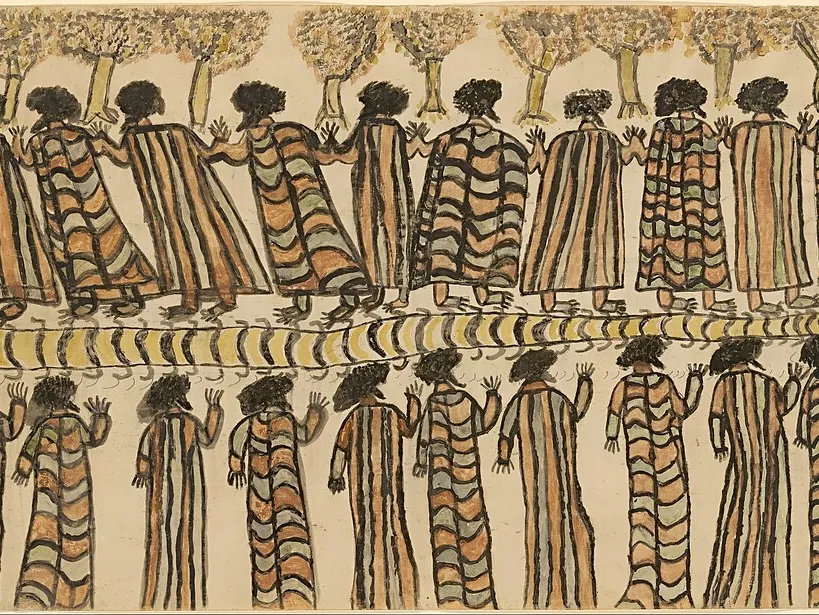
- Possum-skin cloaks were made by peoples across what is now Victoria and southern New South Wales. Dozens of pelts were scraped, stretched and stitched together with kangaroo-tendon thread, then worn fur-side in. The dense fur traps a thick layer of still air, and the skin blocks wind, so the cloak cuts both conduction and convection. Designs incised into the skin side told of the wearer's Country and identity. A child's cloak was added to as they grew, and a person could be buried in theirs. Communities are reviving the practice today.
- At Budj Bim, in Gunditjmara Country in south-west Victoria, people built circular stone house bases with domed roofs of timber, bark and turf, close to the eel traps that supported permanent villages. Thick stone and earth make good thermal mass and windbreaks. Budj Bim was World Heritage listed in 2019.
- Across Australia, shelters such as the gunyah or mia-mia were placed and shaped with their backs to the prevailing wind, and small fires kept going inside or at the entrance radiated heat onto sleepers.
Other cold-climate peoples use the same physics. Inuit snow houses are built from blocks of compacted snow, not solid ice. Snow is mostly trapped air, so it is a good insulator, and body heat plus a small lamp can keep the inside many degrees above the outside temperature.
Test yourself
Metals conduct heat much better than other solids mainly because
Free electrons move through the metal carrying energy as well as passing it by collisions.
Which is the only way heat can cross a vacuum?
Radiation is an electromagnetic wave and needs no particles. That's how the Sun's energy reaches Earth.
Double glazing reduces heat loss mainly because
The trapped air or argon layer is the real insulator.
A wall of area 20 m² has a U-value of 0.5 W/m²/°C. It is 21 °C inside and 1 °C outside. The heat flow through it is
0.5 × 20 × (21 − 1) = 200 W.
A reverse-cycle air conditioner can deliver 4 kJ of heat for every 1 kJ of electricity because it
A heat pump moves heat; energy is still conserved, because the extra 3 kJ comes from the outside air.
Label where heat escapes from the house.
Sort each example by the main way heat is transferred.
Most insulators work by trapping still . In convection, warm fluid is less so it rises. All objects give off radiation. In the southern hemisphere, living-room windows should face , shaded by in summer. Possum-skin cloaks were worn with the on the inside.
A family in Canberra spends a lot on heating. Recommend three changes to their house or heating, and explain how each one saves energy using the ideas of conduction, convection or radiation.
First, lay insulation batts over the ceiling. Warm air rises by convection to the ceiling, and heat then conducts through the thin plasterboard into the roof space. Batts trap air in tiny pockets; still air is a very poor conductor and cannot form convection currents, so heat loss through the ceiling falls by about 90%. Second, seal gaps around doors and windows. Draughts let warm air escape and cold air in by convection, so sealing them keeps the warm air inside. Third, replace the electric panel heater with a reverse-cycle air conditioner. It is a heat pump that moves existing heat from the outside air into the house, delivering about 4 J of heat for every 1 J of electricity, so the same warmth costs about a quarter as much. Heavy curtains with pelmets over the windows would also help by trapping air against the glass and stopping a cold convection current spilling off the panes.