 Coaching Centre
Volcanoes
Where magma comes from, how silica and gas control whether an eruption is gentle or explosive, shield and composite volcanoes, hotspots such as Hawaiʻi, and the hazards and benefits of volcanoes, with recent eruptions including Hunga Tonga–Hunga Haʻapai.
On 15 January 2022 the undersea volcano Hunga Tonga–Hunga Haʻapai exploded. Its plume reached 57 km high, the tallest ever measured. The pressure wave circled the globe several times and was picked up by weather stations across Australia, and its tsunami reached as far as Peru, where two people drowned.
Where magma comes from
The mantle is solid, so something has to happen to melt it. There are three main ways:
- Less pressure. When hot mantle rises, at a mid-ocean ridge or in a hotspot plume, the pressure on it drops and some of it melts. Most of the Earth's magma forms this way, almost all of it under the sea.
- Added water. At a subduction zone the sinking plate carries water down with it. At about 100 km depth the water is released into the hot mantle above, which lowers its melting point and makes magma. This is why there is a chain of volcanoes parallel to every ocean trench.
- Added heat. Hot magma rising into the crust can melt the surrounding crust, making magma richer in silica.
Magma is less dense than the solid rock around it, so it rises and collects in a magma chamber a few kilometres below the surface. When it erupts it is called lava.
Gentle or explosive?
Two things mostly decide how a volcano erupts:
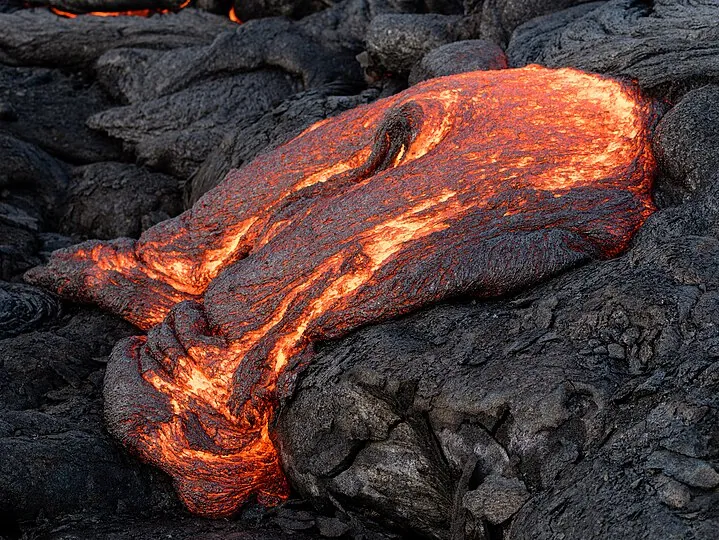
- Silica (SiO2) content. Silica forms chains in the melt, which makes it viscous (thick and sticky). Basalt magma (about 50% silica) is runny, like warm honey. Andesite (about 60%) is stickier, and rhyolite (above 70%) is so stiff it barely flows.
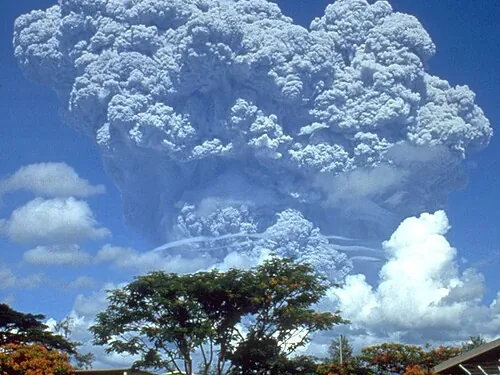
- Gas content. Magma contains dissolved water vapour, carbon dioxide and sulfur dioxide, like the gas in a closed soft drink. As magma rises the pressure drops and the gas comes out as bubbles. In runny magma bubbles escape easily. In sticky magma they are trapped until they blast the magma apart into ash and pumice.
Scientists compare the size of explosive eruptions using the Volcanic Explosivity Index (VEI), from 0 (gentle lava flows) to 8 (super-eruptions). Like earthquake magnitude, each step is about 10 times more material erupted.
| Shield volcano | Composite volcano (stratovolcano) | |
|---|---|---|
| Magma | Basalt, low silica, runny | Andesite or rhyolite, high silica, sticky |
| Eruptions | Gentle lava fountains and long lava flows | Explosive, with ash clouds and pyroclastic flows |
| Shape | Wide with gentle slopes | Steep cone of lava and ash layers |
| Where | Hotspots and ridges | Above subduction zones |
| Examples | Mauna Loa and Kīlauea (Hawaiʻi); the volcanoes of western Victoria | Mt Fuji; Mt Ruapehu; Mt Pinatubo |
A cinder cone is a smaller, steep hill of loose fragments built in one short eruption. A caldera is a huge hollow left when the ground collapses into an emptied magma chamber after a giant eruption. Lake Taupō in New Zealand fills a caldera from an eruption about 25 500 years ago.
- Choose the Basalt (Hawaiʻi) preset and erupt it several times. What shape of volcano builds up?
- Now try Rhyolite (Taupō). How does the eruption and the explosivity (VEI) change?
- Keep the silica low and increase only the gas. Can runny magma ever be very explosive?
- Find the lowest silica that gives a VEI of at least 3 with the most gas.
Where volcanoes are
About three-quarters of the active volcanoes on land are around the edge of the Pacific, the Ring of Fire, above subduction zones. Others are at divergent boundaries such as Iceland and the East African Rift. A few, such as Hawaiʻi, are in the middle of plates above hotspots, where a plume of hot mantle rises from deep below.
Lava on the island of Kauaʻi is about 5.1 million years old. Kauaʻi is about 510 km north-west of Kīlauea, which is erupting above the hotspot today. How fast is the Pacific Plate moving?
510 km ÷ 5.1 million years = 100 km per million years.
100 km per million years = 100 mm per year = 10 cm a year towards the north-west.
GPS measures the Pacific Plate near Hawaiʻi moving about 7 cm a year today. The answer is close; the plate's speed and the hotspot itself have changed a little over time.
Hazards and benefits
The dangers of eruptions include:
- Pyroclastic flows: avalanches of hot gas, ash and rock moving faster than 100 km/h. They are the deadliest hazard.
- Lahars: mudflows of ash mixed with water from rain, rivers or melting snow. A lahar from Mt Ruapehu's crater lake destroyed a rail bridge at Tangiwai in 1953, killing 151 people.
- Ash: it collapses roofs, ruins crops and damages jet engines. Ash from Chile's Puyehue–Cordón Caulle eruption in 2011 circled the Southern Hemisphere and grounded flights across southern Australia and New Zealand.
- Lava flows: they are slow enough to walk away from, but destroy what they cover. Kīlauea's 2018 eruption destroyed about 700 homes.
- Tsunamis and gases: most of the roughly 36 000 deaths from Krakatau in 1883 were caused by tsunamis.
Volcanoes also help people. Weathered volcanic rock makes some of the most fertile soils on Earth, such as the red soils of the Atherton Tableland and western Victoria. Geothermal power stations in New Zealand use underground heat to produce about a fifth of its electricity. Volcanic rocks provide building stone, and many valuable ores of copper and gold formed from hot fluids around magma.
Test yourself
Which magma gives the most explosive eruptions?
Sticky, gas-rich magma traps bubbles until they blast it apart.
Why are there volcanoes above subduction zones?
Added water makes the hot mantle melt.
Hawaiʻi's islands get older towards the north-west because
Each volcano is carried away from the plume.
A lahar is
Lahars can travel tens of kilometres down valleys.
Label the two volcanoes.
Sort the features.
Melted rock underground is called ; once it erupts it is . Magma with a lot of is thick and sticky, or . A chain of islands that get older in one direction forms as a plate moves over a .
Mt Ruapehu in New Zealand erupts explosively, but Kīlauea in Hawaiʻi usually erupts gently. Explain the difference.
Ruapehu is above the subduction zone where the Pacific Plate sinks under the Australian Plate. Its andesite magma has about 60% silica, which makes it viscous. Gas dissolved in the magma comes out of solution as it rises but cannot escape easily from the sticky magma, so pressure builds until the magma is blasted apart into ash, giving explosive eruptions. Kīlauea is above a hotspot in the middle of the Pacific Plate. Its basalt magma has only about 50% silica, so it is runny and gas bubbles escape easily, and the magma flows out gently as lava.