 Coaching Centre
Detecting and responding to stimuli
Types of receptors, why humans have more than five senses, how the eye, ear, tongue, nose and skin detect stimuli, the two-point touch test, electroreception in the platypus, and how plants respond without a nervous system.
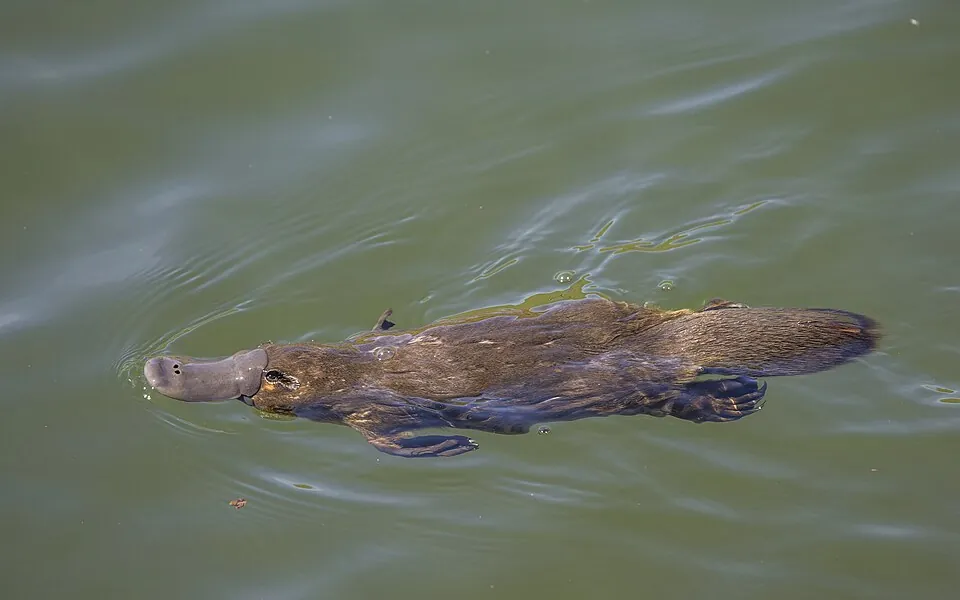
A platypus hunts with its eyes, ears and nostrils shut tight. It sweeps its bill from side to side through the mud at the bottom of a creek and finds yabbies and insect larvae by sensing the tiny electric fields made by their muscles. Its bill has about 40 000 electroreceptors. You don't have a single one.
Receptors
Every response starts with a receptor, a cell or group of cells that detects a particular kind of stimulus and turns it into nerve impulses. Sense organs such as the eye and ear are packed with receptors, with other tissues that help them work.
| Type of receptor | Detects | Found in |
|---|---|---|
| Photoreceptors | Light | Retina of the eye |
| Mechanoreceptors | Touch, pressure, vibration, sound, stretch, movement | Skin, ear, muscles, blood vessels |
| Chemoreceptors | Chemicals | Tongue, nose, blood vessels (which check CO₂ in the blood) |
| Thermoreceptors | Heat and cold | Skin, hypothalamus |
| Pain receptors | Damage, or things likely to cause it | Almost every tissue except the brain itself |
Receptors only detect. You don't see with your eyes or hear with your ears; you see and hear with your brain, which makes sense of the impulses. That is why optical illusions work, and why a blow to the back of the head can make you "see stars".
More than five senses
The old list of five senses (sight, hearing, taste, smell, touch) leaves a lot out. As well as these, you can sense:
- balance and acceleration, from the inner ear
- proprioception, knowing where your body parts are without looking, from stretch receptors in your muscles and joints. Close your eyes and touch your nose: that's proprioception.
- temperature and pain, which use different receptors from touch
- internal states such as hunger, thirst, a full bladder and your heartbeat.
Scientists still argue about the exact number, but it is more than five.
The eye
- The cornea is the clear window at the front. Because it is curved, it does most of the bending of light.
- The iris is the coloured ring of muscle. It changes the size of the pupil, the hole that lets light in: small in bright light, wide in the dark. This is the pupil reflex (4B).
- The lens fine-tunes the focus. Muscles change its shape: fatter for close objects, thinner for distant ones.
- The retina is the light-sensitive layer at the back. It has about 120 million rods, which work in dim light but only see in shades of grey, and about 6 million cones, which need brighter light and detect colour. There are three types of cone, most sensitive to red, green and blue light.
- The optic nerve carries impulses to the occipital lobe. Where it leaves the eye there are no receptors at all, so you have a blind spot in each eye. Your brain fills in the gap so you never notice.
The image on the retina is upside down. The brain learns to interpret it the right way up.
Ears, tongue and nose
Hearing. Sound waves make the eardrum vibrate. Three tiny bones pass the vibrations to the cochlea, a coiled tube full of liquid, where about 15 000 hair cells turn them into impulses. Loud noise can bend and kill these hair cells, and they do not grow back, so noise damage is permanent. Ear infections are also a big problem: many First Nations children, especially in remote communities, have repeated middle ear infections (otitis media) that cause hearing loss during the years they are learning to talk and read. Hearing checks and early treatment in schools and clinics are an important part of closing that gap.
Balance. Next to the cochlea are three fluid-filled semicircular canals at right angles to each other. When your head turns, the fluid lags behind and bends hair cells, telling your brain which way you are moving. Spin around and stop suddenly, and the fluid keeps swirling, which is why you feel dizzy.
Taste and smell. Taste buds on the tongue have chemoreceptors for five basic tastes: sweet, sour, salty, bitter and umami (savoury). Every part of the tongue can detect all five; the "tongue map" in old textbooks is a myth. Most of what we call flavour is actually smell. Your nose has around 400 types of smell receptor, which together can tell apart a huge number of odours. That's why food tastes bland when you have a blocked nose.
Touch
Your skin contains several kinds of touch and pressure receptors, but they are not spread evenly. Fingertips and lips are packed with them; your back has very few. You can measure this with a two-point test: touch the skin with two points close together and find the smallest gap that still feels like two separate points. The more receptors there are, the smaller that gap. Areas with many receptors also have a bigger share of the parietal lobe devoted to them.
- Choose the fingertip. Start with a big gap and make it smaller until the volunteer feels only one point. Record that threshold.
- Test every spot. Which has the smallest threshold, and which the largest?
- Show the real values and compare them with yours. Why would results from one volunteer not be enough to draw a conclusion?
- Suggest why it is useful for the fingertips and lips to be so sensitive.
Senses in other living things
Other animals detect stimuli we can't. Bees and many birds see ultraviolet light, which shows patterns on flowers invisible to us. Sharks and rays, like the platypus, have electroreceptors. Bats and dolphins use echolocation: they make high-pitched clicks and listen for the echoes. Many migrating birds can sense Earth's magnetic field.
Plants have no nervous system, but they still respond to stimuli, mostly by growing in a particular direction. You met these tropisms in Year 8: shoots grow towards light and roots grow downwards with gravity, controlled by plant hormones such as auxin. Some plants respond faster. The leaves of the sensitive plant (Mimosa pudica) fold up within seconds of being touched, as water rushes out of cells at the base of each leaflet. A Venus flytrap snaps shut when an insect touches two of its trigger hairs, using electrical signals that travel across the leaf.
Test yourself
Which part of the eye contains the photoreceptors?
Rods and cones are in the retina.
Which type of receptor detects sound?
Sound is vibration, which bends hair cells in the cochlea.
Why can you tell two pencil points apart on your fingertip but not on your back?
Densely packed receptors give a small two-point threshold.
The platypus finds prey underwater mainly by detecting
Electroreceptors in the bill detect tiny electric fields.
Label the parts of the eye.
Which type of receptor detects each stimulus?
The coloured muscle that controls the size of the pupil is the . Colour is detected by in the retina. Impulses from the eye travel along the nerve. Balance is detected by the canals in the inner ear. Knowing where your limbs are without looking is called .
When you walk from bright sunlight into a dark cinema, at first you can see almost nothing, but after a few minutes you can see the seats, though not their colours. Explain these observations.
In bright sunlight the iris has made the pupil small to protect the retina, so when you first enter the cinema very little light gets in. The pupil reflex then widens the pupil to let in more light. Over the next few minutes the rods in the retina also become far more sensitive to dim light. Rods only detect light and dark, not colour. The cones, which detect colour, need much brighter light to work, so in the dim cinema you see the seats in shades of grey.