 Coaching Centre
Nerve cells and the nervous system
Why multicellular organisms need coordination, the structure of a neuron, sensory, motor and interneurons, how impulses travel and cross synapses, myelin and multiple sclerosis, and the divisions of the nervous system.
A single nerve cell can be more than a metre long. One runs from the base of your spine all the way to your big toe. Messages race along cells like this at up to about 120 metres per second, faster than a Formula 1 car, and your brain alone holds roughly 86 billion of them.
Why bodies need coordination
A bacterium is one cell, so whatever happens to it happens to all of it. Your body is trillions of cells organised into tissues, organs and systems. Your muscles, heart, lungs and gut each have their own job, but they have to work together. When you sprint for a bus, your leg muscles need more oxygen, so your breathing and heart rate must rise at the same moment. Something has to carry messages around the body to make that happen.
Two systems do this job:
- the nervous system, which sends fast electrical messages along nerve cells to exact places
- the endocrine system, which releases chemical messengers called hormones into the blood (4D).
Both follow the same basic pattern. A stimulus (a change inside or outside the body) is detected by receptors. The message goes to a control centre, usually the brain or spinal cord, which decides what to do. Then a message goes to effectors, the muscles or glands that carry out the response.
stimulus → receptor → control centre → effector → response
The neuron
The nervous system is built from nerve cells called neurons. You met them in Year 7 as an example of a specialised cell. Here is how their shape suits the job.
- Dendrites are short branches that pick up messages from receptors or other neurons. Having lots of branches means one neuron can receive messages from thousands of others.
- The cell body holds the nucleus and most of the cell's organelles.
- The axon is a long thin fibre that carries the impulse away from the cell body, sometimes for a metre or more.
- Many axons are wrapped in a fatty myelin sheath. It insulates the axon, a bit like the plastic around a wire, and has small gaps along it. The impulse jumps from gap to gap, which makes it far faster.
- The axon terminals at the far end pass the message on to the next cell.
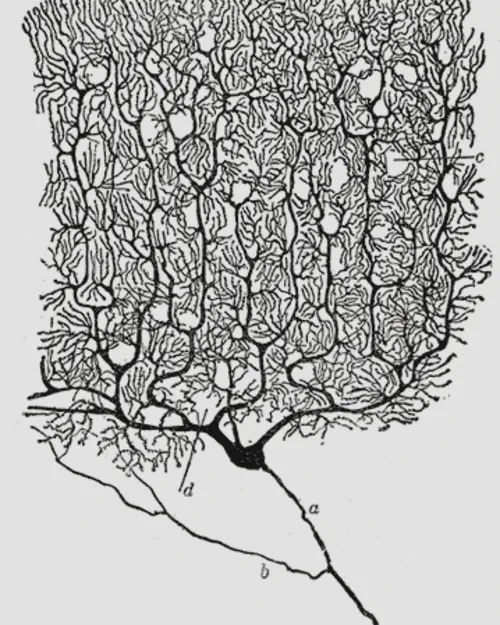
A nerve is not the same thing as a neuron. A nerve is a bundle of hundreds or thousands of axons wrapped together, like the cable that holds many separate wires.
Three types of neuron
| Neuron | Carries messages | Where it is |
|---|---|---|
| Sensory neuron | from receptors to the central nervous system | from the skin, eyes, ears and organs into the spinal cord or brain |
| Interneuron (relay neuron) | between other neurons | only inside the brain and spinal cord; most of your neurons are this type |
| Motor neuron | from the central nervous system to effectors | out to muscles and glands |
Notice that a motor neuron is not itself an effector. It carries the instruction; the muscle or gland that receives it is the effector. Some textbooks blur these two, so be careful in exam answers.
How an impulse travels
A nerve impulse is not electricity flowing along a wire. It is a wave of electrical change that passes along the membrane of the axon as charged particles (ions of sodium and potassium) rush in and out through tiny channels. Each patch of membrane triggers the next, so the impulse arrives at the far end just as strong as it started.
The speed depends on the axon:
- A thick axon with myelin can carry impulses at up to about 120 m/s.
- A thin axon without myelin might manage only 0.5–2 m/s. Slow, dull aching pain travels in fibres like these, which is why you feel a stubbed toe as a sharp jab followed a moment later by a throb.
Crossing the gap: synapses
Neurons don't actually touch. Between the axon terminal of one cell and the next cell there is a tiny gap called a synapse, about 20 nanometres wide. When an impulse arrives at the terminal, it releases chemicals called neurotransmitters. They diffuse across the gap and fit into receptor proteins on the next cell, starting a new impulse there. The neurotransmitter is then broken down or taken back up, so the signal switches off again.
Synapses make sure messages only travel one way, and they are where many drugs and toxins act. Caffeine, alcohol, anaesthetics and many medicines all work by changing what happens at synapses.
Divisions of the nervous system
The central nervous system (CNS) is the brain and spinal cord. It receives information, processes it and sends out instructions. Everything else is the peripheral nervous system (PNS): the 12 pairs of cranial nerves from the brain, the 31 pairs of spinal nerves, and all their branches. The PNS is divided by what it controls.
- The somatic nervous system controls skeletal muscles. These are the movements you can choose to make, such as kicking a ball or typing.
- The autonomic nervous system works automatically, controlling the heart, gut, glands and blood vessels. It has two parts that usually have opposite effects. The sympathetic division gets you ready for action ("fight or flight"): it speeds up the heart and slows digestion. The parasympathetic division calms things down again ("rest and digest").
- Fire an impulse along the myelinated axon, then the one with no myelin. Compare the "Time to travel 1 m" readings. How many times faster is the myelinated axon?
- Watch the close-up of the synapse. What crosses the gap, and what happens when it reaches the other side?
- Switch to damaged myelin and fire several impulses. What happens to some of them, and how would that affect a person?
- Turn on snake venom. The impulse still reaches the end of the axon, so why doesn't the muscle twitch?
When the system is damaged
Multiple sclerosis (MS) is a disease in which the body's own immune system attacks the myelin around neurons in the brain and spinal cord. Where the myelin is scarred, impulses slow down, get scrambled or stop. People with MS can have blurred vision, numbness, weakness and tiredness, and the symptoms often come and go. There is no cure yet, but modern medicines that calm the immune system can slow it down a lot.
Many Australian snakes, including taipans and tiger snakes, have venom containing neurotoxins. Some block the receptors on muscle cells so the neurotransmitter can't attach; others stop the nerve releasing neurotransmitter at all. Either way the muscles can't respond, and the bitten person can become paralysed, including the muscles used for breathing. The first aid you learn in Australia, a firm pressure bandage and keeping the person still, was developed in Melbourne in the 1970s. It slows the movement of venom through the lymph vessels until the person reaches hospital and antivenom.
Test yourself
Which part of a neuron carries the impulse away from the cell body?
The axon is the long fibre that carries impulses away from the cell body.
What is the main job of the myelin sheath?
Myelin insulates the axon, and impulses jump between the gaps in it.
A message travels from a heat receptor in your finger to your spinal cord. Which type of neuron carries it?
Sensory neurons carry messages from receptors to the CNS.
How does a message cross a synapse?
Neurotransmitter molecules diffuse across and bind to receptors on the next cell.
Which division of the nervous system speeds up your heart when you are frightened?
The sympathetic division prepares the body for action.
Label the parts of the neuron.
Which part of the nervous system does each job?
A nerve cell is called a . The gap between two nerve cells is a , and chemicals called carry the message across it. Impulses travel faster along axons covered in . The brain and spinal cord form the nervous system.
Multiple sclerosis damages the myelin sheath around neurons. Explain why this could make a person's movements slow and clumsy.
Myelin is a fatty layer that insulates the axon. Because impulses jump from one gap in the myelin to the next, they travel very quickly, up to about 120 m/s. When MS scars the myelin, impulses in those neurons slow down a lot, or leak away and stop. The motor neurons that carry instructions from the brain and spinal cord to the muscles then deliver them late or not at all, so muscles contract slowly, weakly or at the wrong moment. Sensory messages about where the limbs are can also be delayed, so the brain can't correct movements properly, and the person seems clumsy.