 Coaching Centre
History of the periodic table
How chemists from Lavoisier to Mendeleev, Moseley and Seaborg sorted the elements, how gaps in Mendeleev's table predicted new elements, and how the table was finished in 2016.
In 1871 a Russian chemist described an element no one had ever seen. He gave its atomic weight, its density, the formula of its oxide and even said it would be a grey metal. Fifteen years later a German chemist found it in a silver ore, and every prediction was close. The tool that made this possible was a table.
Before the table
People have used elements for thousands of years without knowing they were elements. Gold, silver, copper, iron, lead, tin, mercury, sulfur and carbon were all known in ancient times. Long before any list of elements was written, people everywhere sorted materials by how they behaved. Aboriginal people quarried the hard greenstone at Wil-im-ee Moor-ring (Mount William) in Victoria for axe heads, and those axes were traded hundreds of kilometres across south-eastern Australia, because experience had shown which stone held an edge best.
The first element discovered by a named person was phosphorus. In 1669 the German alchemist Hennig Brand boiled down huge amounts of urine looking for gold, and instead got a white substance that glowed in the dark.
By 1789 the French chemist Antoine Lavoisier had defined an element as a substance that cannot be broken down into anything simpler. His list had 33 "elements" sorted into gases, metals, non-metals and earths. Some were wrong (he included light and heat, and some were really compounds), but the idea of testing whether a substance could be broken down was a big step. Soon after, the Swedish chemist Jöns Jakob Berzelius measured many atomic weights and introduced the one- and two-letter symbols we still use.
Looking for patterns
As more elements were found, chemists noticed families that behaved alike.
- Döbereiner's triads (1829). Johann Döbereiner found groups of three similar elements where the middle one's atomic weight was close to the average of the other two. Chlorine (35.5) and iodine (126.9) average 81.2, and bromine, which sits between them in properties, is 79.9. Calcium, strontium and barium worked the same way.
- Newlands' law of octaves (1865). John Newlands listed the elements by atomic weight and saw that every eighth element seemed to repeat the properties of the first, like notes in a musical scale. The pattern broke down after calcium, and when he presented it in London one chemist asked whether he had tried listing the elements alphabetically. More than twenty years later the Royal Society gave him a medal for it.
Mendeleev's big idea
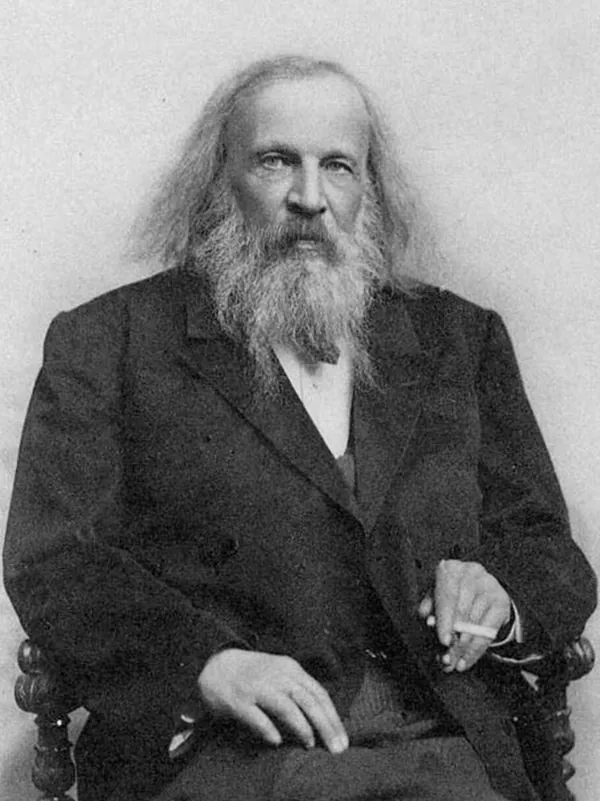
In 1869 Dmitri Mendeleev, a chemistry professor in St Petersburg, was writing a textbook and wanted a sensible order for the 63 elements then known. He wrote each element and its properties on a card and kept rearranging them. He put the elements in order of atomic weight, but he also put elements with similar properties in the same column, even when that meant breaking the order. Two decisions made his table different from everyone else's:
- He left gaps. Where the next element didn't fit the pattern, he left a space and said that an undiscovered element belonged there.
- He trusted properties over weights. Tellurium (127.6) is heavier than iodine (126.9), but iodine clearly behaves like chlorine and bromine. Mendeleev put iodine after tellurium anyway and suggested the weights had been measured wrongly. (They hadn't, but his placement was right. The reason came 44 years later.)
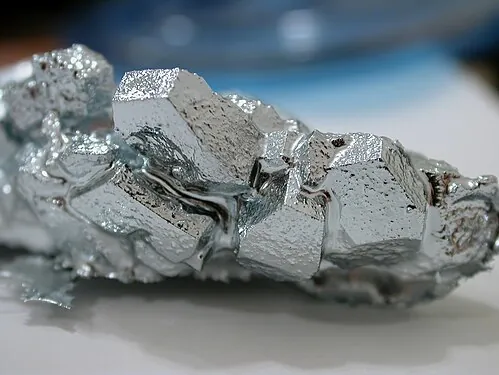
He named the missing elements by adding the Sanskrit word eka ("one") to the element above: eka-aluminium, eka-boron and eka-silicon. When gallium was found in 1875, its discoverer measured its density as 4.7 g/cm³. Mendeleev wrote to him saying it should be about 5.9. The sample was purified, measured again, and came out at 5.9. Germanium (1886) matched his eka-silicon even more closely.
| Property | Eka-silicon (predicted 1871) | Germanium (found 1886) |
|---|---|---|
| Atomic weight | 72 | 72.6 |
| Density | 5.5 g/cm³ | 5.3 g/cm³ |
| Colour | dark grey | greyish white |
| Oxide | EsO₂, density 4.7 g/cm³ | GeO₂, density 4.7 g/cm³ |
| Chloride | EsCl₄, a liquid boiling below 100 °C | GeCl₄, a liquid boiling at 86 °C |
Successful predictions are the strongest evidence a scientific idea can have. The German chemist Lothar Meyer had drawn up a similar table at almost the same time, but Mendeleev's predictions are why he is remembered as the table's inventor.
- Start with eka-silicon. Average the atomic weights above and below the gap, then the ones left and right. Are the two answers close?
- Do the same for density, then press Reveal. How close were you compared to Mendeleev?
- Scandium's real density is further from the prediction than its atomic weight. Why might density be harder to predict?
Filling in and fixing the table
A whole new group. In 1894 Lord Rayleigh and William Ramsay found that nitrogen taken from air was slightly denser than nitrogen made in the lab. The difference was a new, completely unreactive gas: argon. Ramsay went on to find helium on Earth (1895; it had already been spotted in the Sun's light in 1868), then neon, krypton and xenon in 1898. None of them fitted any existing column, so a new group was added on the right. These are the noble gases.
The right order. In 1913 the young English physicist Henry Moseley fired electrons at different metals and measured the X-rays they gave off. The X-ray frequency went up in neat, even steps from one element to the next, and he showed that each step was one extra positive charge in the nucleus. This number, the atomic number, is the real basis of the table. Ordering by atomic number puts tellurium (52) before iodine (53) without breaking any rule, and fixes the argon–potassium and cobalt–nickel pairs the same way. Moseley also showed exactly where elements were still missing: numbers 43, 61, 72 and 75. In 1915, aged 27, he was killed by a sniper at Gallipoli while serving as a signals officer, fighting alongside Australian and New Zealand troops.
Elements made, not found. Uranium (92) is the heaviest element found in useful amounts in nature. In 1940 Edwin McMillan and Philip Abelson made the first heavier element, neptunium (93), in a particle accelerator. A few months later Glenn Seaborg's team made plutonium (94). Seaborg went on to help make nine more elements, and in 1944 he suggested moving the actinoids (89 to 103) into a separate row under the table, the layout you see today. Element 106 was named seaborgium while he was still alive.
The table is complete, for now. In 2016 the last four gaps in period 7 were officially named: nihonium (113, from Nihon, Japan, where it was made), moscovium (115, Moscow), tennessine (117, Tennessee) and oganesson (118, after the Russian physicist Yuri Oganessian). Only a few atoms of each have ever existed, most lasting less than a second. Laboratories are now trying to make element 119, which would start an eighth row.
Test yourself
Why did Mendeleev leave gaps in his table?
He kept similar elements in the same column, so where nothing fitted he left a space for an element still to be found.
Moseley showed that the elements should be ordered by
His X-ray measurements showed each element has one more unit of nuclear charge than the one before: the atomic number.
Lithium (6.9) and potassium (39.1) form a triad with sodium. Döbereiner's rule predicts sodium's atomic weight is about
(6.9 + 39.1) ÷ 2 = 23.0. Sodium's real value is 22.99.
Which discovery forced chemists to add a whole new group to the table?
Argon and the other noble gases didn't fit any existing group.
Tellurium has a larger atomic weight than iodine but comes first in the table. This is correct because tellurium
Tellurium has 52 protons and iodine has 53. Tellurium is heavier only because its common isotopes have more neutrons.
Name the elements that filled Mendeleev's gaps.
Put these steps in the order they happened.
Mendeleev arranged the elements by atomic and put elements with similar in the same column. He predicted eka-silicon, which was later discovered and named . Moseley showed the true order is by atomic . Element 118 is called .
Explain why Mendeleev's periodic table was accepted by scientists over other arrangements of the elements at the time. Refer to specific evidence.
Other chemists such as Newlands had arranged elements by atomic weight, but their patterns broke down. Mendeleev put elements with similar properties in the same column even if this meant leaving gaps, and he said the gaps belonged to elements not yet discovered. He then predicted their properties. For eka-silicon he predicted an atomic weight of 72, a density of 5.5 g/cm³ and an oxide with formula EsO₂. When germanium was discovered in 1886 it had an atomic weight of 72.6, a density of 5.3 g/cm³ and formed GeO₂. Gallium (1875) and scandium (1879) also matched his predictions. A theory that correctly predicts things nobody knew yet is much more convincing than one that only describes known facts, so scientists accepted his table.