 Coaching Centre
Efficiency and energy resources
Following energy through a chain of transformations, multiplying efficiencies, why the grid uses very high voltages and transformers, Australia's changing electricity mix, cleaning up coal and the reality of carbon capture, the UNSW solar cell that conquered the world, storage, and First Nations clean energy.
Burn enough coal to release 100 joules of energy in a power station, send the electricity across the state, and light an old-style incandescent bulb with it. Less than 2 joules come out as light. Swap the coal for wind and the bulb for an LED, and the useful share of the energy leaving the turbine jumps more than twenty times.
Efficiency along a chain
In Year 8 you calculated the efficiency of a single device. Energy is never destroyed, but at every step some of it is transferred to the surroundings as heat (and sometimes sound) that we can't easily use.
efficiency (%) = useful energy out ÷ total energy in × 100
When energy passes through several devices one after another, the overall efficiency is found by multiplying the efficiencies (as decimals), not adding them. A chain is only as good as all its links together, so one inefficient step drags the whole chain down.
overall efficiency = efficiency₁ × efficiency₂ × efficiency₃ …
A black coal power station is 34% efficient. The transmission and distribution network delivers 92% of what it receives. An LED lamp turns 40% of its electrical energy into light.
0.34 × 0.92 × 0.40 = 0.125, so the overall efficiency is 12.5%.
Only 125 J ends up as light. The other 875 J heats the surroundings, mostly in the cooling towers of the power station.
With an incandescent bulb (5%): 0.34 × 0.92 × 0.05 = 0.016, just 1.6%. Switching to LEDs makes the whole chain eight times better without changing the power station.
For a wind turbine or solar panel, efficiency is still worth knowing (a more efficient panel needs less roof), but the "wasted" input is free sunlight or wind that produces no pollution. For coal and gas, every lost joule is fuel that was mined, paid for and burnt, releasing carbon dioxide.
- Start with the Black coal power station, Through the grid and the Old incandescent bulb. How many joules of light do you get from 1000 J of coal?
- Change only the device to the LED globe. By how many times does the light output increase?
- Compare the coal and gas power stations. Where is the biggest loss in each chain?
- Choose Reverse-cycle air con. How can the heat delivered be more than the electricity used? Where does the extra energy come from?
- Choose Solar panels with Used on site. Its efficiency is low, so why is it still a good choice for the environment?
Getting electricity to you
Power stations and wind and solar farms are often hundreds of kilometres from the cities that use their electricity. Long wires have resistance, so some energy is lost as heat. The power lost in the wires depends on the square of the current:
power lost (W) = current² × resistance of the line
P(lost) = I² R
Since P = V I, a power station can send the same power using a much higher voltage and a much smaller current. Ten times the voltage means one-tenth the current and only one-hundredth of the losses. That's why the grid uses transformers to step up the voltage to 330 000 V or 500 000 V on the big transmission towers, then step down through substations to 11 000 V in the street and finally 230 V in your house. Transformers only work with alternating current (AC), which is one reason the grid uses AC.
- Send 200 MW over 200 km at 330 kV. What percentage of the power is lost?
- Now try 132 kV and then 33 kV. What happens to the current, and to the losses?
- Doubling the voltage halves the current. By what factor does the loss change? Check it.
- Turn on Thicker wires. Why don't engineers just use very thick wires instead of high voltages?
- Increase the length to 500 km. Which voltage would you choose to connect a remote wind farm?
Australia's electricity is changing
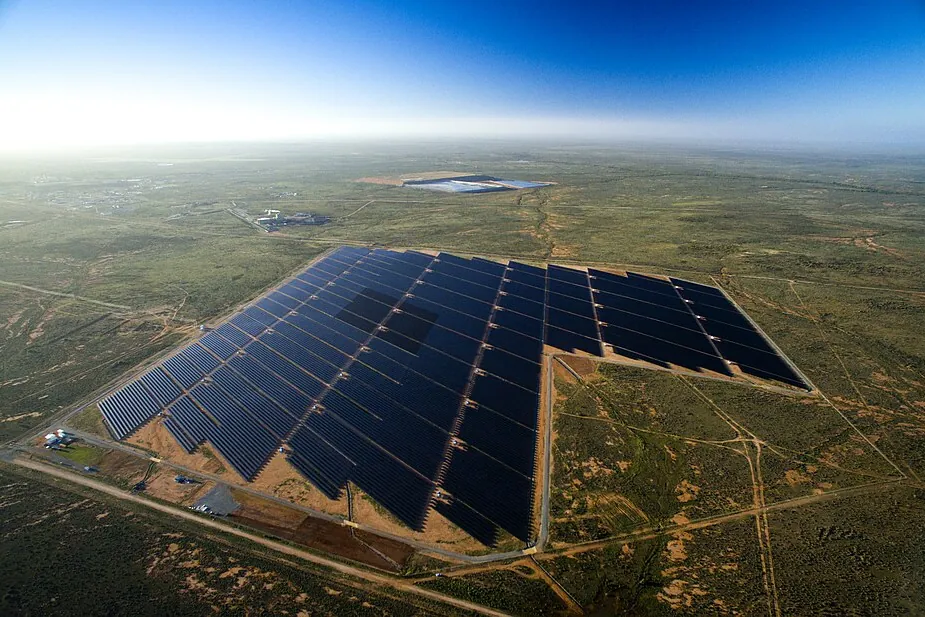
For most of the last century Australia made most of its electricity by burning coal. That is changing fast. Across the whole country in 2023–24, roughly 46% came from coal, about 17% from gas and about 35% from renewables (mostly rooftop and large-scale solar, wind and hydro), and the renewable share has kept rising since. On some sunny days the main eastern grid already runs on more than 70% renewable electricity for a few hours. More than one in three Australian houses has rooftop solar, one of the highest rates in the world. Ageing coal stations are closing: Liddell in the Hunter Valley shut in 2023, and Eraring near Lake Macquarie, the largest, is scheduled to close later this decade.
| Resource | Advantages | Disadvantages |
|---|---|---|
| Coal | Reliable output day and night; Australia has large reserves | Highest CO₂ emissions per kWh; air pollution (SO₂, NOₓ, particles); mining impacts; old stations break down more often |
| Gas | About half the CO₂ of coal; gas turbines can start in minutes to fill gaps | Still a fossil fuel; methane leaks from wells and pipes are a strong greenhouse gas; expensive |
| Solar PV | No fuel or emissions while running; panels are now very cheap; works on rooftops | No output at night and less in cloud; needs storage or other sources |
| Wind | No fuel or emissions; often blows at night and in winter, complementing solar | Variable; needs new transmission lines; visual and land-use concerns |
| Hydro and pumped hydro | Can switch on in minutes; pumped hydro stores energy for hours to days | Few suitable sites; dams flood land and change rivers; big projects are slow and costly |
| Nuclear | Very low CO₂; reliable output | Banned for power generation in Australia under federal law; long build times and high cost; radioactive waste |
Cleaning up coal, and the limits
When coal burns it releases carbon dioxide, sulfur dioxide and nitrogen oxides (which cause acid rain and smog) and fine particles. Power stations use several technologies to reduce the harm:
- Electrostatic precipitators give dust particles an electric charge, then collect them on oppositely charged plates. Fabric filters (baghouses) do a similar job.
- Wet scrubbers spray the waste gas with limestone and water to remove sulfur dioxide. (Australian coal is fairly low in sulfur, and most Australian stations don't have scrubbers.)
- Low-NOₓ burners limit oxygen in the flame to reduce nitrogen oxides.
None of these removes carbon dioxide. Carbon capture and storage (CCS) aims to collect CO₂ and pump it deep underground into old gas fields or porous rock. In practice it has struggled. The Gorgon gas project off Western Australia, the world's largest CCS project, has stored far less CO₂ than promised since it started in 2019. Ideas from the 2000s such as storing CO₂ in the deep ocean were abandoned (it would make the ocean more acidic and is restricted by international law), and no coal power station in Australia has ever captured its emissions. Plans to turn coal into gas (gasification) for "clean coal" stations were also dropped as solar and wind became cheaper.
An Australian invention in nearly every solar panel
Most solar panels sold worldwide today use the PERC solar cell (passivated emitter and rear cell) or designs that grew from it. It was developed at the University of New South Wales in the 1980s by a team led by Martin Green, with Andrew Blakers and others. Adding a special layer to the back of the cell reflects light that would have passed through back into the silicon and stops electrons being lost at the surface, raising efficiency. UNSW researchers held the world record for silicon cell efficiency for about 30 years, and many of their graduates went on to lead the solar industry in China, where most panels are now made. A typical rooftop panel is now about 21 to 23% efficient, up from around 12 to 15% in the early 2000s, and its price has fallen by about 90% in that time.
Storing energy for later
Because solar and wind are variable, a renewable grid needs storage:
- Big batteries such as the Hornsdale Power Reserve in South Australia (2017) respond within a fraction of a second to keep the grid stable, and many larger ones have been built since. Home batteries store rooftop solar for the evening.
- Pumped hydro uses spare electricity to pump water uphill, then lets it flow back down through turbines when needed. Snowy 2.0 in the Snowy Mountains is being built to store enough energy to power millions of homes for about a week, though it has been delayed and cost far more than first planned.
First Nations clean energy
Much of the land where new solar and wind farms and transmission lines will be built is subject to native title or is Aboriginal land. First Nations groups are pushing to make sure clean energy projects are developed with free, prior and informed consent, protect cultural heritage, and share the benefits. The First Nations Clean Energy Network was formed in 2021 to support community-owned and co-owned projects. Many remote communities that relied on expensive, polluting diesel generators now run partly on solar and batteries, which cuts costs and noise and gives communities more control over their own power.
Test yourself
A gas power station is 50% efficient, the grid is 90% efficient and an electric motor is 80% efficient. The overall efficiency is
0.50 × 0.90 × 0.80 = 0.36 = 36%.
If the voltage on a transmission line is doubled while sending the same power, the power lost in the line
The current halves, and loss = I² R, so loss falls to (½)² = ¼.
An electrostatic precipitator in a coal power station removes
It charges particles and collects them on oppositely charged plates.
Transformers on the grid
They step AC voltage up or down; power stays (almost) the same.
The PERC solar cell, now used in most solar panels, was developed at
Martin Green's team at UNSW developed it in the 1980s.
Label the stages of the electricity grid.
Put the steps in order, from coal to light in your bedroom.
Sort these approaches.
The overall efficiency of a chain is found by the efficiencies of each step. Wasted energy is mostly transferred as . Electricity is transmitted at voltage to reduce the and the energy lost. A changes the voltage.
A town is deciding whether to replace its ageing coal power station with a wind and solar farm plus a big battery. Evaluate this proposal, referring to efficiency, the environment, reliability and one social consideration.
A black coal station is only about 34% efficient, so around two-thirds of the energy in the coal is lost as heat, and every unit of fuel must be mined and paid for. Burning it releases carbon dioxide, which enhances the greenhouse effect, as well as sulfur dioxide, nitrogen oxides and particles that harm health. Wind turbines and solar panels convert less than half of their input energy into electricity, but the input is free and running them produces no emissions, so efficiency matters much less. The main weakness is reliability: solar produces nothing at night and wind varies. Combining wind and solar helps because wind often blows at night and in winter, and a big battery can cover short gaps within a fraction of a second, but it holds only a few hours of energy, so the town would still need a grid connection or other storage for long still, cloudy periods. Socially, coal workers would need retraining or new jobs, and the land used for the farms should be chosen in consultation with the community and any First Nations owners, who should share the benefits. Overall, the proposal is a good one as long as it includes enough storage and a grid connection for reliability and a plan for affected workers.