 Coaching Centre
Arranging electrons
Electron shells and energy levels, writing electron configurations for the first 20 elements, drawing shell diagrams, and explaining flame test colours and line spectra.
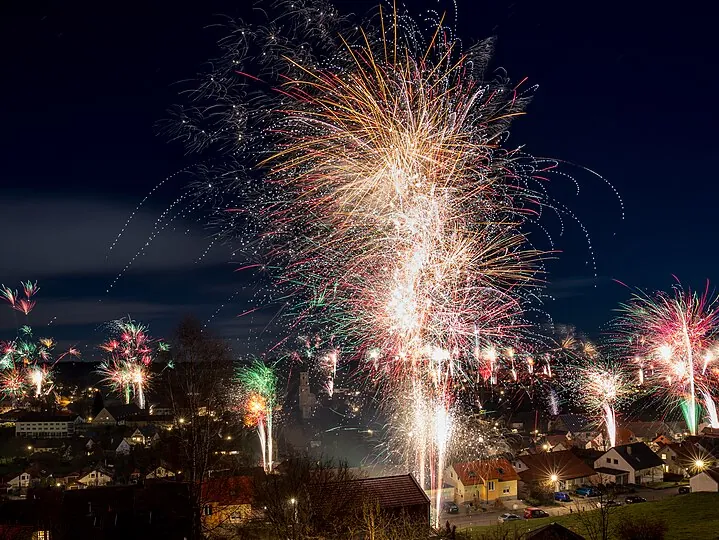
Every colour in a fireworks show is chosen by a chemist. Strontium salts make red, barium makes green, copper makes blue-green and sodium makes yellow. The colours come from electrons jumping between shells inside the atoms.
Electron shells
In the Bohr model, electrons are arranged in shells (also called energy levels) around the nucleus. The shell closest to the nucleus has the lowest energy, and electrons fill the lowest-energy shells first. Each shell can hold only a certain number of electrons. For the first 20 elements:
| Shell | Maximum electrons (first 20 elements) |
|---|---|
| 1st (closest to the nucleus) | 2 |
| 2nd | 8 |
| 3rd | 8 (it can hold 18 in heavier atoms) |
| 4th | the remaining electrons for potassium (1) and calcium (2) |
An electron configuration lists the number of electrons in each shell, starting from the inside. Sodium has 11 electrons: 2 fill the first shell, 8 fill the second and 1 goes in the third, so its configuration is 2, 8, 1.
Shells and the periodic table
Electron configurations explain the layout of the periodic table:
- The number of occupied shells equals the element's period (row). Sodium (2, 8, 1) has three shells and is in period 3.
- The electrons in the outermost shell are called valence electrons. For the main groups, their number matches the group: sodium has 1 and is in group 1; chlorine (2, 8, 7) has 7 and is in group 17 (the old "group VII").
- Elements with the same number of outer electrons react in similar ways, which is why each group is a family. Lithium (2, 1), sodium (2, 8, 1) and potassium (2, 8, 8, 1) all react strongly with water.
- A full outer shell is very stable. Helium (2), neon (2, 8) and argon (2, 8, 8) hardly react at all: they are the noble gases.
| Element | Z | Configuration | Element | Z | Configuration |
|---|---|---|---|---|---|
| H | 1 | 1 | Na | 11 | 2, 8, 1 |
| He | 2 | 2 | Mg | 12 | 2, 8, 2 |
| Li | 3 | 2, 1 | Al | 13 | 2, 8, 3 |
| Be | 4 | 2, 2 | Si | 14 | 2, 8, 4 |
| B | 5 | 2, 3 | P | 15 | 2, 8, 5 |
| C | 6 | 2, 4 | S | 16 | 2, 8, 6 |
| N | 7 | 2, 5 | Cl | 17 | 2, 8, 7 |
| O | 8 | 2, 6 | Ar | 18 | 2, 8, 8 |
| F | 9 | 2, 7 | K | 19 | 2, 8, 8, 1 |
| Ne | 10 | 2, 8 | Ca | 20 | 2, 8, 8, 2 |
- Fill the shells for every element from hydrogen to calcium. How many can you get right first time?
- Which elements have a full outer shell? Where are they on the periodic table?
- Compare lithium, sodium and potassium. What do their configurations have in common?
- Why does potassium start a fourth shell instead of putting a ninth electron in the third?
Flame tests: electrons jumping shells
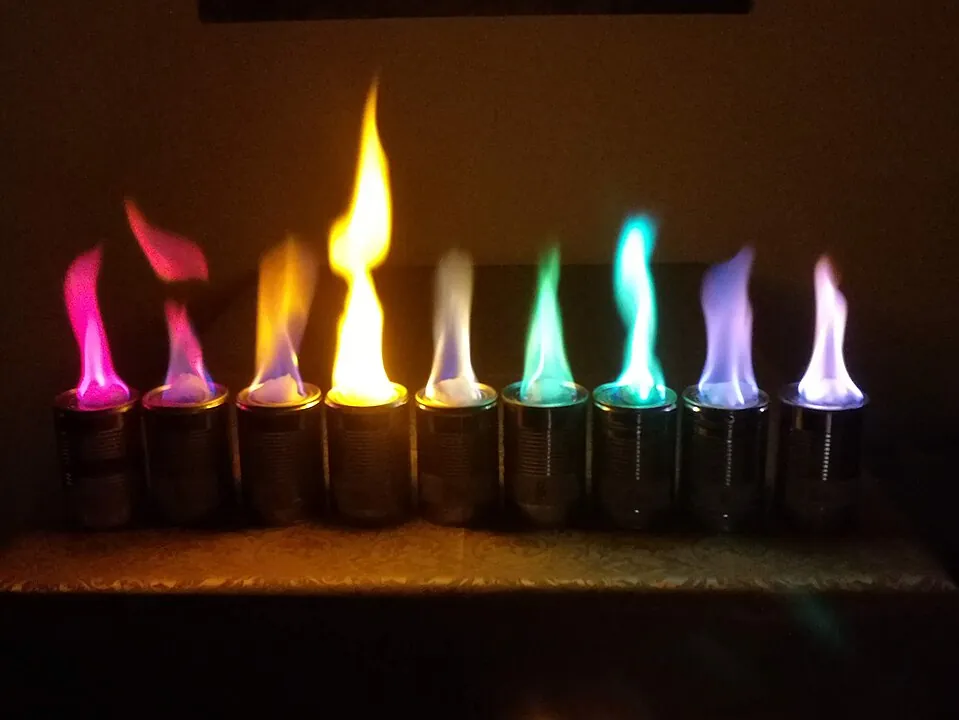
When a compound of a metal is held in a hot flame, the flame turns a colour that depends on the metal. Bohr's model explains why:
- The heat gives some electrons extra energy, and they jump up to a higher shell. The atom is now in an excited state.
- The excited state is unstable. Very quickly the electron falls back to a lower shell.
- As it falls, it gives out the energy it absorbed as a tiny packet of light. The size of the jump decides the energy of the light, and the energy decides its colour.
Because each element has its own set of shell energies, it gives out its own set of colours. That is why flame colour can identify a metal.
| Metal ion | Flame colour |
|---|---|
| Lithium | Crimson red |
| Sodium | Bright orange-yellow (strong enough to hide other colours) |
| Potassium | Lilac (pale purple) |
| Calcium | Orange-red (brick red) |
| Strontium | Bright red |
| Barium | Pale green |
| Copper | Blue-green |
If you look at the light through a spectroscope, which splits light the way a prism does, you don't see a smooth rainbow. You see a few bright lines of exact colours, each one a particular electron jump. This line spectrum is like a barcode for the element. The evidence of line spectra is what led Bohr to his model of fixed shells.
- Test each metal. Which two give red flames that are hard to tell apart?
- Turn on the spectroscope. How could you tell lithium from strontium now?
- Why does sodium give a single yellow colour?
- Try three mystery samples. Use the spectroscope to check your answers.
Test yourself
The electron configuration of aluminium (Z = 13) is
Fill 2, then 8, then the remaining 3.
An element has configuration 2, 8, 6. Which group and period is it in?
Three shells = period 3; six outer electrons = group 16 (sulfur).
In a flame test, light is given out when electrons
The energy they absorbed is released as light.
A sample gives a lilac flame. It probably contains
Potassium gives a pale purple flame.
Neon is unreactive because
2, 8: a full outer shell is very stable.
Explain how a flame colour is produced.
Sort the metals by flame colour.
The outer-shell electrons are called electrons. Elements in the same have the same number of outer electrons. An electron that has jumped to a higher shell is in an state. A spectroscope shows a series of bright . Chlorine's configuration is 2, 8, .
A student holds a wire dipped in copper chloride in a Bunsen flame and the flame turns blue-green. Using the Bohr model, explain why this happens and why a different metal gives a different colour.
The flame gives heat energy to electrons in the copper atoms, and some electrons jump to a higher-energy shell. This excited state is unstable, so the electrons quickly fall back to lower shells and give out the extra energy as light. The colour of the light depends on the size of the energy jump between shells. Each element has a different number of protons and electrons, so its shells have different energies and the jumps are different sizes. That means each element gives out its own particular colours of light, and copper's jumps produce blue-green.