 Coaching Centre
Metals, non-metals and metalloids
Properties of metals, non-metals and metalloids; the alkali metals, alkaline earth metals, transition metals, halogens and noble gases; reactivity trends down a group; and an experiment comparing metals in acid.
Sodium is a metal you can cut with a butter knife. It is lighter than water, it has to be stored under oil, and if you drop a piece into water it melts into a ball and skates across the surface. That isn't how most people imagine a metal, but in chemistry "metal" is about how an element behaves, not how tough it looks.
Metals and non-metals
| Property | Metals | Non-metals |
|---|---|---|
| Appearance | shiny (lustrous) when freshly cut or polished | usually dull; many are colourless gases |
| State at 25 °C | solid, except mercury (liquid) | 11 gases, 1 liquid (bromine), the rest solids |
| Electricity and heat | good conductors | poor conductors (insulators), except graphite |
| Solid shape | malleable (hammer into sheets) and ductile (draw into wires) | brittle: solids shatter when hit |
| Melting point | mostly high | mostly low |
| In reactions | lose electrons to form positive ions | gain or share electrons |
No single property is enough on its own. Graphite (carbon) conducts electricity but is a non-metal; mercury is a liquid but is a metal. Chemists look at the whole set of properties, and especially at how the element reacts.
Metalloids such as silicon and germanium are in between. They look shiny like metals but are brittle like non-metals. Most importantly, they are semiconductors: they conduct electricity a little, and how much can be controlled by temperature, light, or by adding tiny amounts of other elements. That control is what makes computer chips, solar cells and LEDs possible. A single phone chip contains billions of tiny silicon switches.
Group 1: the alkali metals
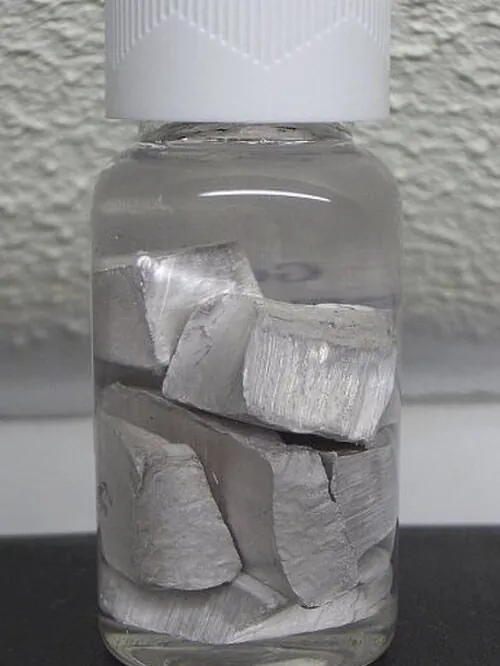
Lithium, sodium, potassium, rubidium, caesium and francium are soft, silvery metals with low melting points and low densities. They tarnish within seconds in air, so they are stored under oil. They all react with water to make hydrogen gas and an alkaline solution of the metal hydroxide (which is where the family name comes from):
sodium + water → sodium hydroxide + hydrogen
Their reactivity increases down the group. Lithium fizzes gently, sodium melts and skates, potassium bursts into a lilac flame, and rubidium and caesium explode. You'll see why in 2D: it comes down to how easily the single outer electron can be lost.
Australia mines more lithium than any other country, mostly from a rock called spodumene in Western Australia. Almost all of it goes into the lithium-ion batteries in phones, laptops and electric cars.
Group 2: the alkaline earth metals
Beryllium, magnesium, calcium, strontium, barium and radium are harder and denser than the alkali metals and less reactive, but reactivity still increases down the group. Magnesium barely reacts with cold water but burns in air with a blinding white light, which is why it is used in flares and fireworks. Calcium reacts steadily with cold water. Calcium compounds are everywhere: limestone, marble, shells, coral, bones and teeth are all built from them.
The transition metals
The central block holds most of the metals people use every day: iron, copper, zinc, nickel, chromium, titanium, silver, gold and platinum. Compared with groups 1 and 2 they are:
- harder, stronger and denser, with high melting points (tungsten melts at 3422 °C, which is why it was used in light bulb filaments; mercury is the exception, liquid at room temperature)
- much less reactive: gold and platinum stay shiny for thousands of years
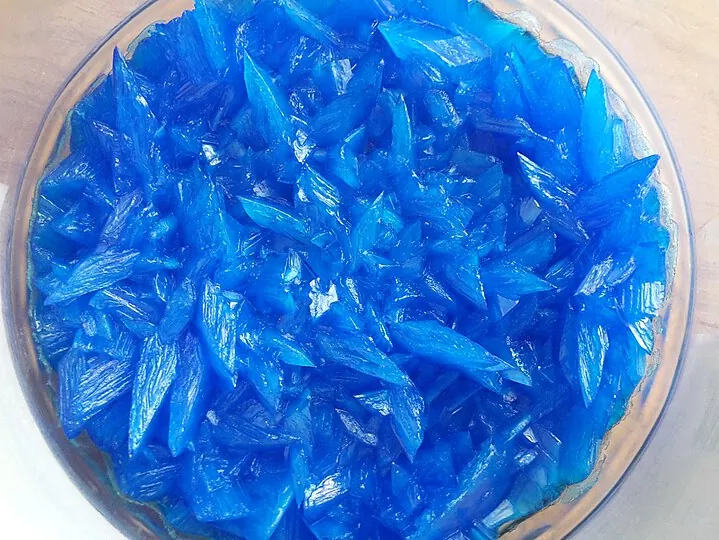
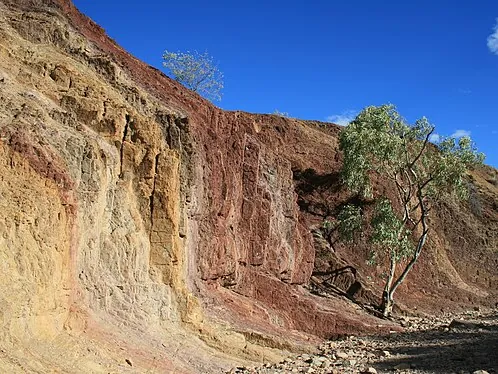
- good at forming coloured compounds: copper sulfate is bright blue, rust (iron oxide) is red-brown, chromium compounds are green, orange or yellow
- often useful as catalysts, which speed up reactions without being used up. The catalytic converter in a petrol car uses platinum, palladium and rhodium.
Iron, cobalt and nickel are also the only common elements that are strongly magnetic at room temperature.
Other metals
To the right of the transition metals are metals such as aluminium, gallium, indium, tin and lead. Aluminium is light and doesn't corrode, because it forms a thin, tough oxide layer. Gallium melts at 29.8 °C, so a piece will melt in your hand. Indium, mixed with tin and oxygen, makes a coating that is both transparent and able to conduct electricity, which is what makes touchscreens work.
Group 17: the halogens
Fluorine, chlorine, bromine and iodine are coloured, poisonous non-metals. They show the change of state down a group very clearly:
- fluorine: pale yellow gas, the most reactive element of all
- chlorine: yellow-green gas
- bromine: dark red-brown liquid that gives off a choking brown vapour
- iodine: shiny grey-black solid that turns straight into a purple vapour when warmed
For the halogens, reactivity decreases down the group, the opposite of group 1. Halogens react with metals to make salts (the name means "salt former"): sodium and chlorine make sodium chloride. Their compounds are useful even though the elements are dangerous: chlorine disinfects drinking water and pools, fluoride in water and toothpaste strengthens teeth, and iodine solutions kill germs on skin.
Group 18: the noble gases
Helium, neon, argon, krypton, xenon and radon are colourless gases that hardly react at all, because their outer shells are already full. For decades chemists thought they could not form any compounds, until in 1962 Neil Bartlett made a compound of xenon with platinum and fluorine. Their lack of reactivity is exactly what makes them useful:
- helium for balloons and airships (it can't catch fire, unlike hydrogen) and, as a liquid at −269 °C, to cool the magnets in MRI scanners
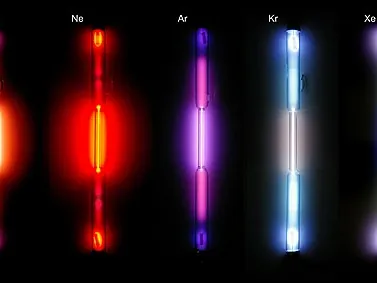
- neon in advertising signs, where electricity makes it glow red-orange
- argon to protect hot metal from air during welding, and between the panes of double-glazed windows
- radon is radioactive, and comes out of rocks into some homes (1E)
Comparing metals in acid
Metals higher in reactivity react faster with dilute acid, giving off hydrogen gas:
metal + hydrochloric acid → metal chloride + hydrogen
- Drop each alkali metal into water in turn. Describe the pattern going down the group.
- Why does the water change colour? What does that tell you about the product?
- Switch to the acid test. Rank the five metals from most to least reactive using the graph.
- Look at aluminium's line. Why is its shape different from the others?
Test yourself
An element is shiny, brittle and conducts electricity slightly. It is most likely
Metal-like lustre but brittle, and a semiconductor: a metalloid such as silicon.
Which alkali metal reacts most violently with water?
Reactivity increases down group 1, and caesium is lowest of these.
Which halogen is a liquid at room temperature?
Bromine is a dark red-brown liquid, one of only two elements that are liquid at 25 °C.
Argon is used in welding because it
It keeps oxygen away from the hot metal, and doesn't react itself.
Why were the metals cleaned with steel wool before the acid experiment?
An oxide coating slows the reaction and would make the test unfair.
Name the two groups.
Is it a property of metals or of non-metals?
Order these metals from most to least reactive.
Group 1 metals react with water to form a metal and hydrogen gas. Their reactivity down the group. Transition metals often form compounds and are used as catalysts. Silicon is a . The noble gases are unreactive because their outer shells are .
A student drops small pieces of lithium, sodium and potassium into separate troughs of water containing universal indicator. Predict and compare what they would observe, and identify the products.
All three metals float, fizz and react to form hydrogen gas and an alkaline solution of the metal hydroxide (lithium hydroxide, sodium hydroxide and potassium hydroxide), so the universal indicator turns from green to blue-purple. The reaction gets more vigorous down the group. Lithium fizzes steadily and slowly gets smaller. Sodium reacts faster, melts into a shiny ball and darts across the surface. Potassium reacts most violently: the hydrogen catches fire with a lilac flame and the metal may spit or pop. The reactivity increases because the outer electron is further from the nucleus in larger atoms, so it is lost more easily.