 Coaching Centre
The nitrogen cycle
Why living things need nitrogen, how bacteria and lightning fix nitrogen from the air, nitrifying and denitrifying bacteria, legumes and fertilisers, and what happens when too much nitrogen reaches waterways.
You are surrounded by nitrogen. It makes up 78% of every breath you take, yet your body can't use a single molecule of it. Every nitrogen atom in your muscles and DNA had to be captured from the air by bacteria, or by a factory, before it could reach you.
Why nitrogen matters
Living things need nitrogen to make proteins (muscles, enzymes, hair) and DNA. The air is about 78% nitrogen gas (N₂), but in N₂ the two atoms are held by a triple bond, one of the strongest bonds in chemistry (2F). Plants and animals can't break it. Plants can only take in nitrogen as nitrate (NO₃⁻) or ammonium (NH₄⁺) ions dissolved in soil water, and animals get theirs by eating plants or other animals. That makes nitrogen one of the main things that limits how fast plants can grow.
Steps in the nitrogen cycle
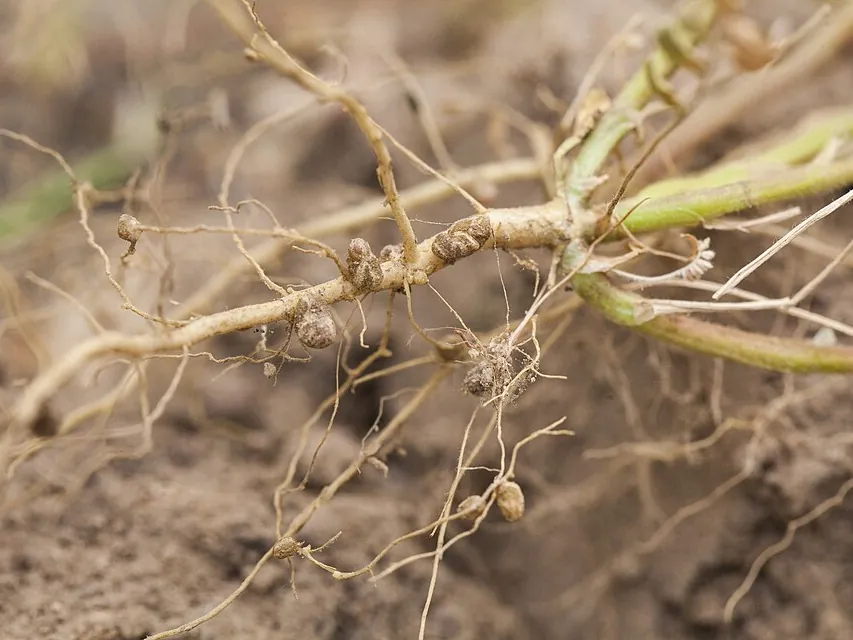
- Nitrogen fixation. Nitrogen-fixing bacteria break the triple bond and turn N₂ into ammonium. Some live free in the soil. Others live in swellings called nodules on the roots of legumes such as peas, beans, clover and wattles. The plant feeds the bacteria sugar; the bacteria give the plant nitrogen, a classic case of mutualism (3E). Lightning also fixes a small amount: its energy splits N₂ so nitrogen joins with oxygen, and the products wash down in rain as nitrate.
- Nitrification. Nitrifying bacteria in the soil turn ammonium into nitrite and then into nitrate, the form most plants absorb best.
- Assimilation. Plants absorb nitrate through their roots and use it to make proteins and DNA. Animals get nitrogen by eating plants.
- Decomposition. When plants and animals die, or animals produce urine and dung, decomposers break down the proteins and release ammonium back into the soil.
- Denitrification. In waterlogged soils with little oxygen, denitrifying bacteria turn nitrate back into N₂ gas, which returns to the air and completes the cycle.
Australian soils are old and weathered and are naturally low in nutrients. That is one reason so many Australian plants are legumes. There are about 1000 species of wattle (Acacia), and their root nodules let them grow in poor sandy soils and after bushfires, adding nitrogen that other plants later use.
- Get the atom from the air into a plant. Which two routes are possible?
- Get it into an animal, then back into the soil. Which organisms do the work?
- Find two ways the atom can leave the soil without entering a plant.
- Can you visit all seven places in eight moves or fewer?
People and the nitrogen cycle
In 1909 the German chemist Fritz Haber found a way to fix nitrogen in a factory, combining N₂ from the air with hydrogen at high temperature and pressure to make ammonia. The Haber process now makes most of the world's nitrogen fertiliser. It has made it possible to grow food for billions more people: roughly half the nitrogen atoms in your body were probably fixed in a fertiliser factory.
There is a cost. Crops take up only about half of the nitrogen fertiliser spread on farms. The rest can:
- leach out of the soil in heavy rain and run into rivers and the sea, causing eutrophication: an explosion of algae that then die and decay, using up oxygen so fish suffocate. Fertiliser runoff from farms in Queensland is one of the pressures on the Great Barrier Reef.
- be turned by bacteria into nitrous oxide (N₂O), a greenhouse gas about 270 times more powerful than carbon dioxide over a century.
Farmers can reduce this by applying fertiliser in smaller amounts at the right time, and by crop rotation: growing a legume crop such as lupins, field peas or clover between wheat crops so bacteria restore the soil's nitrogen naturally. Australia grows most of the world's lupins, mainly in Western Australia, partly for this reason.
Test yourself
Plants absorb most of their nitrogen as
Nitrate dissolved in soil water is absorbed by roots.
Which organisms return nitrogen to the atmosphere?
They turn nitrate into N₂ gas.
Farmers grow clover between wheat crops because clover
Legumes add nitrogen to the soil for the next crop.
Eutrophication is caused by
Extra nutrients trigger algal blooms that use up oxygen when they decay.
Label the processes in the nitrogen cycle.
Put the journey of a nitrogen atom in order, starting in the air.
Nitrogen is needed to make and DNA. Legumes have root containing nitrogen-fixing bacteria. Nitrifying bacteria turn ammonium into . The factory method of fixing nitrogen is the process. Fertiliser washing out of soil in heavy rain is called .
A farmer adds large amounts of nitrogen fertiliser to a paddock next to a creek. Explain the possible effects on the creek ecosystem, and suggest one way to reduce them.
Plants can only use part of the fertiliser. In heavy rain the excess nitrate is leached from the soil and runs into the creek. The extra nutrients let algae and cyanobacteria multiply rapidly, forming an algal bloom that blocks light from water plants. When the algae die, decomposers break them down and use up the dissolved oxygen in respiration, so fish, yabbies and insect larvae can suffocate and die. This is eutrophication. The farmer could apply smaller amounts of fertiliser when the crop needs it, avoid spreading it before heavy rain, or leave a strip of native vegetation along the creek bank to absorb nitrate before it reaches the water.