 Coaching Centre
Light and the electromagnetic spectrum
Light as a transverse electromagnetic wave, the speed of light, crests, troughs, wavelength and amplitude, colour and white light, the seven parts of the electromagnetic spectrum with their uses and dangers, ionising radiation and UV safety, the wave equation for light, and radio astronomy at Murriyang and on Wajarri Yamaji Country.
The radio playing in a car, the microwave heating your lunch, the heat from a fire, the colours of a rainbow, a sunburn, an X-ray of a broken wrist and the gamma rays from a dying star are all the same thing: electromagnetic waves. The only difference is their wavelength.
Light is an electromagnetic wave
Light is a transverse wave made of changing electric and magnetic fields, so it is called an electromagnetic (EM) wave. Unlike sound, it needs no medium: it travels fastest of all through empty space, at about 300 000 km/s (3 × 10⁸ m/s). Light from the Sun takes about 8 minutes 20 seconds to reach us. Light from the Moon takes 1.3 seconds.
- The crest is the highest point and the trough the lowest.
- The amplitude is measured from the rest position to a crest (not crest to trough). For light, bigger amplitude means brighter.
- The wavelength is the distance between two matching points, such as crest to crest or trough to trough.
Objects that make their own light, such as the Sun, a candle flame or an LED, are luminous. Everything else we see because it reflects light into our eyes.
White light and colour
A glass prism splits sunlight into a spectrum: red, orange, yellow, green, blue, indigo and violet. Isaac Newton showed in the 1660s that white light is a mixture of all these colours, because a second prism could recombine them into white. Each colour has a different wavelength, from about 700 nanometres (nm) for red down to about 400 nm for violet. (1 nm is a billionth of a metre.)
An object's colour depends on which wavelengths it reflects and which it absorbs:
- A red car reflects red light and absorbs the other colours.
- A white shirt reflects all colours; a black shirt absorbs them all, which is why black clothes get hot in the sun.
- A green leaf absorbs red and blue light for photosynthesis and reflects green.
- A filter lets only some colours through. A red object seen through a green filter looks black, because no red light gets through.
The electromagnetic spectrum
Visible light is a tiny slice of a much bigger family. All EM waves travel at the same speed in a vacuum, so the wave equation becomes:
speed of light (3 × 10⁸ m/s) = frequency × wavelength
c = f λ
The shorter the wavelength, the higher the frequency and the more energy each "packet" of radiation (each photon) carries.
| Type | Typical wavelength | Uses | Dangers |
|---|---|---|---|
| Radio waves | 1 mm to over 1 km | Radio, TV, Wi-Fi, mobile phones, radio telescopes, MRI scanners | None known at normal exposures |
| Microwaves | 1 mm to 30 cm | Microwave ovens, radar, satellite links, 5G | Heating of tissue at very high power |
| Infrared | 700 nm to 1 mm | Heaters, remote controls, thermal cameras, optic-fibre data | Burns |
| Visible light | 400 to 700 nm | Seeing, photography, lasers, photosynthesis | Very bright light (or lasers) can damage the retina |
| Ultraviolet (UV) | 10 to 400 nm | Sterilising water and surfaces, detecting forged banknotes, making vitamin D in skin | Sunburn, skin cancer, cataracts |
| X-rays | 0.01 to 10 nm | Imaging bones and teeth, airport scanners, CT scans, cancer treatment | Damages DNA, can cause cancer |
| Gamma rays | less than 0.01 nm | Sterilising medical equipment and food, PET scans, killing cancer cells | Damages DNA, can cause cancer |
Radiation with enough energy per photon to knock electrons off atoms is called ionising radiation. High-energy UV, X-rays and gamma rays are ionising, so they can break DNA and cause mutations. Radio waves, microwaves, infrared and visible light are non-ionising: at high power they can heat things, but they can't break chemical bonds the way ionising radiation does. The Australian Radiation Protection and Nuclear Safety Agency (ARPANSA) sets exposure limits for mobile phones, Wi-Fi and 5G; everyday exposure is far below them.
Most radiotherapy in Australian hospitals now uses high-energy X-rays made by machines called linear accelerators, aimed precisely at a tumour from many directions. Gamma-ray sources such as cobalt-60 are still used in some specialised machines.
- Drag the wavelength slider from radio to gamma. What happens to the frequency? Where does radiation become ionising?
- Try the Microwave oven preset. Check its frequency using c = f λ with a calculator.
- Compare the TV remote and Red light presets. Why can't you see the remote's beam? (Try looking at it through a phone camera.)
- Find the wavelength of FM radio. How many times longer is it than visible light?
- Try the Hydrogen 21 cm preset. Why is this wavelength so useful to radio astronomers?
Triple J in Sydney broadcasts at 105.7 MHz. What is the wavelength of its radio waves? (1 MHz = 1 000 000 Hz.)
c = f λ, so λ = c ÷ f.
λ = 300 000 000 ÷ 105 700 000 = 2.84 m. That is why FM car aerials are around 70 cm (a quarter of a wavelength).
Red light has λ = 700 nm = 7 × 10⁻⁷ m, so f = 3 × 10⁸ ÷ 7 × 10⁻⁷ = 4.3 × 10¹⁴ Hz: about 430 trillion waves every second.
UV and you
Australia has some of the highest UV levels on Earth, and about two in three Australians will be diagnosed with skin cancer in their lifetime. The ozone layer absorbs nearly all UV-C and much of UV-B, but enough gets through to burn skin in under 15 minutes on a summer day. Check the UV index (shown in the weather forecast and the SunSmart app): when it is 3 or above, protect your skin even if it is cool or cloudy, because UV can't be felt. Remember the five steps: slip on clothing, slop on SPF 50+ sunscreen, slap on a hat, seek shade and slide on sunglasses.
Listening to the sky
Many objects in space give off radio waves that pass through cloud and dust. Cold hydrogen gas, the most common substance in the Universe, gives off radio waves at exactly 21 cm, which lets astronomers map gas in galaxies.
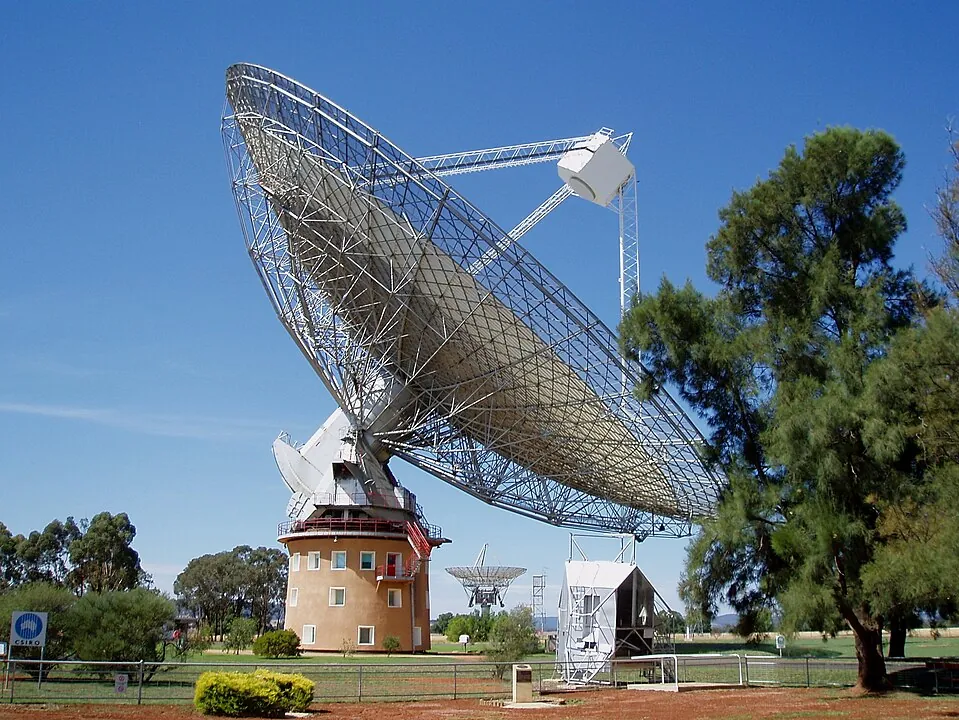
- The 64 m CSIRO radio telescope at Parkes, NSW, relayed TV pictures of the first Moon landing in 1969 and later helped discover mysterious fast radio bursts. In 2020 it was given the Wiradjuri name Murriyang, meaning "Skyworld", in honour of the traditional owners of the land it stands on.
- In Western Australia, the low-frequency part of the international Square Kilometre Array (SKA-Low), with more than 130 000 antennas, is being built on Wajarri Yamaji Country. The observatory site is called Inyarrimanha Ilgari Bundara, which means "sharing sky and stars" in Wajarri. The area was chosen because it is extremely radio quiet, far from phones and TV transmitters.
First Nations astronomers have watched the sky for tens of thousands of years. For example, many peoples across Australia read the Emu in the Sky, a shape made of dark dust lanes in the Milky Way, to know when emus are laying eggs.
Test yourself
Which list is in order of increasing frequency?
Frequency increases as wavelength decreases: radio → microwave → infrared → visible → UV → X-ray → gamma.
A blue T-shirt looks blue in white light because it
We see the colours an object reflects into our eyes.
Which type of radiation is ionising?
X-rays carry enough energy per photon to remove electrons from atoms.
A Wi-Fi router uses 5 GHz (5 × 10⁹ Hz). The wavelength is
λ = 3 × 10⁸ ÷ 5 × 10⁹ = 0.06 m = 6 cm.
A red rose is viewed through a blue filter. It looks
The rose reflects only red light, and the blue filter blocks red, so no light reaches your eye.
Label the parts of the electromagnetic spectrum.
Sort the radiation.
Put the electromagnetic spectrum in order from longest to shortest wavelength.
Light is a wave that can travel through a . A prism splits white light into a . Of the colours of visible light, has the longest wavelength. Radiation that can knock electrons off atoms is called .
Compare ultraviolet radiation and radio waves. In your answer, refer to wavelength, frequency, energy, one use and one risk of each.
Ultraviolet radiation and radio waves are both electromagnetic waves, and both travel at 3 × 10⁸ m/s in a vacuum. Radio waves have very long wavelengths (from millimetres to kilometres) and low frequencies, while UV has very short wavelengths (10 to 400 nm) and much higher frequencies. Because energy per photon increases with frequency, UV photons carry far more energy, enough to ionise atoms. UV is used to sterilise water and hospital equipment, but it damages DNA in skin cells, causing sunburn and skin cancer. Radio waves are used for broadcasting, mobile phones and radio astronomy at telescopes such as Murriyang. They are non-ionising, so at normal exposures they cause no known harm; only at very high power can they heat tissue.