 Coaching Centre
Reactions of hydrocarbons
Addition reactions of alkenes and alkynes with hydrogen, halogens, hydrogen halides and water, substitution reactions of alkanes with halogens in UV light, and the bromine water test that tells saturated from unsaturated hydrocarbons, with equations and conditions.
Canola oil is a liquid; margarine made from it is a soft solid. The difference is a few hundred hydrogen atoms. Bubbling hydrogen through warm oil with a nickel catalyst adds H₂ across some of the C=C double bonds in the fat molecules. Straighter, more saturated chains pack together more tightly, so the oil sets. The same addition reaction, on smaller molecules, turns ethene into ethanol, ethane or chloroethane.
Addition reactions of alkenes
The C=C double bond is made of one strong bond and one weaker, more exposed one. In an addition reaction, the weaker bond breaks and a small molecule adds across the two carbons, one atom (or group) to each. Two molecules become one, the C=C becomes C–C, and the product is saturated.
| Reaction | Reagent | Conditions | Ethene gives |
|---|---|---|---|
| Hydrogenation | H₂ | Ni, Pt or Pd catalyst, about 150 °C | ethane, CH₃CH₃ |
| Halogenation | X₂ (Cl₂, Br₂) | room temperature, no catalyst; fast | 1,2-dibromoethane, CH₂BrCH₂Br |
| Hydrohalogenation | HX (HCl, HBr) | room temperature | chloroethane, CH₃CH₂Cl |
| Hydration | H₂O | steam, H₃PO₄ catalyst, about 300 °C and 6–7 MPa (industry); dilute H₂SO₄ in the lab | ethanol, CH₃CH₂OH |
CH₂=CH₂ + H₂O → CH₃CH₂OH
Write these as structural formulae in the HSC, showing the two carbons of the old double bond each gaining one new atom.
Unsymmetrical alkenes
When H₂ or Br₂ add to propene, there is only one product. When HCl or H₂O add, there are two possible products, because the H can go on either carbon:
CH₃CH=CH₂ + HCl → CH₃CHClCH₃ (2-chloropropane) or CH₃CH₂CH₂Cl (1-chloropropane)
In practice the major product is the one where the H adds to the carbon that already has more hydrogens (Markovnikov's rule), so 2-chloropropane and propan-2-ol dominate. The rule isn't in the syllabus; HSC questions accept either product if your equation is correct, but naming both shows you understand that two products form.
Alkynes
Alkynes add in two stages, because the triple bond has two weaker bonds to break. One mole of H₂ turns ethyne into ethene; a second mole gives ethane. With excess bromine, ethyne becomes 1,1,2,2-tetrabromoethane.
Substitution reactions of alkanes
Alkanes have no double bond to open, so they can't do addition. With chlorine or bromine in ultraviolet light (or sunlight), they undergo substitution: a halogen atom replaces a hydrogen atom, and a hydrogen halide is formed as well.
CH₄ + Cl₂ → CH₃Cl + HCl (UV light)
UV light splits Cl₂ into chlorine atoms (radicals), which pull H atoms off the alkane and start a chain of reactions. The substitution doesn't stop neatly after one swap: CH₃Cl can react again to give CH₂Cl₂, CHCl₃ and CCl₄, and with longer alkanes the halogen can replace H on any carbon. That makes substitution a messy way to make one particular haloalkane, which is why industry often prefers addition to an alkene.
Write equations to make chloroethane from (a) ethane and (b) ethene. Which route gives the purer product?
Telling alkenes from alkanes
Hexane and hex-1-ene are both colourless liquids with similar boiling points. Bromine water tells them apart. It is orange-brown because of dissolved Br₂. Shake a few drops with the alkene and the colour disappears within seconds, because the bromine adds across the C=C to form a colourless dibromoalkane. With the alkane, the orange colour stays, unless the mixture is left in bright UV light, where slow substitution gradually fades it and produces acidic HBr fumes.
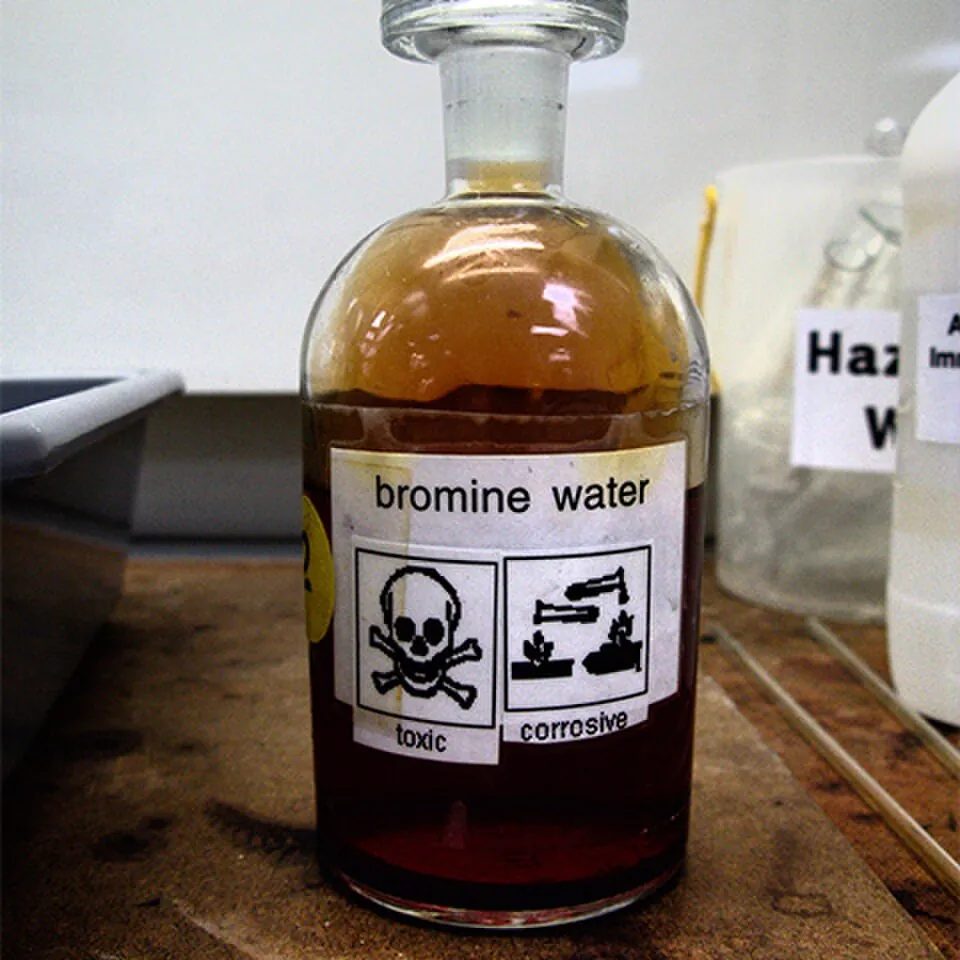
Acidified potassium permanganate works too: purple MnO₄⁻ is quickly decolourised by alkenes but not by alkanes.
- Pick ethene and add each reagent in turn. Write the four equations from the products shown.
- Add bromine water to hexane, then to hex-1-ene. Now switch the UV lamp on and try hexane again. What changes, and what is the extra product?
- React propene with HCl and then with H₂O. How many products appear, and which is the major one?
- Add H₂ to ethyne once, then again. What forms after each step?
- Try cyclohexene and benzene with bromine water. Why doesn't benzene react like an alkene?
Test yourself
But-2-ene reacts with HBr. The product is
H adds to one carbon of the C=C and Br to the other; but-2-ene is symmetrical, so only 2-bromobutane forms.
Which reaction needs ultraviolet light?
Substitution of an alkane needs UV to split the halogen molecules.
The industrial conditions for making ethanol from ethene are
Hydration of ethene uses steam over an acid catalyst at high temperature and pressure.
How many moles of H₂ are needed to convert one mole of propyne into propane?
The triple bond adds H₂ twice: propyne → propene → propane.
Name each reaction of ethene.
Classify each reaction.
Alkenes react by , because they have a C=C double bond. Adding hydrogen needs a such as nickel. Alkanes react with halogens by in ultraviolet light. Bromine water changes from orange-brown to when shaken with an alkene. Adding water to an alkene is called .
Describe a chemical test that distinguishes hexane from hex-1-ene. Include the expected observations, a balanced equation using structural or condensed formulae for the reaction that occurs, and an explanation of why only one compound reacts quickly.
Add about 1 mL of bromine water to a small sample of each liquid in separate test tubes, in a fume cupboard and away from strong light, and shake. With hex-1-ene the orange-brown colour disappears almost immediately, leaving a colourless mixture. With hexane the orange-brown colour remains. Hex-1-ene reacts by addition across its double bond:
CH₂=CHCH₂CH₂CH₂CH₃ + Br₂ → CH₂BrCHBrCH₂CH₂CH₂CH₃ (1,2-dibromohexane)
The C=C double bond contains a weaker, more reactive bond that breaks easily, allowing one Br atom to add to each carbon at room temperature. Hexane is saturated, so it has no double bond to add across. It can only react by substitution, which needs UV light to split the Br₂ molecules, so in normal light the reaction is too slow to see.