 Coaching Centre
Properties and reactions of acids and bases
Properties and IUPAC names of common inorganic acids and bases, amphoteric oxides, and balanced, ionic and net ionic equations for acids reacting with bases, carbonates and metals, plus everyday and industrial uses of neutralisation.
Around half of Australia's farming soils are acidic enough to cut crop yields. Acid builds up slowly as nitrogen fertilisers are used and as each harvest carries basic minerals off the paddock. In the worst soils, aluminium ions dissolve and poison the roots. Farmers treat this with crushed limestone, spreading millions of tonnes of it every year. That is one large-scale neutralisation reaction, and by the end of this page you'll be able to write its equation in three different ways.
Properties of acids and bases
Long before anyone knew what an acid was, chemists knew what acids do. That kind of description is an operational definition: it tells you how to recognise something by testing it. In the next few pages you'll see how chemists replaced it with conceptual definitions that explain why acids behave this way.
| Property | Acids | Bases |
|---|---|---|
| Taste (never test this in a lab) | sour | bitter |
| Feel | sting on cuts and in eyes | slippery (they react with the oils in your skin to make soap) |
| Litmus | blue → red | red → blue |
| pH at 25 °C | below 7 | above 7 |
| Conductivity | Aqueous solutions conduct, because they contain mobile ions | |
| Typical reactions | with reactive metals (H₂ forms) and carbonates (CO₂ forms) | neutralise acids; NH₃ and hydroxides react with ammonium salts on warming |
A base is any substance that neutralises an acid. A base that dissolves in water, such as NaOH, KOH or NH₃, is called an alkali. So every alkali is a base, but not every base is an alkali: CuO and Mg(OH)₂ are bases that barely dissolve.
Naming common inorganic acids and bases
You need to know the IUPAC names and formulae of the common acids and bases, and be able to name their salts. The salt's name comes from the acid: the anion of hydrochloric acid is chloride, of sulfuric acid is sulfate, and so on.
| Acid | Formula | Anion in its salts | Notes |
|---|---|---|---|
| hydrochloric acid | HCl | chloride, Cl⁻ | strong, monoprotic; in your stomach at about pH 1.5–3.5 |
| nitric acid | HNO₃ | nitrate, NO₃⁻ | strong, monoprotic |
| sulfuric acid | H₂SO₄ | sulfate, SO₄²⁻ (and hydrogen sulfate, HSO₄⁻) | strong for its first ionisation, diprotic |
| phosphoric acid | H₃PO₄ | phosphate, PO₄³⁻ | weak, triprotic; in cola drinks |
| carbonic acid | H₂CO₃ | carbonate, CO₃²⁻; hydrogen carbonate, HCO₃⁻ | weak, diprotic; forms when CO₂ dissolves |
| ethanoic (acetic) acid | CH₃COOH | ethanoate (acetate), CH₃COO⁻ | weak, monoprotic; vinegar is about 4–5% by mass |
| hydrofluoric acid | HF | fluoride, F⁻ | weak, but extremely dangerous: it penetrates skin |
| sulfurous acid / nitrous acid | H₂SO₃ / HNO₂ | sulfite / nitrite | weak; -ite anions come from -ous acids |
The pattern: a binary acid (H plus one non-metal) is named hydro…ic acid and gives an -ide salt. An oxyacid ending in -ic gives an -ate salt, and one ending in -ous gives an -ite salt. Common bases are sodium hydroxide (NaOH), potassium hydroxide (KOH), calcium hydroxide (Ca(OH)₂, slaked lime), magnesium hydroxide (Mg(OH)₂, milk of magnesia), ammonia (NH₃), sodium carbonate (Na₂CO₃) and sodium hydrogen carbonate (NaHCO₃, bicarbonate of soda), along with metal oxides such as CaO (quicklime) and CuO.
Acidic, basic and amphoteric oxides
Most metal oxides are basic: they react with acids to give a salt and water. Most non-metal oxides are acidic: CO₂, SO₂, SO₃ and NO₂ react with water to form acids, which is why they cause acid rain and ocean acidification. A few oxides, notably those of zinc, aluminium, tin and lead, are amphoteric: they react with both acids and bases.
ZnO(s) + 2HCl(aq) → ZnCl₂(aq) + H₂O(l)
ZnO(s) + 2NaOH(aq) + H₂O(l) → Na₂[Zn(OH)₄](aq)
In the second equation the zinc ends up in the zincate ion, [Zn(OH)₄]²⁻, which carries a 2− charge (Zn²⁺ plus four OH⁻). Writing it as [Zn(OH)₄]²⁺ is a common slip. Some oxides, such as CO and N₂O, are neutral and react with neither.
Predicting the products of acid reactions
Three patterns cover nearly every acid reaction in the HSC course. In every one the acid supplies H⁺ and the other reactant's metal ends up in a salt with the acid's anion.
| Reaction | General equation | What you see |
|---|---|---|
| acid + base (hydroxide or oxide) | acid + base → salt + water | usually no visible change; the mixture warms |
| acid + carbonate or hydrogen carbonate | acid + carbonate → salt + water + carbon dioxide | fizzing; the gas turns limewater milky |
| acid + reactive metal | acid + metal → salt + hydrogen | fizzing; the gas pops with a lit splint |
The metal reaction is a redox reaction (the metal is oxidised and H⁺ is reduced), so only metals above hydrogen in the activity series react: copper, silver and gold don't. The other two are acid–base reactions.
Full ionic and net ionic equations
A balanced molecular equation shows whole formulae. A full ionic equation splits every strong electrolyte that is dissolved (strong acids, soluble ionic compounds) into its ions. Ions that appear unchanged on both sides are spectator ions. Cross them out and you have the net ionic equation, which shows only the particles that actually change.
Keep these as whole formulae, not ions: solids, liquids, gases, weak acids (such as CH₃COOH), weak bases (NH₃), and water.
Write the balanced, full ionic and net ionic equations for the reaction of nitric acid with solid calcium carbonate.
$\mathrm{CaCO_3(s) + 2H^+(aq) + 2NO_3^-(aq) \rightarrow Ca^{2+}(aq) + 2NO_3^-(aq) + H_2O(l) + CO_2(g)}$
$\mathrm{CaCO_3(s) + 2H^+(aq) \rightarrow Ca^{2+}(aq) + H_2O(l) + CO_2(g)}$
Magnesium ribbon is dropped into dilute sulfuric acid. Write the balanced and net ionic equations.
Write the net ionic equation for ethanoic acid reacting with sodium hydroxide solution.
$\mathrm{CH_3COOH(aq) + Na^+(aq) + OH^-(aq) \rightarrow CH_3COO^-(aq) + Na^+(aq) + H_2O(l)}$
- Choose HCl and NaOH. Which ions are struck out, and what is left as the net ionic equation?
- Keep NaOH and switch the acid to HNO₃, then H₂SO₄. Does the net ionic equation change? Explain why in one sentence.
- Choose H₂SO₄ and CaCO₃. What does the sim say you would see, and why does the reaction stop?
- Choose CH₃COOH with Mg. Why does the net ionic equation now include CH₃COOH and not H⁺?
- Choose HCl with NH₃. There is no water in the products. What kind of particle does NH₃ turn into?
Neutralisation at work
The syllabus asks you to know a range of contexts where neutralisation is used. For each one, be ready to name the acid, the base and the product, and to write the equation.
| Context | What is neutralised, and with what |
|---|---|
| Liming acidic soils | Agricultural lime (CaCO₃) or dolomite (CaMg(CO₃)₂) reacts with H⁺ in the soil. It is cheap, insoluble so it acts slowly, and safe to handle. |
| Antacids | Mg(OH)₂, Al(OH)₃, CaCO₃ or NaHCO₃ neutralise excess stomach HCl. All are weak or insoluble bases, so they can't overshoot to a dangerously basic pH. |
| Chemical spills | Acid spills are covered with solid NaHCO₃ (fizzing stops when it is neutralised). Base spills are treated with a weak acid such as citric acid or vinegar. A strong acid or base is never used: an excess would be just as dangerous, and the reaction can release a lot of heat. |
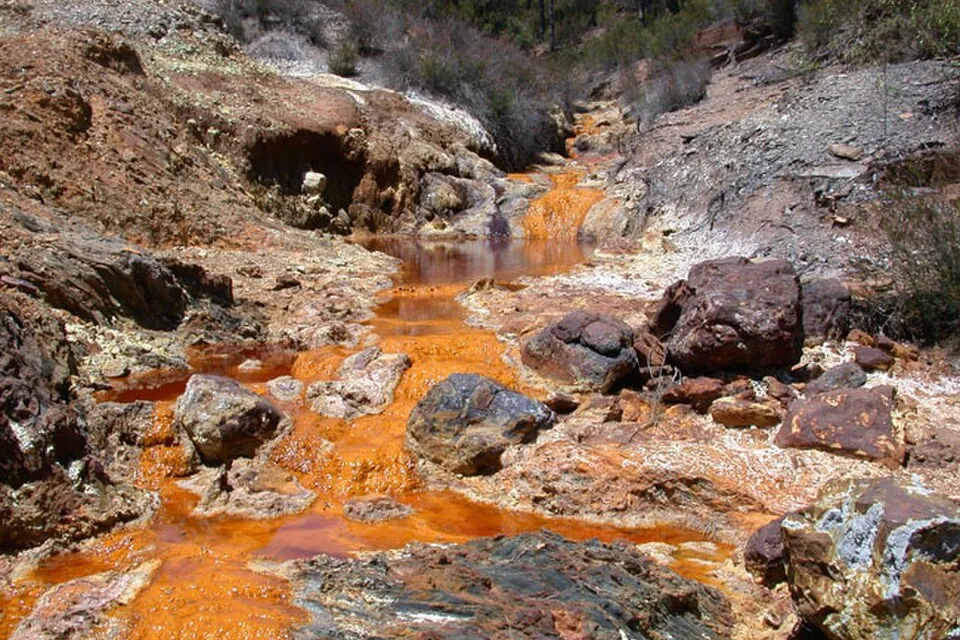
| Acid mine drainage and acid sulfate soils | Exposed sulfide minerals (such as pyrite, FeS₂) oxidise to sulfuric acid. Old mine sites and drained coastal wetlands in Australia are treated with lime or limestone to raise the pH and precipitate dissolved metals. |
| Industry and water treatment | Acidic waste and flue gases (SO₂) are scrubbed with lime; drinking water and pools are adjusted with Na₂CO₃ or HCl. |
| Cooking | Baking powder is NaHCO₃ plus a dry solid acid. Adding water lets them react, and the CO₂ makes the cake rise. |
A farmer needs to neutralise 1.5 × 10⁴ mol of H⁺ in the top layer of a paddock. What mass of agricultural lime (CaCO₃, M = 100.09 g/mol) is needed, assuming it all reacts?
Test yourself
Which is the net ionic equation for the reaction of hydrochloric acid with solid copper(II) oxide?
The oxide is a solid, so it stays whole. Cl⁻ is a spectator and is removed.
Which pair of names and formulae is correct?
H₂SO₄ is sulfuric acid, HNO₃ is nitric acid and HClO₃ is chloric acid. Phosphoric acid is H₃PO₄.
Which oxide would react with both hydrochloric acid and sodium hydroxide solution?
Aluminium oxide is amphoteric. CaO is basic, SO₂ is acidic and CO is neutral.
An acid spill on a lab bench is best treated with
NaHCO₃ is a weak, solid base: excess does no harm, and the end of the fizzing shows the acid is used up.
How many spectator ions are in the reaction of sodium carbonate solution with nitric acid?
The net reaction is CO₃²⁻(aq) + 2H⁺(aq) → H₂O(l) + CO₂(g). Sodium and nitrate ions are unchanged.
Label the properties of acids and bases.
Sort the reactions by their products.
A base that dissolves in water is called an . The salts of nitric acid are called . An oxide that reacts with both acids and bases is . Ions that are unchanged in a reaction are ions. Acids react with carbonates to produce a salt, water and .
Agricultural lime (CaCO₃) and quicklime (CaO) can both be used to treat acidic soil. (a) Write a balanced equation and a net ionic equation for each with the H⁺ in soil water. (b) Explain why a farmer would usually choose agricultural lime, referring to the chemistry of the two bases.
(a) With sulfuric acid as the soil acid: CaCO₃(s) + H₂SO₄(aq) → CaSO₄(s) + H₂O(l) + CO₂(g); net: CaCO₃(s) + 2H⁺(aq) → Ca²⁺(aq) + H₂O(l) + CO₂(g). CaO(s) + 2HCl(aq) → CaCl₂(aq) + H₂O(l); net: CaO(s) + 2H⁺(aq) → Ca²⁺(aq) + H₂O(l).
(b) Calcium carbonate is insoluble and only reacts where H⁺ is present, so it neutralises acid slowly over months and the soil pH cannot rise much above neutral even if extra is spread. It is also safe to handle and cheap, since it is simply crushed limestone. Quicklime reacts strongly and exothermically with soil water to form Ca(OH)₂, a soluble strong base, so it acts quickly, can push the pH too high and harm soil organisms, and is caustic to skin and eyes. For these reasons agricultural lime is the usual choice.