 Coaching Centre
Hydrocarbons: safety and society
How to handle and dispose of organic chemicals safely (flash point, toxicity, safety data sheets, the hierarchy of controls and waste streams), how crude oil is refined and cracked, and the environmental, economic and sociocultural implications of obtaining and using hydrocarbons, with Australian examples.
In 2009 the Montara wellhead platform in the Timor Sea blew out and leaked oil for 74 days, spreading a slick over about 90 000 square kilometres and damaging seaweed farms in Indonesia. More than a decade later, thousands of Indonesian seaweed farmers won a class action in the Federal Court of Australia. Getting hydrocarbons out of the Earth, moving them and burning them touches the environment, the economy and people's lives all at once. This page looks at both scales: a test tube of hexane in the school lab, and the oil and gas industry that supplies most of the world's energy.
Why organic chemicals need care
- Flammability. Most small organic molecules have weak intermolecular forces, so they evaporate easily and their vapours ignite. The flash point is the lowest temperature at which a liquid gives off enough vapour to ignite in air. Liquids with a flash point below 23 °C are classed as highly flammable: hexane (about −22 °C), cyclohexane (about −20 °C) and ethanol (13 °C) all qualify. Vapours are often denser than air, so they can roll along a bench to a flame.
- Toxicity. Vapours are usually colourless and can be absorbed through the lungs or skin. Acute effects of a short exposure include headaches, dizziness and drowsiness; chronic effects of repeated exposure include liver and kidney damage and harm to the nervous system. Hexane damages nerves, methanol can cause blindness, and benzene causes leukaemia, which is why it is no longer used in school labs.
- Reactivity. Some organic compounds form explosive peroxides on standing, and halogenated solvents can give off toxic gases if they burn.
Handling and disposal
Every chemical comes with a Safety Data Sheet (SDS), the document Australian work health and safety law requires, which lists its hazards, safe handling, first aid, spill clean-up and disposal. Labels use the Globally Harmonised System (GHS) pictograms, such as a flame for flammable and a skull for acutely toxic. Risks are managed with the hierarchy of controls, from most to least effective:
- Eliminate or substitute: use a less hazardous chemical (cyclohexane instead of benzene, ethanol instead of methanol) and the smallest practical amounts.
- Engineering controls: work in a fume cupboard; heat with a hotplate, heating mantle or water bath, never a naked flame; store flammables in a flammable-liquids cabinet.
- Administrative controls: read the SDS, write a risk assessment, label everything, keep containers closed.
- Personal protective equipment: safety glasses, gloves suited to the solvent, lab coat, closed shoes.
Disposal: organic chemicals must never go down the sink, where they can poison aquatic life, damage treatment plants and collect as flammable vapour in drains. Collect them in labelled waste bottles, keeping halogenated and non-halogenated organic waste separate, because halogenated waste needs high-temperature incineration to avoid forming toxic by-products. A licensed contractor then removes the waste. Small spills are soaked up with an inert absorbent and treated as waste too.
Getting hydrocarbons from the Earth
Crude oil and natural gas formed over millions of years from buried marine organisms. Crude oil is a mixture of hundreds of hydrocarbons, separated at a refinery by fractional distillation: the oil is heated to about 400 °C, and the vapour rises up a tower that gets cooler towards the top. Each fraction condenses at the level where the temperature falls below its boiling range, so small molecules leave near the top and large ones near the bottom.
Crude oil naturally contains more large molecules than the market wants, and fewer petrol-sized ones. Cracking breaks long chains into shorter ones over a hot catalyst, and always produces some alkenes, because there aren't enough hydrogen atoms to make every product saturated:
C₁₂H₂₆ → C₈H₁₈ + 2C₂H₄
The ethene and propene from cracking are the raw materials for the polymers in 7L and for most of the chemical industry. Natural gas (mostly methane) is extracted from conventional fields, coal seams and, in some places, shale rock by hydraulic fracturing ("fracking").
- With cracking off, compare supply and demand for each fraction. Which fractions are in surplus, and which are short?
- Turn up cracking until petrol supply meets demand. How much fuel oil is left over, and how much ethene was made?
- Switch to the heavy crude. How much more cracking do you need? Why might a refinery pay more for light crude?
- Read the equation the sim writes for cracking. Check that it balances, and explain why one product is always unsaturated.
Implications of obtaining and using hydrocarbons
When the HSC asks you to "examine implications", it wants specific, balanced points in all three categories, linked to the chemistry.
| Benefits | Costs | |
|---|---|---|
| Environmental | Natural gas emits about half the CO₂ of coal per unit of electricity, so it can bridge a transition. Hydrocarbons make lightweight plastics that reduce vehicle fuel use. | Combustion releases CO₂, the main cause of the enhanced greenhouse effect; global CO₂ is now about 425 ppm, up from 280 ppm before industrialisation. Dissolved CO₂ acidifies the ocean, threatening corals and shellfish. Methane leaks from gas fields are a potent greenhouse gas. Spills (Montara, 2009), groundwater risks from fracking, smog and plastic pollution. |
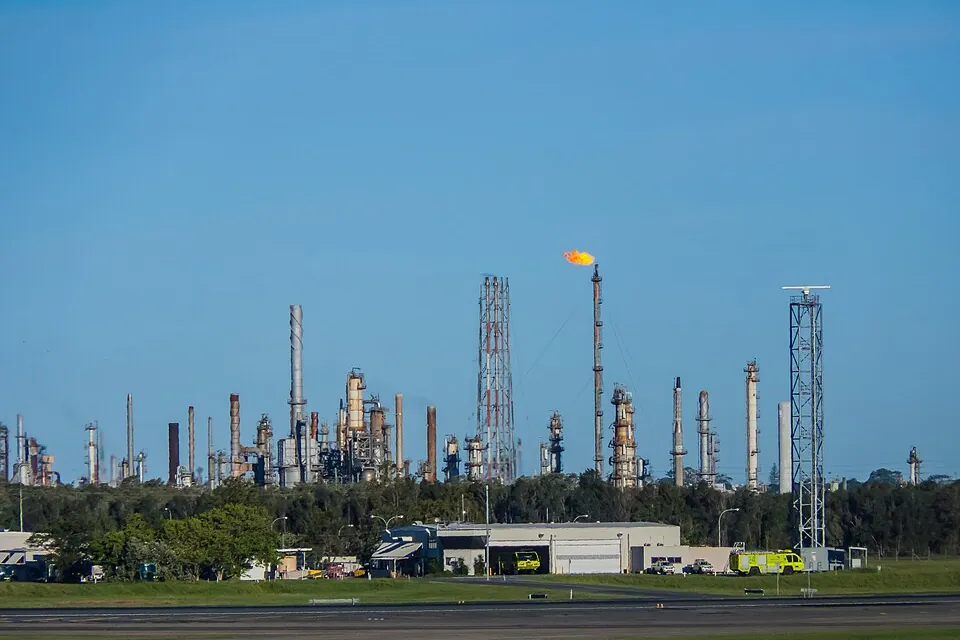
| Economic | Cheap, energy-dense fuels power transport and industry. Australia is one of the world's largest exporters of liquefied natural gas, earning tens of billions of dollars a year and supporting jobs in regional Queensland and Western Australia. Petrochemicals underpin plastics, fertilisers, medicines and solvents. | Australia imports most of its liquid fuel and has only two refineries left (Lytton in Brisbane and Geelong), leaving fuel supply exposed to world prices and shipping disruptions. Climate damage, clean-up and health costs are borne by everyone. Fossil fuel assets risk becoming "stranded" as the world decarbonises. |
| Sociocultural | Affordable energy for heating, cooking, travel and medical care has transformed daily life. Hydrocarbon-derived products are everywhere, from clothing to phones. | Projects can damage Country and cultural heritage: on the Murujuga (Burrup) Peninsula, gas and industrial plants sit beside one of the world's largest collections of rock engravings, and Traditional Owners have long raised concerns that industrial emissions damage them. Murujuga was inscribed on the World Heritage List in 2025. In the Northern Territory's Beetaloo Basin, many Traditional Owners have opposed fracking over risks to water and sacred sites. Communities that depend on fossil fuel jobs face uncertainty in the energy transition. |
Test yourself
The most effective way to reduce the risk of using benzene in a school experiment is to
Substitution sits near the top of the hierarchy of controls; PPE is the last line of defence.
Waste dichloromethane from a school experiment should be
Halogenated waste is kept separate because it needs special high-temperature disposal.
In a fractionating column, the fraction collected nearest the top has
The column is coolest at the top, where only small, volatile molecules are still gaseous.
Cracking C₁₀H₂₂ produces octane and
C₁₀H₂₂ → C₈H₁₈ + C₂H₄: the remaining two carbons have only four H, so the product is ethene.
Label the fractions.
Classify each implication of the oil and gas industry.
The lowest temperature at which a liquid gives off enough vapour to ignite is its . Hazards and safe handling are listed on a safety data . Volatile organic chemicals should be used in a . Crude oil is separated by fractional . Breaking long hydrocarbon chains into shorter ones is called .
Australia is a major producer of natural gas. Examine the environmental, economic and sociocultural implications of extracting and using natural gas in Australia.
Environmental. Natural gas is mostly methane: CH₄ + 2O₂ → CO₂ + 2H₂O. Because methane has a high proportion of hydrogen, it releases less CO₂ per kilojoule than coal, so replacing coal-fired electricity with gas lowers emissions. However, burning gas still adds CO₂, which enhances the greenhouse effect and acidifies the ocean, and methane that leaks unburnt during extraction and transport traps far more heat per molecule than CO₂ over the following decades. Fracking raises concerns about groundwater contamination and water use.
Economic. Liquefied natural gas is one of Australia's largest exports, earning tens of billions of dollars a year and supporting jobs and infrastructure in regional Queensland and Western Australia. Gas is also a feedstock for ammonia fertiliser and plastics. Against this, strong export demand can push up domestic gas prices, and long-lived gas projects risk becoming stranded assets as other countries decarbonise.
Sociocultural. Gas provides reliable heating, cooking and electricity. But projects can affect Country: Traditional Owners on the Murujuga Peninsula have long raised concerns that industrial emissions damage ancient rock engravings, and many Traditional Owners in the Beetaloo Basin oppose fracking because of risks to water and sacred sites. Workers in gas regions face uncertainty during the energy transition.
Judgement. Natural gas brings significant economic and social benefits and can help replace coal in the short term, but its greenhouse impact, especially from methane leaks, means it is a transition fuel rather than a long-term solution, and projects need the consent of the Traditional Owners whose Country they affect.