 Coaching Centre
Combustion of alcohols
Complete and incomplete combustion of alcohols, the enthalpy of combustion and why it rises by about 650 kJ/mol per CH₂, and the practical investigation that measures it with a spirit burner and calorimeter, including calculations, errors, validity and reliability.
From the late 1920s, Australian motorists could fill up with "power alcohol": petrol blended with ethanol distilled from sugar-cane molasses at Sarina in Queensland. Ethanol burns cleanly, but a litre of it carries only about two-thirds of the energy of a litre of petrol, so blends have always been a trade-off. How much energy does an alcohol release when it burns, and why does it change down the series? You can measure it with a spirit burner, a can of water and a thermometer, and that experiment is one of the HSC's favourite sources of questions.
Combustion equations
With plenty of oxygen, alcohols burn completely to carbon dioxide and water, with a clean blue flame:
C₂H₅OH(l) + 3O₂(g) → 2CO₂(g) + 3H₂O(l) ΔH = −1367 kJ/mol
For any alkan-1-ol, CₙH₂ₙ₊₁OH + $\tfrac{3n}{2}$O₂ → nCO₂ + (n+1)H₂O. Balance C first, then H, then O, remembering the alcohol already has one oxygen. Odd numbers of O atoms can give a half: propan-1-ol needs 4½ O₂, so double the whole equation:
2C₃H₇OH + 9O₂ → 6CO₂ + 8H₂O
With a limited oxygen supply, combustion is incomplete: some carbon ends up as carbon monoxide or soot, the flame turns yellow, and less energy is released. For example, C₂H₅OH + 2O₂ → 2CO + 3H₂O. Because alcohols already contain an oxygen atom, they burn more completely than alkanes of similar size, which is one reason ethanol blends cut tailpipe CO.
Enthalpy of combustion
The enthalpy of combustion, ΔcH, is the enthalpy change when one mole of a substance burns completely in oxygen, with reactants and products in their standard states. It is always negative, because combustion is exothermic. (Some questions use the molar heat of combustion, the same number reported as a positive amount of heat released.)
| Alcohol | Formula | M (g/mol) | ΔcH (kJ/mol) | Energy per gram (kJ/g) |
|---|---|---|---|---|
| methanol | CH₃OH | 32.04 | −726 | 22.7 |
| ethanol | C₂H₅OH | 46.07 | −1367 | 29.7 |
| propan-1-ol | C₃H₇OH | 60.10 | −2021 | 33.6 |
| butan-1-ol | C₄H₉OH | 74.12 | −2676 | 36.1 |
| pentan-1-ol | C₅H₁₁OH | 88.15 | −3329 | 37.8 |
| (octane, for comparison) | C₈H₁₈ | 114.2 | −5464 | 47.8 |
The trend is almost a straight line. Each extra CH₂ means one more C–C and two more C–H bonds to break, but also one more CO₂ and one more H₂O to form, and the bonds made release far more energy than the bonds broken absorb. So every CH₂ adds the same chunk, about −650 kJ/mol. Per gram, the energy rises more slowly, towards the value for alkanes, because the oxygen atom becomes a smaller fraction of the mass. Alcohols release less energy per gram than alkanes because they are already partly oxidised.
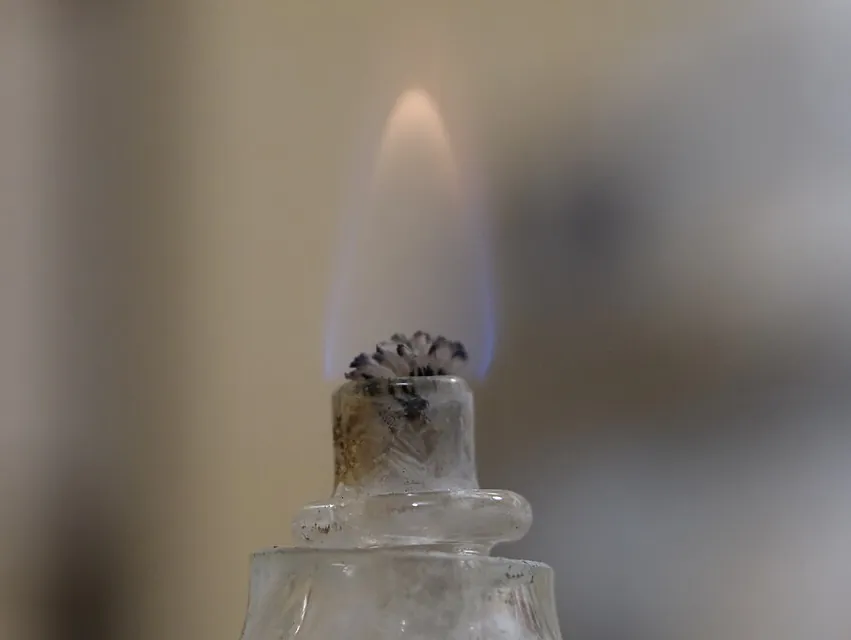
Measuring ΔcH in the lab
- Measure 200 mL (200 g) of water into a copper or aluminium can and clamp it about 2 cm above the wick. Surround it with a draught shield.
- Weigh the spirit burner with its cap on. Record the water's starting temperature.
- Light the burner and stir gently until the temperature has risen by about 15–20 °C.
- Put out the flame with the cap, record the highest temperature reached, and reweigh the capped burner straight away.
- Repeat at least three times with each alcohol, keeping everything else the same.
Burning 0.85 g of ethanol raised the temperature of 200 g of water from 19.5 °C to 34.5 °C. Calculate ΔcH for ethanol and compare it with the data sheet value of −1367 kJ/mol.
Why the result is always too small
- Heat lost to the surroundings: the air, the clamp and the can itself. This is the biggest error and it is systematic, always making the measured value smaller in magnitude. A draught shield, a lid, a shorter gap and a copper can reduce it; including the can's heat capacity in the calculation helps too.
- Incomplete combustion: soot on the bottom of the can shows that less than the full ΔcH was released. It gets worse for longer-chain alcohols.
- Evaporation of alcohol from the wick, which makes the measured mass loss too big. Keep the cap on when weighing.
- Not standard conditions: water produced as vapour carries away energy that the data sheet value includes.
Validity, reliability and accuracy. The comparison between alcohols is valid only if the water mass, can, distance, draught shield and temperature rise are the same for each. Repeating trials and checking that results agree makes them reliable. Even a valid, reliable experiment is usually not accurate, because heat loss is systematic; but because it affects every alcohol similarly, the trend of about −650 kJ/mol per CH₂ still shows clearly.
- Burn ethanol with the bare can and no shield. Calculate ΔcH from the readings and compare it with the sim's answer and the data sheet.
- Add the draught shield and the lid. How close to −1367 kJ/mol can you get?
- Run three trials each of methanol, ethanol, propan-1-ol and butan-1-ol with the same setup, then plot them. What is the average increase per CH₂, and how does it compare with the data sheet?
- Turn on Forgot the cap. Which way does the error push your result, and why?
Test yourself
Which equation shows the complete combustion of propan-1-ol?
O atoms: 2 + 18 = 20 on the left; 12 + 8 = 20 on the right.
Burning 1.20 g of methanol heats 250 g of water by 13.0 °C. The experimental ΔcH is closest to
q = 250 × 4.18 × 13.0 = 13.6 kJ; n = 1.20 ÷ 32.04 = 0.0375 mol; ΔcH = −13.6 ÷ 0.0375 = −363 kJ/mol.
A draught shield is placed around the burner and can. This mainly improves the
It reduces a systematic heat loss, bringing results closer to the true value.
Why does ΔcH become more negative by roughly the same amount for each extra CH₂ in an alcohol?
Each CH₂ contributes the same net energy release.
Label the equipment.
Put the method in order.
The enthalpy change when one mole of a substance burns completely in oxygen is its enthalpy of . Combustion is , so ΔcH is negative. With too little oxygen, alcohols also produce carbon monoxide and . The main reason lab values are too small is heat to the surroundings. Repeating trials and getting similar results makes an experiment .
A student burned butan-1-ol (M = 74.12 g/mol) in a spirit burner under a can containing 150 g of water. The burner lost 0.62 g and the water temperature rose from 20.2 °C to 41.0 °C. Calculate the enthalpy of combustion of butan-1-ol, compare it with the accepted value of −2676 kJ/mol, and suggest two specific improvements to the method.
q = mcΔT = 150 × 4.18 × (41.0 − 20.2) = 150 × 4.18 × 20.8 = 13 042 J = 13.0 kJ.
n = 0.62 ÷ 74.12 = 8.36 × 10⁻³ mol.
ΔcH = −q/n = −13.0 ÷ 0.00836 = −1.6 × 10³ kJ/mol (about −1560 kJ/mol).
This is only about 58% of the accepted value of −2676 kJ/mol. Much of the heat released was lost to the air and the can rather than absorbed by the water, and some butan-1-ol burned incompletely (soot), releasing less energy. Improvements: place a draught shield around the burner and can and put a lid on the can to reduce heat loss; and keep the cap on the burner whenever it is weighed so that evaporation does not inflate the measured mass loss. Lowering the can closer to the flame and using a copper can would also help.