 Coaching Centre
Acid–base indicators
How indicators work as weak acids whose two forms have different colours, colour change ranges and pKa, universal indicator, natural indicators from plants, and the practical investigation to prepare an indicator and use it to follow the pH during a reaction.
Shred some red cabbage, pour boiling water over it and you get a purple liquid that turns red in lemon juice, blue-green in bicarb solution and yellow in drain cleaner. Every one of those colour changes comes from a single idea. An indicator is a weak acid whose two forms are different colours, and the pH decides which form wins.
How an indicator works
An acid–base indicator is a weak acid (or weak base) in which the molecule and its conjugate base have different colours. Writing the acid form as HIn:
$$\mathrm{HIn(aq) + H_2O(l) \rightleftharpoons H_3O^+(aq) + In^-(aq)}$$
Use Le Chatelier's principle. Adding acid raises [H₃O⁺], so the equilibrium shifts left and the HIn colour dominates. Adding base removes H₃O⁺ (OH⁻ + H₃O⁺ → 2H₂O), so the equilibrium shifts right and the In⁻ colour dominates. Only a few drops of indicator are used, so it doesn't noticeably change the pH of the solution it is testing.
Your eye sees a clear colour change only when one form outnumbers the other by roughly ten to one. Since the ratio of the two forms depends on pH (you'll prove this in 6K), the change happens over about two pH units centred on the indicator's p$K_a$:
$$\text{colour change range} \approx \mathrm{p}K_a(\mathrm{HIn}) \pm 1$$
Common indicators
| Indicator | Acid colour | Change range (pH) | Base colour |
|---|---|---|---|
| methyl orange | red | 3.1–4.4 | yellow |
| bromophenol blue | yellow | 3.0–4.6 | blue |
| methyl red | red | 4.4–6.2 | yellow |
| litmus | red | about 4.5–8.3 | blue |
| bromothymol blue | yellow | 6.0–7.6 | blue |
| phenol red | yellow | 6.8–8.4 | red |
| phenolphthalein | colourless | 8.3–10.0 | pink |
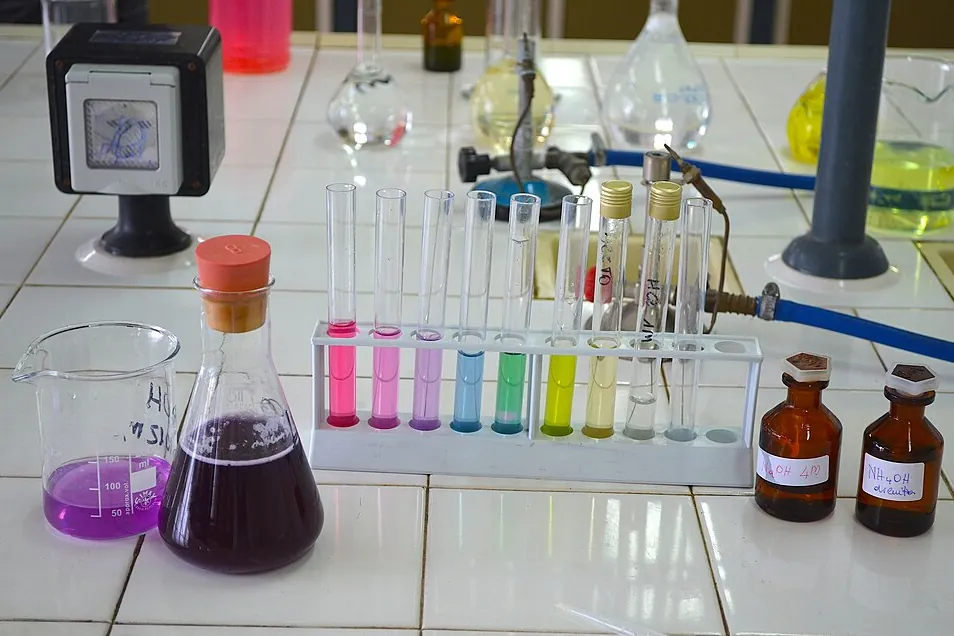
One indicator only tells you whether the pH is above, within or below its range. To estimate a pH you either test with several indicators and narrow it down, or use universal indicator, a mixture of indicators chosen so that the colour changes gradually from red (pH 1) through orange, yellow and green (pH 7) to blue and violet (pH 12–14).
A solution turns methyl orange yellow, bromothymol blue yellow and methyl red orange. Estimate its pH.
Natural indicators
Many plants contain anthocyanins, the water-soluble pigments that make red cabbage, beetroot, blueberries, purple carrots, black tea, rose petals and grape skins coloured. Anthocyanins are weak acids with several protons they can lose, so instead of one colour change they run through a whole series: typically red in strong acid, purple near neutral, blue to green in weak base, and yellow in strong base. That makes red cabbage extract a cheap homemade universal indicator. Deeply coloured Australian native fruits such as Davidson's plum and riberry contain anthocyanins too and can be tested the same way.
Natural indicators have drawbacks for analysis: they go off within a day or two, their colours are less sharp than synthetic indicators, the colour series depends on the plant, and the strong colour of the extract can hide small changes. They're ideal for showing that the pH changes during a reaction, but not for an accurate titration.
- Start with bromothymol blue at pH 7.0. What are the ratio [In⁻] : [HIn] and the percentage of In⁻? Why is the colour green rather than yellow or blue?
- Slide to pH 6.1, then 8.1. Read the ratio each time. How do these numbers explain the "p$K_a$ ± 1" rule?
- Pick methyl orange and set pH 3.5. What ratio do you get, and how does that relate to its p$K_a$?
- Choose the equivalence point "WA + SB (pH 8.7)". Try phenolphthalein, bromothymol blue and methyl orange. Which does the sim say is suitable?
- Now choose "SA + WB (pH 5.3)". Which indicator does the sim accept? Try litmus too, and read why it is rejected. (In 6I you'll see that methyl orange also works for this titration, because the steep part of the curve reaches down to about pH 3.5.)
Indicators, pH meters and data loggers
A pH meter or digital pH probe measures pH to ±0.01 and isn't affected by coloured or cloudy solutions. It needs care: calibrate it with buffer solutions (usually pH 4.00, 7.00 and 10.00) before use, rinse the glass bulb with distilled water between samples, never let it dry out, and allow for temperature. Connected to a data logger, a probe can record pH every second during a titration and draw the whole titration curve (6I). Indicators are still useful: they are cheap and quick, and for a titration an indicator's sharp colour change at the right pH gives a precise end point.
Test yourself
An indicator HIn has p$K_a$ = 5.0. Its acid form is red and its base form is yellow. What colour is it at pH 8?
pH 8 is three units above the p$K_a$, so In⁻ outnumbers HIn by 1000 to 1.
A solution is yellow in bromothymol blue and yellow in methyl orange. Its pH is
Yellow in methyl orange means above 4.4; yellow in bromothymol blue means below 6.0.
When NaOH is added to an indicator solution, the colour changes to the base colour because
Removing a product shifts the equilibrium to replace it, forming more In⁻.
Which is a limitation of red cabbage extract compared with a pH meter?
Natural indicators give subjective, approximate results and don't keep. Calibration is needed for the pH meter, not the indicator.
Label the indicator equilibrium.
Put the steps of the natural indicator investigation in order.
An indicator is a acid whose acid and conjugate base forms have different colours. Its colour change range is about pH units wide, centred on its p$K_a$. A mixture of indicators that gives a different colour at each pH is called indicator. The pigments in red cabbage are called . A pH meter is calibrated using solutions.
Phenolphthalein can be represented as HPh. Use an equation and Le Chatelier's principle to explain why phenolphthalein is colourless in hydrochloric acid but turns pink when excess sodium hydroxide solution is added.
Phenolphthalein is a weak acid: HPh(aq) + H₂O(l) ⇌ H₃O⁺(aq) + Ph⁻(aq), where HPh is colourless and Ph⁻ is pink. In hydrochloric acid, [H₃O⁺] is high, so by Le Chatelier's principle the equilibrium lies far to the left: almost all the indicator is HPh and the solution is colourless. When sodium hydroxide is added, OH⁻ reacts with H₃O⁺ (OH⁻ + H₃O⁺ → 2H₂O), decreasing [H₃O⁺]. The system partially counteracts this by shifting to the right, ionising HPh to produce more H₃O⁺ and Ph⁻. Once the base is in excess (above about pH 8.3), Ph⁻ is present in a high enough proportion that the solution looks pink.