 Coaching Centre
Condensation polymers
How monomers with two functional groups join by losing water to make polyesters and polyamides, the structures and uses of PET, nylon 6,6, nylon 6 and PLA, natural condensation polymers, and how to compare addition and condensation polymers.
When Wallace Carothers' team at DuPont first pulled a fibre of nylon from a molten polymer in 1935, they had made the first fully synthetic fibre. Nylon stockings sold out in hours when they launched in 1940, then vanished from shops during the Second World War because nylon was needed for parachutes. The chemistry behind them is the same reaction that makes an ester or an amide, repeated thousands of times at both ends of every molecule.
Condensation polymerisation
In condensation polymerisation, monomers join by reacting functional groups, and a small molecule (usually water) is released at every link. For the chain to keep growing in both directions, each monomer must have two reactive groups. That can be:
- two different monomers, each with two of the same group (a diacid + a diol, or a diacid + a diamine), or
- one monomer with one of each group (a hydroxy acid or an amino acid).
Joining $n$ monomers in a chain makes $n-1$ links, so $n-1$ water molecules are lost. For a long chain the end groups barely matter, and a polymer made from $n$ repeating units has a molar mass of very nearly $n \times M(\text{repeating unit})$.
Polyesters
A polyester forms when a dicarboxylic acid reacts with a diol. Each link is an ester group, –COO–, formed just as in esterification (7I).
The most important polyester is PET, poly(ethylene terephthalate), made from benzene-1,4-dicarboxylic acid (terephthalic acid) and ethane-1,2-diol (ethylene glycol):
$$n\,\mathrm{HOOC{-}C_6H_4{-}COOH} + n\,\mathrm{HO{-}CH_2CH_2{-}OH} \longrightarrow \mathrm{-\!\!\left[OC{-}C_6H_4{-}COO{-}CH_2CH_2{-}O\right]_{\!n}\!\!-} + (2n-1)\,\mathrm{H_2O}$$
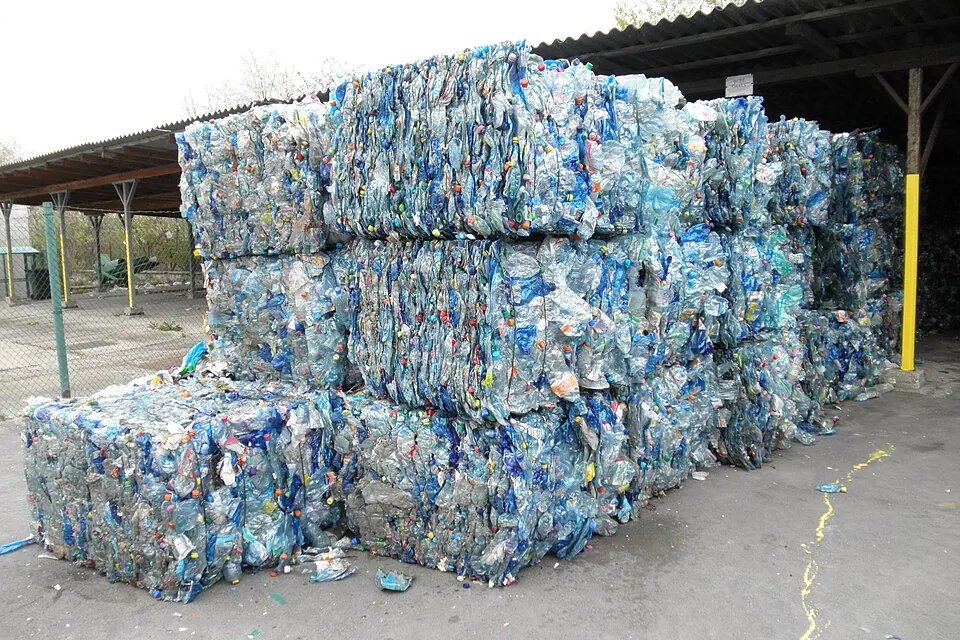
The flat benzene rings make the chains stiff, and the polar ester groups add dipole–dipole attractions, so PET is strong, tough and has a high melting point (~260 °C). It's used for soft-drink and water bottles, food trays and polyester clothing fibres. PET is labelled with resin code 1 and is widely recycled in Australia; container deposit schemes in every state and territory now pay 10 cents for most drink bottles.
PLA, poly(lactic acid), is a polyester made from a single monomer, lactic acid (2-hydroxypropanoic acid), which has both –OH and –COOH. Lactic acid is made by fermenting sugars from corn or sugarcane. PLA is used for compostable cups, packaging and 3D-printing filament. It breaks down by hydrolysis of its ester links, but only quickly at the high temperatures of industrial composting, not in a backyard or the ocean.
Polyamides
A polyamide forms when a dicarboxylic acid reacts with a diamine. Each link is an amide group, –CONH–.
Nylon 6,6 is made from hexane-1,6-diamine and hexanedioic acid (adipic acid). The two numbers are the carbons in each monomer:
$$n\,\mathrm{H_2N(CH_2)_6NH_2} + n\,\mathrm{HOOC(CH_2)_4COOH} \longrightarrow \mathrm{-\!\!\left[NH(CH_2)_6NH{-}CO(CH_2)_4CO\right]_{\!n}\!\!-} + (2n-1)\,\mathrm{H_2O}$$
Nylon 6 comes from a single six-carbon monomer containing both an amine and an acid group (made by ring-opening caprolactam), so its repeating unit is –[NH(CH₂)₅CO]–.
The N–H and C=O groups in neighbouring chains form hydrogen bonds, so nylons are very strong and have high melting points (nylon 6,6 ~265 °C). When the molten polymer is drawn into a fibre, the chains line up and the hydrogen bonds hold them in register, giving a fibre with high tensile strength. Nylon is used for rope, fishing line, clothing, carpets, gears, zip ties and seatbelts. Kevlar, a polyamide with benzene rings in the chain, lines up so well that it is used in bulletproof vests.
Natural condensation polymers
Nature made condensation polymers long before chemists did:
- Proteins are polyamides. Amino acids (each with –NH₂ and –COOH) join by peptide links (amide groups), releasing water. Wool and silk are protein fibres.
- Polysaccharides such as cellulose and starch are condensation polymers of glucose. Each link (a glycosidic link, C–O–C) releases water. Cellulose chains are straight and hydrogen-bond into strong fibres: cotton, wood, paper.
Aboriginal and Torres Strait Islander peoples have long used natural polymers with great skill. Fibres stripped from plants such as pandanus and lomandra (mostly cellulose) were twisted into string and woven into baskets, bags and fish traps, and plant resins such as spinifex resin were heated and worked into a strong adhesive for hafting stone blades to handles.
Addition vs condensation polymers
| Addition | Condensation | |
|---|---|---|
| Monomer requirement | a C=C double bond | two functional groups per monomer (–OH, –COOH, –NH₂) |
| By-product | none (100% atom economy) | a small molecule (usually H₂O) at every link |
| Polymer backbone | only carbon atoms | contains O or N in the links (ester or amide) |
| Empirical formula | same as the monomer | differs from the monomer(s) |
| Interchain forces | mostly dispersion (dipole–dipole in PVC) | dipole–dipole (polyesters), hydrogen bonds (polyamides) |
| Biodegradability | very slow; the C–C backbone isn't hydrolysed | ester and amide links can be hydrolysed, so some (PLA) are compostable |
| Examples | PE, PVC, PS, PTFE | PET, PLA, nylon 6,6, nylon 6, proteins, cellulose |
- Choose PET and add monomers one at a time. After 6 monomers, how many water molecules have been released?
- Choose nylon 6,6 and turn on "Show H-bonds" to see where neighbouring chains link up.
- Switch to lactic acid (PLA): only one monomer is needed. Why?
- Set n = 1000 repeating units of nylon 6,6 and read the molar mass of the chain: about 226 000 g/mol.
Test yourself
Which pair of monomers could form a polyamide?
A diamine and a diacid give amide links in both directions.
Ethanol and ethanoic acid react to form an ester but cannot form a polymer because
After one link there are no reactive groups left at either end.
Nylon 6,6 has a higher melting point than polyethylene of similar chain length mainly because of
N–H···O=C hydrogen bonds are much stronger than the dispersion forces between PE chains.
Which feature is common to all condensation polymers?
That is what "condensation" means. The other options describe addition polymers.
Label the parts of the PET reaction.
Sort each polymer by how it is made.
A polyester is made from a diol and a . Nylon 6,6 is made from hexanedioic acid and . Each link in a polyamide is an group, and neighbouring chains are held together by . The small molecule released in most condensation reactions is .
Compare the structure, formation and properties of polyethylene and nylon 6,6, and evaluate their suitability for making climbing rope.
Formation. Polyethylene is an addition polymer: ethene molecules join by opening their C=C double bonds, with no by-product, giving a saturated carbon-only backbone –[CH₂–CH₂]ₙ–. Nylon 6,6 is a condensation polymer: hexane-1,6-diamine and hexanedioic acid react at both ends, releasing water at each link and forming amide groups (–CONH–) in the backbone.
Forces and properties. Polyethylene chains are non-polar and held only by dispersion forces, so it is relatively soft, melts at about 110–135 °C and stretches. Nylon chains contain N–H and C=O groups that hydrogen bond to neighbouring chains. When drawn into fibres, the chains align and these hydrogen bonds give very high tensile strength, a higher melting point (~265 °C) and good abrasion resistance.
Evaluation. Climbing rope must hold large loads, absorb the energy of a fall by stretching, and not melt when rope runs over rope. Nylon 6,6 is far better suited: it is stronger, stretches elastically to absorb shock and has a higher melting point. Polyethylene floats and doesn't absorb water, so it is used for some water-rescue ropes, but its low melting point and low friction make it unsafe for dynamic climbing ropes. A limitation of nylon is that it absorbs some water and weakens slightly when wet, and degrades in UV light, so ropes must be stored properly and retired after a set time. Overall, nylon 6,6 is the appropriate choice.
A sample of nylon 6,6 has an average molar mass of $3.39 \times 10^{4}$ g mol⁻¹. The repeating unit is –[NH(CH₂)₆NH–CO(CH₂)₄CO]–. Calculate the average number of repeating units per chain and the mass of water released when 1.00 kg of this nylon is made.
Repeating unit C₁₂H₂₂N₂O₂: $M = 12(12.01) + 22(1.008) + 2(14.01) + 2(16.00) = 226.3$ g mol⁻¹.
$n = \dfrac{3.39\times10^{4}}{226.3} \approx 150$ repeating units.
Each repeating unit contains two amide links, so about 2 mol of water is released per mole of repeating units (ignoring the chain ends). Moles of repeating units in 1.00 kg: $\dfrac{1000}{226.3} = 4.42$ mol. Water: $2 \times 4.42 = 8.84$ mol, so $m = 8.84 \times 18.02 = 159$ g.