 Coaching Centre
Buffers
What a buffer is, how a weak acid and its conjugate base resist changes in pH (with equations and Le Chatelier's principle), preparing a buffer, buffer capacity and range, the Henderson–Hasselbalch equation as an extension, and natural buffers in blood, cells and the ocean, including ocean acidification and the Great Barrier Reef.
Your blood pH sits between 7.35 and 7.45. Drop below 7.0 or climb above 7.8 and you would be in a medical emergency, yet every minute your cells pour carbon dioxide and lactic acid into it. The reason it barely moves is a buffer: a pair of particles that mop up added acid and added base before they can change the pH much. The same chemistry is at work in shampoos, eye drops, soils and the whole of the ocean.
What a buffer is
A buffer is a solution that resists changes in pH when small amounts of acid or base are added, or when it is diluted. A buffer contains a weak acid and its conjugate base (or a weak base and its conjugate acid), both in significant and similar amounts. Common examples:
- ethanoic acid and sodium ethanoate: CH₃COOH / CH₃COO⁻ (pH about 4.7)
- sodium dihydrogen phosphate and sodium hydrogen phosphate: H₂PO₄⁻ / HPO₄²⁻ (pH about 7.2)
- ammonium chloride and ammonia: NH₄⁺ / NH₃ (pH about 9.3)
- carbonic acid and hydrogen carbonate: H₂CO₃ / HCO₃⁻ (the main blood buffer).
A strong acid with its conjugate base (HCl with NaCl) is not a buffer, because Cl⁻ is too weak a base to remove added H₃O⁺. A weak acid on its own isn't a good buffer either: it has hardly any conjugate base to react with added acid.
How a buffer works
Take the ethanoic acid–ethanoate buffer. Both members of the conjugate pair are present in large amounts, linked by an equilibrium:
$$\mathrm{CH_3COOH(aq) + H_2O(l) \rightleftharpoons CH_3COO^-(aq) + H_3O^+(aq)}$$
- Adding a small amount of acid: the added H₃O⁺ increases [H₃O⁺], so the equilibrium shifts left (Le Chatelier). The large reserve of CH₃COO⁻ reacts with it: CH₃COO⁻ + H₃O⁺ → CH₃COOH + H₂O. Most of the added H₃O⁺ is used up, so the pH falls only slightly.
- Adding a small amount of base: the added OH⁻ reacts with H₃O⁺, lowering its concentration, so the equilibrium shifts right and more CH₃COOH ionises to replace it. Overall, the large reserve of CH₃COOH neutralises the base: CH₃COOH + OH⁻ → CH₃COO⁻ + H₂O. The pH rises only slightly.
The pH changes a little, not zero, because the ratio [CH₃COO⁻] : [CH₃COOH] shifts slightly each time. HSC answers need the equilibrium equation, the direction of the shift, and which member of the pair reacts.
Buffer capacity and range
Buffer capacity is the amount of acid or base a buffer can absorb before its pH changes significantly. It depends on:
- the concentrations of the weak acid and conjugate base: the more there is, the more can be neutralised
- their ratio: capacity is greatest when [HA] = [A⁻], so the buffer can cope equally with acid and base.
Once added acid has used up most of the conjugate base (or added base most of the weak acid), the buffer is exhausted and the pH changes sharply. A buffer works best within about one pH unit of the weak acid's p$K_a$, so you choose the conjugate pair whose p$K_a$ is closest to the pH you need. You've already met this: the buffer region of a weak acid titration curve (6I) is exactly a buffer being made and used up.
Extension: the Henderson–Hasselbalch equation
Rearranging the $K_a$ expression and taking −log₁₀ of both sides gives a quick way to find the pH of a buffer:
$$K_a = \frac{[\mathrm{H_3O^+}][\mathrm{A^-}]}{[\mathrm{HA}]} \quad\Rightarrow\quad \mathrm{pH} = \mathrm{p}K_a + \log_{10}\frac{[\mathrm{A^-}]}{[\mathrm{HA}]}$$
When [A⁻] = [HA], the log term is zero and pH = p$K_a$, which is the half-equivalence point again. Because both species are in the same volume, you can use their moles instead of concentrations, which makes adding acid or base easy to handle. This equation isn't on the HSC data sheet, but it's a fast check on any buffer calculation.
A buffer contains 0.20 mol/L CH₃COOH and 0.15 mol/L CH₃COONa. Find its pH. (p$K_a$ = 4.76)
To 100.0 mL of the buffer above, 1.0 mL of 1.0 mol/L HCl is added. Find the new pH, and compare with adding the same acid to 100.0 mL of water.
What volume of 0.50 mol/L NaOH must be added to 100.0 mL of 0.40 mol/L CH₃COOH to make a buffer of pH 4.76?
- The tank starts with 100 mL of 0.10 mol/L ethanoic acid–ethanoate buffer. Read the Henderson–Hasselbalch estimate and the exact pH. Add 1.0 mL of 1.0 M HCl: what is the new pH and ΔpH?
- Switch to pure water and add the same 1.0 mL of HCl. Compare ΔpH with the buffer.
- Choose "Ethanoic acid only" and add 1.0 mL of NaOH. How far does the pH move? Why is this a poor buffer?
- Back on the ethanoic acid–ethanoate buffer, add HCl five times. What does the sim say, and what is the pH? Now set the total concentration to 0.50 mol/L and add five lots of HCl again.
- Set the ratio slider to +1. What is the starting pH, and how does it match pH = p$K_a$ + 1?
- Try the phosphate and ammonium buffers. Which would you use to keep a solution near pH 7.2, and which near pH 9.3?
Buffers in natural systems
The syllabus asks you to describe why buffers matter in nature. Living things depend on proteins whose shape, and therefore function, changes with pH, so pH has to be held almost constant.
Blood
Blood is buffered mainly by carbonic acid and hydrogen carbonate:
$$\mathrm{CO_2(aq) + H_2O(l) \rightleftharpoons H_2CO_3(aq) \rightleftharpoons HCO_3^-(aq) + H^+(aq)}$$
Acid released by exercising muscles (lactic acid) is neutralised by HCO₃⁻, which shifts the equilibrium left and produces CO₂ that is breathed out faster. Base is neutralised by H₂CO₃. What makes this buffer so effective is that it is an open system: the lungs control [CO₂] within minutes, and the kidneys control [HCO₃⁻] over hours to days. The ratio [HCO₃⁻] : [H₂CO₃] in blood is about 20 : 1. If blood pH falls below 7.35 (acidosis, e.g. in uncontrolled diabetes or lung disease) or rises above 7.45 (alkalosis, e.g. from hyperventilating), enzymes and nerves stop working properly. Haemoglobin and plasma proteins add extra buffering.
Inside cells
The dihydrogen phosphate–hydrogen phosphate pair, H₂PO₄⁻ ⇌ HPO₄²⁻ + H⁺ (p$K_a$ 7.2), is the main buffer inside cells, where its p$K_a$ sits right at the cell's pH of about 7.0–7.4. Proteins, whose amino acid side chains can gain or lose protons, also buffer cells.
Oceans
Sea water is buffered by the carbonate system. Dissolved CO₂ forms carbonic acid, which equilibrates with hydrogen carbonate and carbonate ions:
$$\mathrm{CO_2 + H_2O \rightleftharpoons H_2CO_3 \rightleftharpoons H^+ + HCO_3^- \qquad H^+ + CO_3^{2-} \rightleftharpoons HCO_3^-}$$
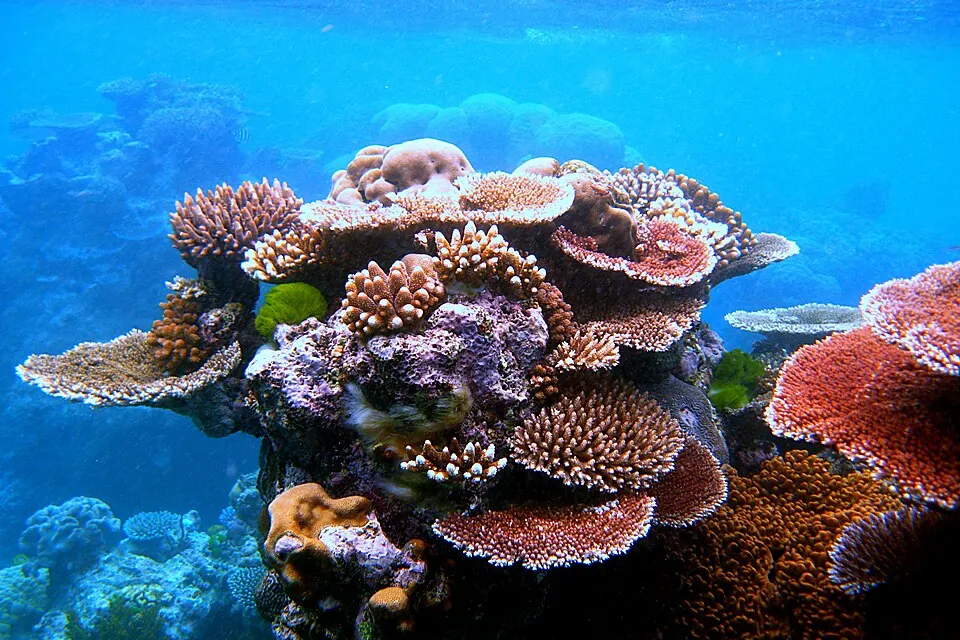
The ocean has absorbed roughly a quarter to a third of the CO₂ released by humans since about 1850. The carbonate buffer has stopped the pH from falling as far as it otherwise would, but it hasn't held it steady: average surface pH has fallen from about 8.2 before industrialisation to about 8.05 today, an increase in [H₃O⁺] of roughly 30–40%. Each extra H⁺ uses up a carbonate ion (H⁺ + CO₃²⁻ → HCO₃⁻), and corals, oysters, sea urchins and many plankton need carbonate to build calcium carbonate skeletons and shells. On the Great Barrier Reef, falling carbonate levels slow coral growth and add to the stress from marine heatwaves. This is called ocean acidification, even though the ocean is still basic: the word describes the direction of change, not an acidic pH.
Test yourself
Which mixture forms a buffer?
NH₃ is a weak base and NH₄⁺ is its conjugate acid.
When a small amount of NaOH is added to an ethanoate buffer, the OH⁻ is mostly removed by
The weak acid member of the pair neutralises added base.
Which buffer has the greatest capacity?
High and equal concentrations of both members give the greatest capacity.
A person who hyperventilates breathes out CO₂ faster than normal. Their blood pH will
Removing CO₂ shifts the equilibria left, consuming H⁺, so pH rises (respiratory alkalosis).
Using pH = p$K_a$ + log₁₀([A⁻] ÷ [HA]), a buffer with p$K_a$ = 7.20 and [HPO₄²⁻] : [H₂PO₄⁻] = 1 : 10 has pH
log₁₀(0.1) = −1, so pH = 7.20 − 1 = 6.20.
Show how the buffer responds.
Which of these mixtures are buffers?
A buffer contains a weak acid and its base. It resists changes in when small amounts of acid or base are added. Buffer capacity is greatest when the weak acid and conjugate base are in a ratio. The main buffer in blood is carbonic acid and . The pH of blood is normally between 7.35 and .
Ocean surface pH has fallen from about 8.2 to about 8.05 since 1850. (a) Use equations to explain how the carbonate system in sea water acts as a buffer. (b) Explain why the ocean's pH has nevertheless fallen, and calculate the percentage increase in [H₃O⁺]. (c) Explain one consequence for marine organisms.
(a) Dissolved CO₂ sets up the equilibria CO₂(aq) + H₂O(l) ⇌ H₂CO₃(aq) ⇌ H⁺(aq) + HCO₃⁻(aq), and HCO₃⁻(aq) ⇌ H⁺(aq) + CO₃²⁻(aq). If acid is added, the extra H⁺ reacts with CO₃²⁻ (and HCO₃⁻), H⁺ + CO₃²⁻ → HCO₃⁻, so the equilibria shift left and most of the H⁺ is removed. If base is added, OH⁻ removes H⁺, and H₂CO₃ and HCO₃⁻ ionise to replace it, shifting the equilibria right. Either way the pH changes only slightly.
(b) Human activity has raised atmospheric CO₂, and the ocean absorbs a large fraction of it. This is a continuous, very large addition of acid: CO₂ dissolving shifts the equilibria to the right, producing H⁺. The buffer absorbs most of it, which is why the change is small, but a buffer only reduces a pH change; it can't prevent one, and its carbonate is being used up. [H₃O⁺] has increased by a factor of 10⁸·²⁰ ÷ 10⁸·⁰⁵ = 10⁰·¹⁵ = 1.41, about a 41% increase.
(c) Each H⁺ absorbed converts a carbonate ion into hydrogen carbonate, so [CO₃²⁻] falls. Corals, oysters, sea urchins and many plankton build skeletons and shells from CaCO₃ (Ca²⁺ + CO₃²⁻ → CaCO₃), so they calcify more slowly, have thinner shells, or see existing structures dissolve. On the Great Barrier Reef this slows coral growth and recovery after bleaching.