 Coaching Centre
Superposition, standing waves and resonance
The principle of superposition, constructive and destructive interference, how two waves travelling in opposite directions make a standing wave with nodes and antinodes, and resonance in mechanical systems, including the effect of damping.
In June 2000 the Millennium Footbridge across the Thames opened, and on its first day began to sway sideways so badly that people had to grab the rails. The bridge's natural sideways frequency, about 1 Hz, was close to the frequency of people's sideways sway as they walked. As it moved, people fell into step with it and pushed it further. It closed after two days and was fitted with dampers. Engineers now check every footbridge for exactly this kind of resonance.
The principle of superposition
When two or more waves pass through the same point at the same time, the resulting displacement is the sum of the displacements each wave would cause on its own:
$y_{\text{total}} = y_1 + y_2$
Displacements are signed, so a crest (positive) and a trough (negative) partly or completely cancel. After overlapping, each wave carries on unchanged, as if the other had never been there. Waves pass through each other; they do not bounce off each other.
- Constructive interference: waves meet in phase (crest on crest), so the amplitudes add and the result is larger.
- Destructive interference: waves meet out of phase (crest on trough), so the result is smaller. Equal amplitudes cancel completely, for that instant.
Destructive interference does not destroy energy. At the moment two equal and opposite pulses cancel, the string is flat but every part of it is moving, so the energy is all kinetic for that instant. Noise-cancelling headphones use the idea: a microphone picks up incoming noise and the speaker plays the inverted wave so the two superpose to nearly zero at your ear.
Pulse A has a maximum displacement of +3.0 cm and pulse B a maximum of −1.0 cm. They meet with their peaks at the same point. Find the displacement there at that instant, and the maximum displacement afterwards.
Standing waves
A wave that travels along, carrying energy from place to place, is a progressive (travelling) wave. If two identical waves travel in opposite directions through the same medium, usually a wave and its reflection, their superposition is a standing wave: a pattern that oscillates in place but does not travel.
- Nodes are points that never move, because the two waves always cancel there.
- Antinodes are points of maximum oscillation, halfway between nodes, with an amplitude of twice that of each travelling wave.
- Neighbouring nodes (or antinodes) are $\lambda/2$ apart, where $\lambda$ is the wavelength of the travelling waves.
- All points between two neighbouring nodes move in phase; points in the next section move in antiphase.
| Progressive wave | Standing wave | |
|---|---|---|
| Energy | transferred along the wave | stored in the pattern; no net transfer |
| Amplitude | same for every particle | zero at nodes, greatest at antinodes |
| Phase | changes steadily along the wave | all points between two nodes in phase |
| Pattern | moves at speed $v$ | stays in place |
A string fixed at both ends can only hold standing waves that have a node at each end, so only certain wavelengths "fit". Those allowed patterns are the harmonics that give musical instruments their notes; page 3F works through them.
A string vibrated at 120 Hz shows a standing wave with nodes 25 cm apart. Find the wavelength and the speed of the travelling waves that make it.
Resonance in mechanical systems
Pull a mass on a spring down and let go: it oscillates at its own natural frequency $f_0$, set by the system (the mass and the stiffness of the spring), not by how far you pulled it. Every object that can vibrate has one or more natural frequencies.
Now drive the system with a periodic force at a driving frequency $f_d$. After a short time it settles into oscillating at $f_d$. How big the oscillation is depends on how close $f_d$ is to $f_0$:
- Far from $f_0$, the pushes are often against the motion, so little energy is transferred and the amplitude stays small.
- When $f_d = f_0$, every push is in step with the motion, so energy is transferred to the system on every cycle and the amplitude grows until the energy lost each cycle (to friction, air resistance and so on) equals the energy put in. This is resonance: the largest amplitude occurs when the driving frequency matches the natural frequency.
Damping is anything that removes energy from the oscillation. Heavier damping gives a lower, broader peak; very light damping gives a tall, sharp one. Within the system, energy is continually transformed between kinetic energy and potential energy (elastic or gravitational), and damping transforms some into thermal energy each cycle.
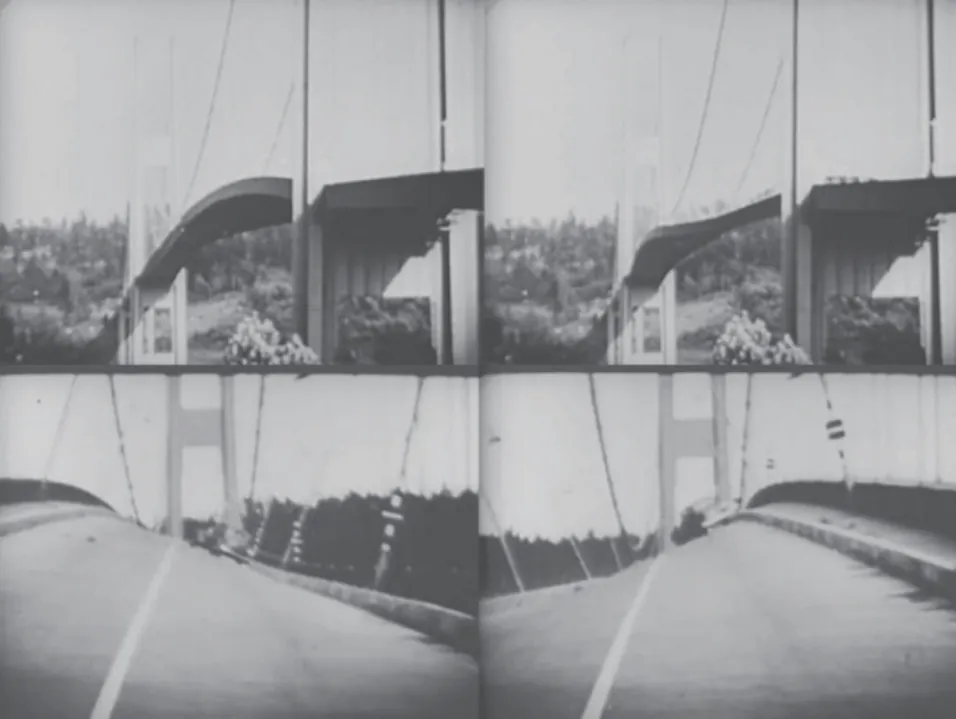
Resonance is useful in a swing pushed in time, the body of a guitar, the quartz crystal that keeps time in a watch, and MRI scanners. It is dangerous in bridges, buildings in earthquakes, and car parts that rattle at particular engine speeds. Engineers either shift the natural frequency away from likely driving frequencies or add damping, such as the tuned mass dampers in tall buildings.
A car's dashboard panel rattles loudly at an engine speed of 2700 rpm and is quiet at other speeds. (a) Find the natural frequency of the panel. (b) Suggest two ways to stop the rattle.
- In Two pulses mode with both amplitudes at 1.0, wait for the pulses to meet: the middle of the string reaches 2.00. Set pulse B to −1.0: the readout falls to 0.00 at the meeting moment.
- Turn on Show each pulse and check that the yellow curve is always the sum of the dashed ones. Do the pulses change after they pass?
- In Standing wave mode, find the points marked N. Do they ever move? Check that they are 20 cm apart when λ = 40 cm.
- In Resonance mode with light damping, set 1.00 Hz: the steady amplitude is 12.0 cm. At 0.50 Hz it is only 0.8 cm. Switch to heavy damping at 1.00 Hz: 2.4 cm.
Test yourself
Two pulses of amplitude 4 cm and −4 cm on a rope meet so that their peaks coincide. At that instant
The displacements add to zero, so the rope is momentarily straight, but its particles are moving. Afterwards both pulses continue.
A standing wave has adjacent antinodes 15 cm apart and a frequency of 200 Hz. The speed of the travelling waves is
Antinode to antinode = $\lambda/2$, so $\lambda = 0.30$ m and $v = 200 \times 0.30 = 60$ m/s.
Which statement correctly distinguishes a standing wave from a progressive wave?
In a standing wave the amplitude is zero at nodes and largest at antinodes. In a progressive wave every particle has the same amplitude.
A child on a swing with a natural frequency of 0.40 Hz is pushed once every 2.5 s. Increasing friction at the swing's pivot would
Pushing every 2.5 s is 0.40 Hz, so the swing is at resonance. More friction is more damping, which lowers the amplitude reached.
Label the resonance graph.
Progressive or standing?
When waves overlap, the total displacement is the of the individual displacements. Points on a standing wave that never move are , and neighbouring ones are a wavelength apart. A driven system has its largest amplitude when the driving frequency equals its frequency. Adding makes the resonance peak lower and broader.
A mass hanging on a spring has a natural frequency of 2.0 Hz. It is attached to a vibrator whose frequency is slowly increased from 0.5 Hz to 4.0 Hz. (a) Describe how the amplitude of the mass changes, and sketch the expected graph. (b) Analyse the transfer and transformation of energy in the system at resonance. (c) Predict the effect of attaching a large card to the mass.
(a) At 0.5 Hz the mass moves with a small amplitude, roughly following the vibrator. As the frequency rises the amplitude increases, slowly at first then sharply, reaching a maximum at 2.0 Hz, the natural frequency. Above 2.0 Hz the amplitude falls again and becomes very small by 4.0 Hz. (Sketch: amplitude against driving frequency, a single peak at 2.0 Hz.)
(b) At resonance each push of the vibrator happens in the same direction as the mass is already moving, so the vibrator does positive work on the system on every cycle: energy is transferred into it. Within the system, energy is continually transformed between kinetic energy (greatest as the mass passes its rest position) and elastic and gravitational potential energy (greatest at the top and bottom). The amplitude grows until the energy transformed into thermal energy each cycle by friction and air resistance equals the energy put in each cycle, and then it stays steady.
(c) The card increases air resistance, which is greater damping. More energy is removed each cycle, so the peak amplitude is smaller and the peak is broader. Resonance still occurs at about 2.0 Hz.