 Coaching Centre
Mechanical and electromagnetic waves
What a wave is, how waves transfer energy without transferring matter, mechanical waves that need a medium, electromagnetic waves that do not, and the difference between transverse and longitudinal waves.
On 26 December 2004 an earthquake off Sumatra lifted the sea floor by a few metres. The tsunami it made crossed the Indian Ocean at about 700 km/h, the speed of a jet airliner, yet a ship in deep water would have felt the wave pass as a gentle rise of less than a metre. The water out at sea mostly just went up and down. What travelled across the ocean was energy, and it was the energy that did the damage when the wave reached the shallows.
In Year 9 you met sound and light as waves. This page builds the Stage 6 model: what is actually moving in a wave, what a wave needs in order to travel, and the two ways the particles of a medium can move.
What a wave is
A wave is a disturbance that transfers energy from one place to another without transferring matter. Flick one end of a stretched rope and a pulse runs along it, but each bit of rope only moves out and back. Drop a stone in a pond and a leaf floating nearby bobs up and down as the ripples pass, then stays roughly where it was.
Two kinds of disturbance are worth separating:
- A pulse is a single disturbance, made by one flick.
- A periodic wave (or continuous wave) is a train of disturbances made by a source that keeps vibrating. Every wave has a vibrating source.
Mechanical waves need a medium
A mechanical wave is a disturbance of a material, called the medium: a rope, a slinky, water, air, rock. Each particle of the medium is pulled back towards its rest position by the forces between it and its neighbours, overshoots, and pushes on the next particle along. That chain of pushes is how the energy is handed on. With no particles there is nothing to push, so mechanical waves cannot travel through a vacuum. That is why no sound reaches us from explosions on the Sun.
The medium also sets the speed. A wave travels faster along a tighter rope, and sound travels faster in water (about 1500 m/s) and steel (about 5000 m/s) than in air (about 340 m/s), because the forces between particles are stronger. Changing how hard or how often you shake the source changes the wave's size and frequency, but not its speed: the speed belongs to the medium.
Electromagnetic waves need no medium
An electromagnetic (EM) wave is a travelling disturbance in electric and magnetic fields. The two fields vibrate at right angles to each other and to the direction of travel, and each changing field keeps creating the other, so the wave sustains itself. It needs no particles at all, which is how sunlight crosses 150 million km of nearly empty space to reach us.
All EM waves travel at the same speed in a vacuum, $c = 3.00 \times 10^8$ m/s. Since 1983 this value has been fixed exactly by the definition of the metre ($c = 299\,792\,458$ m/s). In a material such as glass or water EM waves travel more slowly, which is the reason for refraction (page 3H).
The EM spectrum runs from radio waves (longest wavelength, lowest frequency) through microwaves, infrared, visible light, ultraviolet and X-rays to gamma rays (shortest wavelength, highest frequency). They differ only in frequency and wavelength. You met the uses of each part in Year 9; at Stage 6 the point is that they are all the same kind of wave.
Transverse and longitudinal waves
Waves are classified by how the particles move compared with the direction the wave travels (the direction energy is transferred).
- In a transverse wave the particles vibrate at right angles to the direction of travel. The high points are crests and the low points are troughs. Examples: a wave on a rope or guitar string, S waves in an earthquake, and all EM waves (where the "vibration" is the field, not particles).
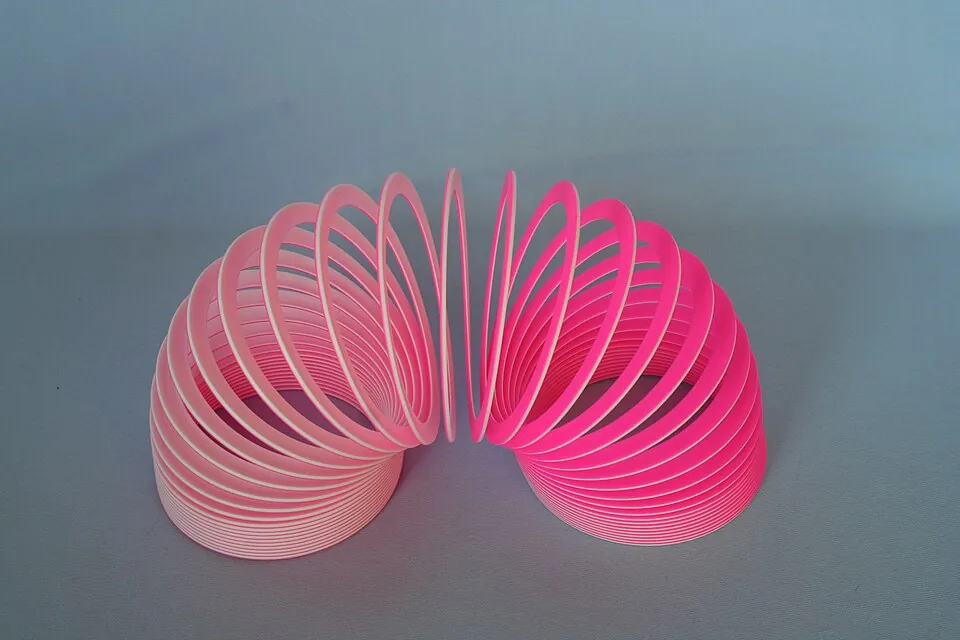
- In a longitudinal wave the particles vibrate parallel to the direction of travel. Regions where particles are bunched together are compressions; regions where they are spread out are rarefactions. Examples: sound in any medium, a slinky pushed and pulled along its length, P waves in an earthquake.
Transverse waves need a medium that resists being sheared sideways, so mechanical transverse waves travel through solids and along surfaces but not through the body of a liquid or gas. Longitudinal waves only need the medium to resist being squashed, so they travel through solids, liquids and gases. Seismologists used this in 1906 to 1926 to discover that Earth's outer core is liquid: S waves (transverse) never arrive at stations on the far side of Earth, while P waves (longitudinal) do. Water waves are a mixture: the water particles move in circles, partly up and down and partly back and forth.
A student holds one end of a slinky still on the floor while a friend holds the other end. Describe how to make (a) a transverse wave and (b) a longitudinal wave, and state what stays the same for both.
- With the wave speed fixed at 1.50 m/s, set the frequency to 1.00 Hz. The readout shows λ = 1.50 m. Change to 2.00 Hz: λ halves to 0.75 m, and the speed does not change.
- Switch between Transverse and Longitudinal and watch the orange coil. Does it ever leave its dashed rest line for good?
- Choose Single pulse in longitudinal mode. Find the red bar (compression) and the blue bar (rarefaction) as the pulse travels.
- Increase the amplitude. The coils move further, but does the pulse reach the far wall any sooner?
Test yourself
Which statement about mechanical waves is correct?
The particles of the medium oscillate about fixed positions while energy is passed along. Mechanical waves need a medium, and their speed depends on it.
A sound wave travels from left to right through air. The air molecules
Sound is longitudinal: the molecules oscillate parallel to the direction of travel, and that motion creates the pressure changes.
Earthquake S waves are not detected on the opposite side of Earth from an earthquake, but P waves are. This is evidence that
S waves are transverse, and transverse mechanical waves cannot pass through the body of a liquid. P waves are longitudinal and can.
Which pair is made up of two transverse waves?
All EM waves (including microwaves and X-rays) are transverse, as are waves on strings. Ultrasound, sound and P waves are longitudinal.
Label the transverse and longitudinal waves.
Sort these waves.
A wave transfers from place to place. A mechanical wave needs a , which also sets its speed. In a longitudinal wave the particles vibrate to the direction of travel, forming compressions and . Electromagnetic waves can travel through a .
Astronauts on a spacewalk can see a nearby satellite's thrusters fire but cannot hear them, even though they can hear each other by radio. Explain these observations, referring to the nature of the waves involved.
Sound is a mechanical wave: energy is passed on as each particle of a medium pushes on its neighbours, producing compressions and rarefactions. Space is almost a vacuum, so there are no particles to carry the compressions, and the sound of the thrusters cannot reach the astronauts.
Light from the thruster flame is an electromagnetic wave. Its changing electric and magnetic fields generate each other, so it needs no medium and travels through the vacuum at $3.00 \times 10^8$ m/s, which is why the astronauts see the flame.
Radio is also an EM wave, so it crosses the vacuum between them. Each helmet's receiver converts the radio signal into sound in the air inside the helmet, where there is a medium for it to travel through.