 Coaching Centre
Elastic and inelastic collisions
Classifying collisions as elastic, inelastic or completely inelastic by comparing kinetic energy before and after, where the lost kinetic energy goes, one-dimensional elastic collisions, Newton's cradle, and the two-stage analysis of the ballistic pendulum.
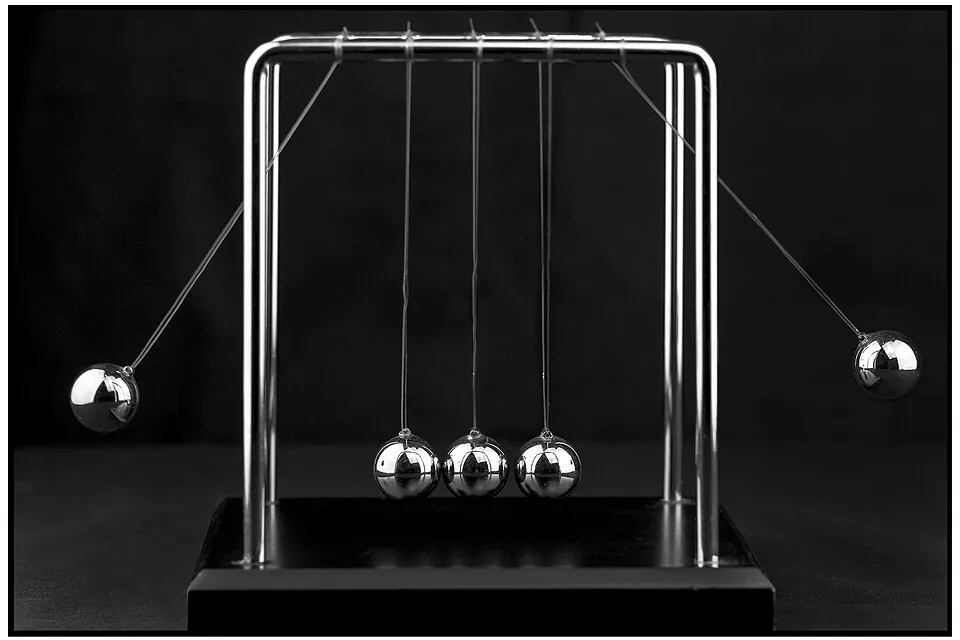
Lift one ball of a Newton's cradle and let it go. One ball flies out the far end, at almost the same speed. Why not two balls at half the speed? That would conserve momentum too. The answer is energy: only one ball out at full speed also keeps the kinetic energy the same, and the steel balls are springy enough that very little is lost.
Momentum is conserved in every collision in a closed system. Kinetic energy is not. Comparing the kinetic energy before and after is how physicists classify a collision, and it tells you how much energy went into sound, heat and bent metal.
Three kinds of collision
| Type | Momentum | Kinetic energy | Examples |
|---|---|---|---|
| Elastic | conserved | conserved: $\Sigma K_{before} = \Sigma K_{after}$ | gas molecules, atoms and subatomic particles; very nearly, steel balls and billiard balls |
| Inelastic | conserved | some lost: $\Sigma K_{after} \lt \Sigma K_{before}$ | most real collisions: a ball bouncing, cars bumping |
| Completely inelastic | conserved | maximum possible loss; objects stick together | a bullet lodging in a block, a rugby tackle, coupling train carriages |
Kinetic energy "lost" in an inelastic collision isn't destroyed. It becomes thermal energy (the objects warm slightly), sound, and the work done permanently deforming the objects. Total energy is always conserved.
A completely inelastic collision doesn't always lose all the kinetic energy. If the total momentum isn't zero, the combined object must still be moving, so some kinetic energy remains. It is the maximum loss allowed by conservation of momentum.
Testing whether a collision is elastic
A 0.50 kg trolley moving at 2.0 m s⁻¹ hits a stationary 1.5 kg trolley. Afterwards the 0.50 kg trolley moves backwards at 1.0 m s⁻¹. Find the velocity of the 1.5 kg trolley and decide whether the collision is elastic.
A 1200 kg car at 20 m s⁻¹ rear-ends a stationary 800 kg car and they move off together. What fraction of the kinetic energy is lost?
Elastic collisions in one dimension
For a head-on elastic collision you have two equations (momentum and kinetic energy) and can solve for both final velocities. Three results are worth remembering for a moving object A hitting a stationary object B:
- Equal masses: A stops and B moves off with A's original velocity. They swap velocities.
- A much heavier than B: A barely slows, and B shoots off at almost twice A's speed.
- A much lighter than B: A bounces back at almost its original speed, and B hardly moves.
Newton's cradle is the equal-mass case in a chain. Each ball passes its velocity to the next, so one ball in gives one ball out. Two balls in give two balls out, because that is the only outcome that conserves both momentum and kinetic energy.
The ballistic pendulum
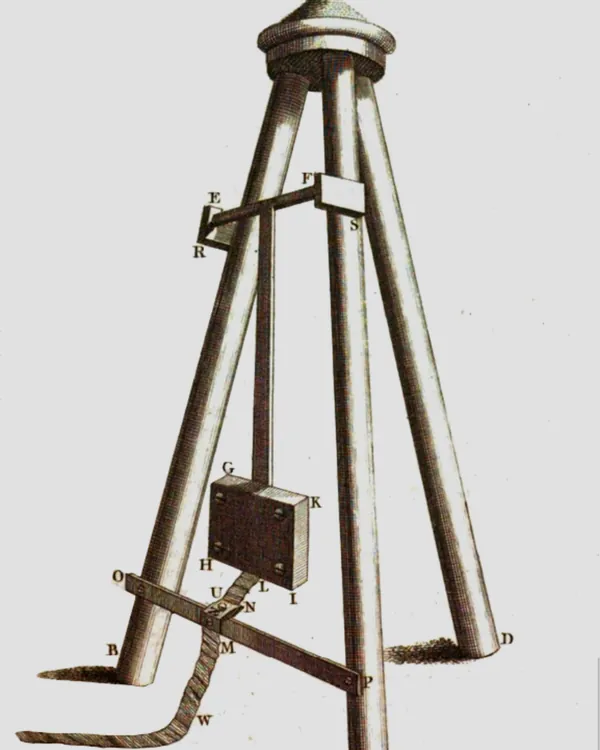
Before electronic timers, the speed of a bullet was measured by firing it into a heavy wooden block hanging on strings and measuring how high the block swung. The analysis has two separate stages, and using the right conservation law for each stage is the whole trick.
- The collision is completely inelastic. Kinetic energy is not conserved (most becomes heat and deformation), but momentum is: $mu = (m + M)V$.
- The swing involves no collision. Only gravity does work (string tension is perpendicular to the motion), so mechanical energy is conserved: $\tfrac12(m + M)V^2 = (m + M)gh$, giving $V = \sqrt{2gh}$.
A 10 g pellet is fired into a 2.0 kg hanging block, which rises 11.4 cm. Find the pellet's speed and the percentage of its kinetic energy lost in the collision.
- Fire a 10 g bullet at 300 m/s into a 2.0 kg block. The block moves off at 1.493 m/s and rises 11.4 cm. The kinetic energy drops from 450 J to 2.24 J, a 99.5% loss.
- Double the block's mass to 4.0 kg: $V$ halves (to 0.748 m/s) and the rise drops to a quarter (2.9 cm).
- Turn on Measure mode. Fire, read the rise, work out the bullet speed with the two-stage method, then press Reveal to check.
- Try 20 g at 500 m/s into a 1.0 kg block: the block would swing right over the top.
Test yourself
In an elastic collision,
Elastic collisions conserve kinetic energy as well as momentum.
A 2.0 kg ball at 3.0 m s⁻¹ hits a stationary 1.0 kg ball. Afterwards the 2.0 kg ball moves at 1.0 m s⁻¹ and the 1.0 kg ball at 4.0 m s⁻¹, both forwards. The collision is
Momentum: 6.0 = 2.0 + 4.0 ✓. KE before 9.0 J; after 1.0 + 8.0 = 9.0 J. Conserved, so elastic.
A 0.020 kg bullet at 400 m s⁻¹ embeds in a 4.0 kg block at rest on ice. The speed of the block afterwards is
$V = \dfrac{0.020 \times 400}{4.020} = 1.99$ m s⁻¹.
In the previous question, the percentage of kinetic energy lost is about
Before: $\tfrac12(0.020)(400)^2 = 1600$ J. After: $\tfrac12(4.02)(1.99)^2 = 7.96$ J. Loss = 99.5%.
Label the ballistic pendulum.
Classify each collision.
In every collision in a closed system, total is conserved. If total kinetic energy is also conserved, the collision is . When objects stick together the collision is completely . In a head-on elastic collision between equal masses, the objects swap . Kinetic energy lost in a collision is transformed into heat, sound and .
A student fires a 5.0 g dart at a 0.25 kg block hanging from a light string. The dart sticks in the block, which rises 18 cm. (a) Calculate the speed of the dart. (3 marks) (b) Compare the collision with an elastic collision, using calculations of kinetic energy to support your answer. (3 marks)
(a) During the swing only gravity does work, so mechanical energy is conserved: $V = \sqrt{2gh} = \sqrt{2 \times 9.8 \times 0.18} = 1.88$ m s⁻¹. During the collision momentum is conserved: $u = \dfrac{(m + M)V}{m} = \dfrac{0.255 \times 1.88}{0.0050} = 96$ m s⁻¹.
(b) Kinetic energy before: $\tfrac12(0.0050)(96)^2 = 23$ J. Kinetic energy just after: $\tfrac12(0.255)(1.88)^2 = 0.45$ J. About 98% of the kinetic energy is transformed in the collision, into heat, sound and the work done pushing the dart into the block. The collision is completely inelastic: the objects stick together and the kinetic energy loss is the greatest that conservation of momentum allows. In an elastic collision no kinetic energy would be lost, and the dart would have to bounce off rather than stick.