 Coaching Centre
Net force and components
Finding the net force on an object by algebraic addition in one dimension, vector addition (tip to tail) in two dimensions, and resolving forces into perpendicular components with F cos θ and F sin θ; the resultant and the equilibrant.
When a big ship is guided into Port Botany, two or three tugboats push and pull it from different angles. The pilot doesn't care about any one tug's force. What matters is the single combined force: how big it is and which way it points. Working that out is the core skill of this page.
Newton's second law uses the net force, the vector sum of every force on an object. There are three ways to find it, and the HSC expects all three: add along a line with signs, add arrows tip to tail, and split each force into components.
Forces along one line: algebraic addition
When all the forces act along the same line, pick one direction as positive and add the forces with signs.
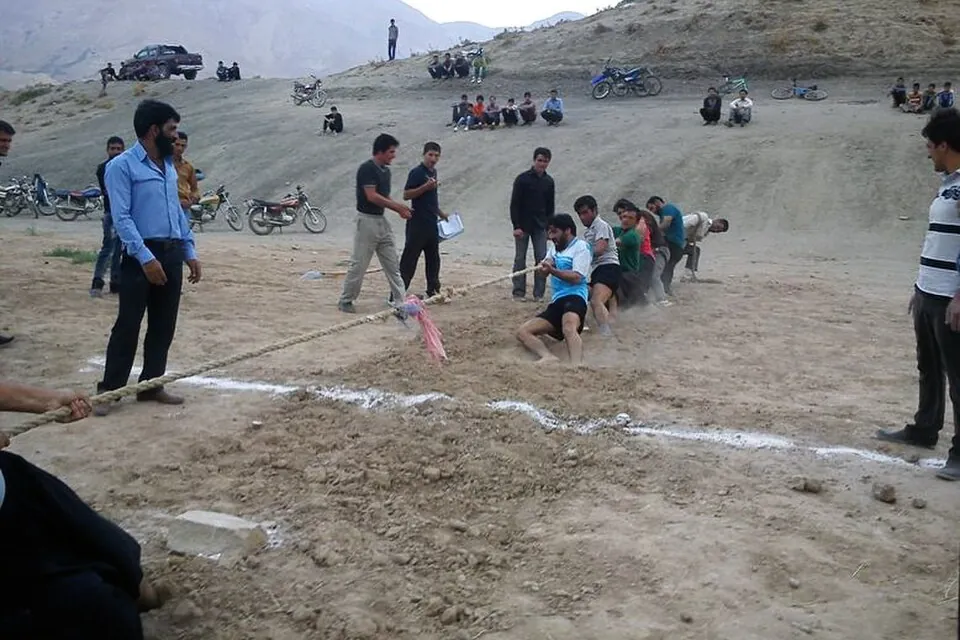
In a tug of war, team East pulls with 1850 N and team West with 1720 N. The rope and both teams have a total mass of 1300 kg. Find the net force and the acceleration.
Vector addition: tip to tail
When forces act in different directions, draw them as arrows to scale, place them tip to tail (the tail of each arrow starts at the tip of the previous one), then draw the resultant from the tail of the first to the tip of the last. The order doesn't matter.
For two perpendicular forces this gives a right-angled triangle, so Pythagoras and trigonometry give the exact answer.
Two ropes pull a post: 30 N east and 40 N north. Find the resultant force.
Resolving forces into components
Any force can be replaced by two perpendicular forces that have the same effect, called its components. If $\theta$ is measured from the $x$-axis:
$$F_x = F\cos\theta \qquad F_y = F\sin\theta$$This is the most powerful method, because it works for any number of forces at any angles:
- Resolve each force into $x$ and $y$ components (with signs).
- Add the $x$ components: $\Sigma F_x$. Add the $y$ components: $\Sigma F_y$.
- Recombine: $F_{net} = \sqrt{(\Sigma F_x)^2 + (\Sigma F_y)^2}$ and $\tan\theta = \dfrac{\Sigma F_y}{\Sigma F_x}$, checking the quadrant from the signs.
Three forces act on a ring: 35 N at 30°, 25 N at 150° and 20 N at 270° (angles measured anticlockwise from east). Find the net force.
Resultant and equilibrant
The equilibrant is the single extra force that would bring the object into equilibrium. It is the same size as the resultant and points the opposite way. In the example above, the equilibrant is 13.2 N at 229.1°.
- Press Right angles: 30 N east and 40 N north give a resultant of 50.0 N at 53.1° (bearing 37°).
- Press Three in balance: three 20 N forces 120° apart add to 0.0 N. The tip-to-tail chain closes into a triangle.
- Press Tugboats: two tugs at 20° either side of the bow give 65.9 N almost straight ahead. Their sideways components cancel.
- Press Find the third and turn on the equilibrant. Set F3 to 31 N at 254° and the resultant drops almost to zero.
Test yourself
A 60 N force acts at 25° above the horizontal. Its horizontal component is
$F_x = 60\cos25° = 54.4$ N.
Forces of 12 N east and 5 N south act on an object. The resultant is
$\sqrt{12^2 + 5^2} = 13$ N; $\tan^{-1}(5/12) = 22.6°$ south of east.
Three forces act on an object in equilibrium. Two of them add to 20 N north. The third force is
In equilibrium the net force is zero, so the third force is the equilibrant of the other two.
A force has components $F_x = -8.0$ N and $F_y = 6.0$ N. Its direction, measured anticlockwise from the positive $x$-axis, is
$\tan^{-1}(6.0/8.0) = 36.9°$ from the negative $x$-axis. With $x$ negative and $y$ positive it is in the second quadrant: $180° - 36.9° = 143°$.
Label the force on the suitcase and its components.
Put the steps for finding a net force by components in order.
A force at angle $\theta$ to the $x$-axis has an $x$ component of $F$ and a $y$ component of $F$. Forces drawn tip to tail give a from the first tail to the last tip. The force that would balance the resultant is called the .
A boat is towed by two ropes. Rope A pulls with 450 N on a bearing of 020°, and rope B pulls with 380 N on a bearing of 075°. Calculate the size and direction of the net force from the ropes.
Take east as $+x$ and north as $+y$. A bearing $\beta$ means an angle $90° - \beta$ from east.
Rope A (70° from east): $F_x = 450\cos70° = 153.9$ N, $F_y = 450\sin70° = 422.9$ N.
Rope B (15° from east): $F_x = 380\cos15° = 367.1$ N, $F_y = 380\sin15° = 98.4$ N.
$\Sigma F_x = 521.0$ N, $\Sigma F_y = 521.3$ N.
$F_{net} = \sqrt{521.0^2 + 521.3^2} = 737$ N, at $\tan^{-1}(521.3/521.0) = 45.0°$ from east, which is a bearing of about 045°.
Net force: about $7.4 \times 10^2$ N on a bearing of 045°.