 Coaching Centre
Friction and resistance forces
Static and kinetic friction and their coefficients, friction = μN, how friction depends on the normal force, applying Newton's first and second laws with friction, rolling resistance, air resistance and terminal velocity.
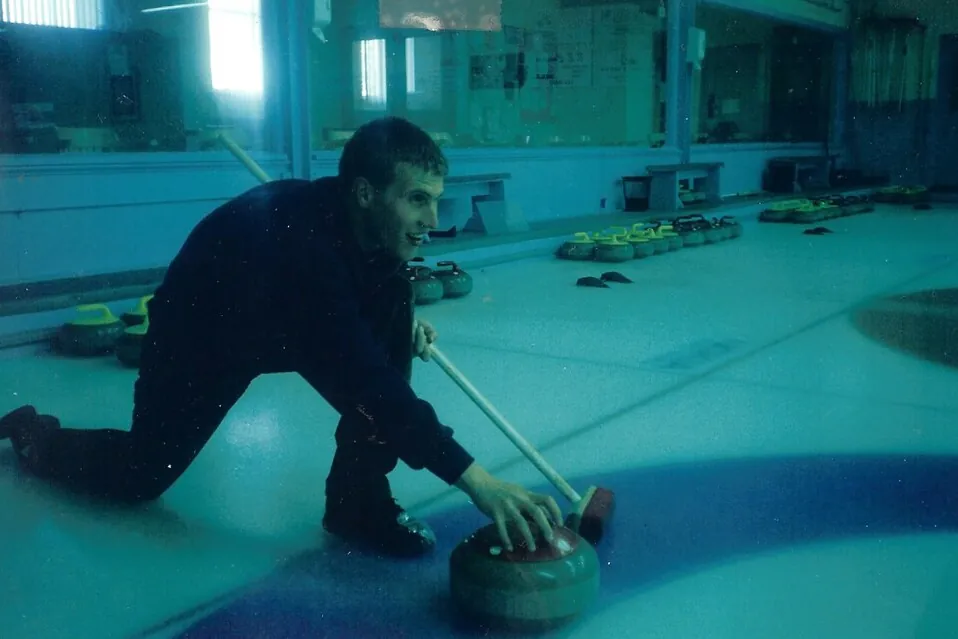
In curling, players sweep the ice in front of a sliding granite stone. Brisk sweeping warms the ice very slightly and smooths it, lowering the friction just enough that a stone can travel a couple of metres further or curl less. A whole sport is built on fine control of one coefficient.
Friction is the force that opposes surfaces sliding (or trying to slide) over each other. Without it you couldn't walk, drive or hold a pen. This page puts numbers on it with the model $f = \mu N$, then uses it with Newton's laws.
Where friction comes from
Even polished surfaces are rough at the microscopic scale. When two surfaces are pressed together, only the highest points touch, and at those points the atoms are close enough to bond. Sliding means breaking those bonds and shearing or riding over the bumps. Press the surfaces together harder and more points touch, so friction rises in proportion to the normal force.
Static and kinetic friction
Push gently on a heavy box and it doesn't move: static friction pushes back with exactly the force needed to stop it sliding. Push harder and static friction grows to match, up to a maximum. Past that, the box breaks free and kinetic friction takes over, which is usually a little smaller and roughly constant.
$$f_s \le \mu_s N \qquad f_k = \mu_k N$$Here $\mu_s$ and $\mu_k$ are the coefficients of static and kinetic friction. They have no units, depend on the pair of surfaces, and for most surfaces $\mu_k \lt \mu_s$. To a good approximation, friction does not depend on the apparent contact area or (for kinetic friction) on the sliding speed.
| Surfaces | $\mu_s$ | $\mu_k$ |
|---|---|---|
| Rubber tyre on dry concrete | 0.9 to 1.0 | 0.7 to 0.8 |
| Rubber tyre on wet concrete | about 0.6 | about 0.5 |
| Steel on steel (dry) | 0.74 | 0.57 |
| Wood on wood | 0.25 to 0.5 | 0.2 to 0.3 |
| Waxed ski on snow | about 0.10 | about 0.05 |
| Teflon on steel | 0.04 | 0.04 |
These are typical values only. Real coefficients vary a lot with surface condition, temperature and moisture, which is why any practical should measure its own.
Using Newton's laws with friction
A worker pulls a 40 kg crate across a level floor with a horizontal rope. The coefficients are $\mu_s = 0.50$ and $\mu_k = 0.35$. (a) What pull is needed to start the crate moving? (b) What pull keeps it moving at constant speed? (c) What is the acceleration if the worker keeps pulling with the force from (a)?
The same 40 kg crate is pulled with 180 N along a rope at 30° above the horizontal ($\mu_k = 0.35$). Find its acceleration.
A car travelling at 60 km/h brakes hard on dry concrete with the wheels locked ($\mu_k = 0.70$). How far does it skid?
Friction that makes things move
Friction opposes relative sliding between surfaces, which isn't always the direction of motion. When you walk, your foot pushes back on the ground and static friction pushes you forward. A car's driven wheels push back on the road, and static friction from the road pushes the car forward. On ice, with tiny $\mu_s$, that forward force has a very low maximum, which is why walking and driving on ice are so hard.
Rolling resistance and air resistance
Moving vehicles feel two main resistance forces:
- Rolling resistance comes mostly from tyres flexing as they roll, which turns energy into heat. It is roughly constant with speed and proportional to the normal force: $F_{roll} = C_{rr} N$, with $C_{rr}$ about 0.01 for car tyres on a good road and around 0.001 for steel train wheels on rails.
- Air resistance (drag) comes from pushing air out of the way. At everyday speeds it is roughly proportional to $v^2$: double the speed, four times the drag.
A falling object speeds up until air resistance grows to equal its weight. Then the net force is zero and it falls at its terminal velocity. A skydiver spread out reaches around 55 m s⁻¹ (200 km/h); diving head-first, closer to 90 m s⁻¹.
- With Wood on wood and a 2 kg block, press Pull. The force rises to a peak of 9.8 N (that's $\mu_s N$), then drops to a sliding value of 5.9 N.
- Pull again at 1, 3, 4, 5 and 6 kg. The points on the friction against normal force graph fall on a straight line with gradient 0.30, which is $\mu_k$.
- Switch to Rubber on concrete and pull the 2 kg block: the peak is 17.6 N and the sliding force 13.7 N.
Test yourself
A 25 kg box rests on a level floor ($\mu_s = 0.40$). A horizontal push of 60 N is applied. The friction force on the box is
Maximum static friction is $0.40 \times 245 = 98$ N. The push (60 N) is less, so the box stays still and static friction equals the push: 60 N.
A sled slides across snow and slows from 6.0 m s⁻¹ to rest in 12 m. The coefficient of kinetic friction is about
$a = u^2/(2s) = 36/24 = 1.5$ m s⁻². $\mu_k = a/g = 1.5/9.8 = 0.15$.
When a car accelerates from rest on a level road, the external horizontal force that speeds it up is
The tyres push back on the road; the road's static friction pushes the car forward. Engine forces are internal.
Doubling a car's speed from 50 km/h to 100 km/h changes the air resistance by a factor of about
Drag is roughly proportional to $v^2$, so $2^2 = 4$.
Label the friction graph.
How does each change affect kinetic friction on a block sliding on a bench?
Friction on a surface is proportional to the force. The coefficient of friction sets the force needed to start an object sliding, and is usually than the coefficient of kinetic friction. Air resistance increases roughly with the of speed, and a falling object reaches velocity when drag equals its weight.
A 1200 kg car is travelling at 72 km/h on a wet road when the driver brakes hard. With anti-lock brakes the tyres use static friction ($\mu_s = 0.60$); with locked wheels they skid ($\mu_k = 0.45$). Calculate the braking distance in each case, and explain why anti-lock brakes improve safety.
$u = 72/3.6 = 20$ m s⁻¹. The braking force is friction, $\mu mg$, so $a = \mu g$ and the mass cancels.
Anti-lock: $a = 0.60 \times 9.8 = 5.88$ m s⁻². $s = \dfrac{u^2}{2a} = \dfrac{400}{11.76} = 34$ m.
Locked wheels: $a = 0.45 \times 9.8 = 4.41$ m s⁻². $s = \dfrac{400}{8.82} = 45$ m.
Anti-lock brakes keep the tyres rolling just short of slipping, so the friction between tyre and road is static, and maximum static friction is larger than kinetic friction. The larger braking force gives a larger deceleration and a stopping distance about 11 m shorter. Because the wheels keep turning, sideways static friction is also available, so the driver can still steer around a hazard. A skidding car can't be steered.