 Coaching Centre
Current and potential difference in circuits
Electric current as the rate of flow of charge (I = q/t), conventional current and electron flow, drift velocity and why it is so slow, emf and potential difference as energy per coulomb (V = W/q), and how to connect ammeters and voltmeters.
Flick a light switch and the globe on the ceiling lights before you can blink. Yet the electrons in the wire crawl along at a fraction of a millimetre per second: an electron leaving the switch would take hours to reach the light. Something must be travelling fast, and it isn't the electrons. Sorting out what moves, and how fast, is the starting point for every circuit you'll analyse.
Current is the rate of flow of charge
An electric current is a flow of charged particles. In metal wires these are free electrons; in salt solutions, your nerves and the electrolyte of a battery they are ions. Current is the amount of charge passing a point per second:
$$I = \frac{q}{t}$$
The unit is the ampere (A), one coulomb per second. Since 2019 the ampere has been defined by fixing the value of the elementary charge: one ampere is a flow of exactly 1/(1.602 176 634 × 10−19) ≈ 6.24 × 10¹⁸ elementary charges per second. (Some textbooks still give the older definition using the force between two parallel wires, which you'll meet in Year 12; it was retired in 2019.)
A car's headlights draw 2.5 A for 3.0 minutes. How much charge flows, and how many electrons is that?
$q = It = (2.5)(3.0 \times 60) = 450$ C.
$n = \dfrac{q}{e} = \dfrac{450}{1.602 \times 10^{-19}} = 2.8 \times 10^{21}$ electrons.
Conventional current and electron flow
Long before anyone knew about electrons, the direction of current was defined as the way positive charge would flow: out of the positive terminal of a battery, round the circuit and back into the negative terminal. This is conventional current, and every rule in physics (including the right-hand rules in 4J) uses it. In a metal the electrons actually move the opposite way, from negative to positive. A flow of negative charge one way is equivalent to a flow of positive charge the other way, so the two descriptions give the same current.
How fast do the electrons move?
Free electrons in a metal already zip around randomly at about 105 m s−1, colliding with the vibrating ions, but with no net direction there is no current. A battery sets up an electric field along the wire, and the electrons pick up a tiny average drift velocity v against the field. The current depends on how many free electrons there are per cubic metre (n), their charge (q), their drift velocity and the cross-sectional area (A) of the wire:
$$I = nqvA$$
A copper wire 1.0 mm in diameter carries 2.0 A. Copper has 8.5 × 1028 free electrons per m3. Find the drift velocity.
$A = \pi r^2 = \pi(0.50 \times 10^{-3})^2 = 7.85 \times 10^{-7}$ m2.
$v = \dfrac{I}{nqA} = \dfrac{2.0}{(8.5 \times 10^{28})(1.602 \times 10^{-19})(7.85 \times 10^{-7})} = 1.9 \times 10^{-4}$ m s−1, about 0.19 mm s−1.
The wire is already full of free electrons. When the switch closes, the electric field spreads through the circuit at close to the speed of light and every electron starts drifting at once, like water in a full hose. The electrons that light the globe were already in its filament.
Potential difference in a circuit
In 4D, potential difference was defined as energy per unit charge. In a circuit, a battery or power supply does work on the charges, raising their potential energy; the components then convert that energy into heat, light or motion. For any two points,
$$V = \frac{W}{q}$$
where W is the energy transferred to or from charge q. The energy per coulomb supplied by a source is often called its emf (ε). A 9.0 V battery gives each coulomb 9.0 J; a 6.0 V lamp in a circuit converts 6.0 J of electrical energy into heat and light for every coulomb that passes through it. Charge is not used up in a circuit: the same coulombs go round and round. What is used up is the energy they carry.
A 9.0 V battery drives a current of 0.15 A through a radio for 20 minutes. How much energy does it supply?
$q = It = (0.15)(20 \times 60) = 180$ C.
$W = qV = (180)(9.0) = 1.6 \times 10^{3}$ J.
Measuring current and potential difference
- An ammeter measures the current through a component, so it is connected in series with it. An ideal ammeter has zero resistance, so it doesn't reduce the current it is measuring.
- A voltmeter measures the potential difference across a component, so it is connected in parallel with it, one lead on each side. An ideal voltmeter has infinite resistance, so it draws no current from the circuit.
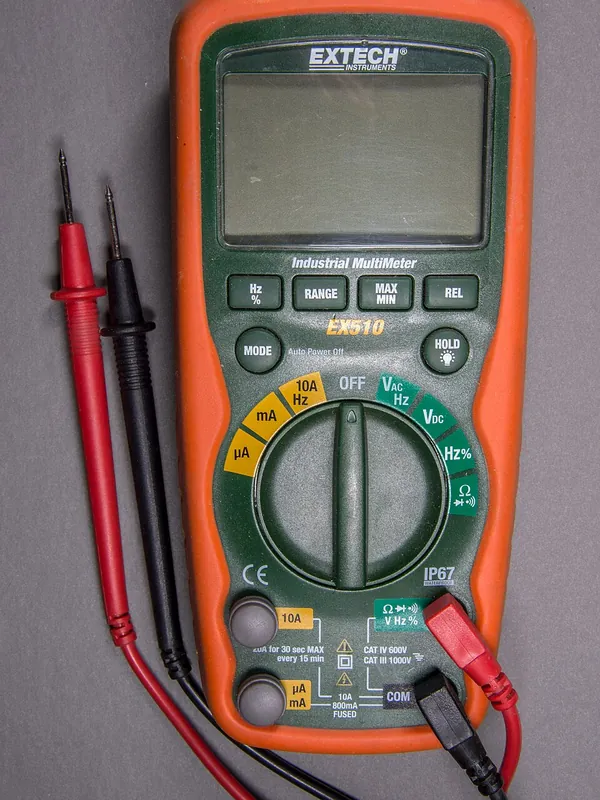
- Digital multimeters do both jobs: switch the dial and move the red lead to the "A" or "mA" socket for current, or the "V" socket for voltage. Putting a meter on its current setting across a battery is a short circuit and usually blows the meter's fuse.
- Copper, 2.0 A, 1.0 mm wire: 1.25 × 10¹⁹ electrons pass the gate each second, yet the drift speed is only 0.19 mm s−1 and it takes about 89 min to drift 1 m.
- Press "Count charge for 10 s". You should get 20 C. Check with q = It.
- Double the diameter to 2.0 mm. The drift speed falls to 0.047 mm s−1, a quarter. Use I = nqvA to explain why.
- Switch to silver (fewer free electrons per m3) at 1.0 mm. Predict whether the drift speed rises or falls, then check (0.27 mm s−1).
Test yourself
A charge of 36 C passes a point in a wire in 1.5 minutes. The current is
I = q/t = 36/(1.5 × 60) = 0.40 A.
A 12 V battery transfers 3.0 kJ of energy to a circuit. How much charge flowed?
q = W/V = 3000/12 = 250 C.
The same current flows through a thin wire and a thick wire of the same metal joined end to end. In the thin wire, the drift velocity of the electrons is
I = nqvA with I, n and q fixed, so v ∝ 1/A. The electrons drift faster through the narrower section.
Which describes the correct way to connect meters to measure the resistance of a lamp?
Current is measured through (series), potential difference across (parallel).
In a circuit with a battery and a lamp, conventional current flows
Conventional current is the direction positive charge would flow: out of the + terminal, round the external circuit, back to −.
Label the measuring circuit.
Sort the properties.
Current is the rate of flow of and is measured in . Conventional current flows from the terminal round the circuit, the opposite way to the in a metal. Potential difference is energy per and is measured with a connected in parallel.
A student says: "When I turn on a torch, the electrons from the battery race through the wires to the globe, which is why it lights up instantly." Evaluate this statement, using the idea of drift velocity in your answer.
The statement is incorrect. The free electrons in a metal drift very slowly, typically a fraction of a millimetre per second (I = nqvA gives about 10−4 m s−1 for a few amps in a household wire), so an electron leaving the battery would take minutes to hours to reach the globe. The wires and filament are already full of free electrons. Closing the switch sets up an electric field throughout the circuit, and this field travels at close to the speed of light. Every free electron, including those already in the filament, begins drifting almost immediately, so energy is transferred to the filament at once and it lights. The energy is carried by the field acting on charges everywhere in the circuit, not by particular electrons travelling from the battery.
A phone charger delivers 2.1 A at 5.0 V for 45 minutes. Calculate (a) the charge delivered and (b) the energy transferred to the phone.
(a) t = 45 × 60 = 2700 s. q = It = (2.1)(2700) = 5.7 × 10³ C.
(b) W = qV = (5670)(5.0) = 2.8 × 10⁴ J.