 Coaching Centre
Work, energy and potential difference
Work done on a charge by a uniform electric field, electric potential energy, potential difference as energy per unit charge (V = W/q), why E = V/d, equipotential lines, the electron volt, and the speed of a charge accelerated from rest.
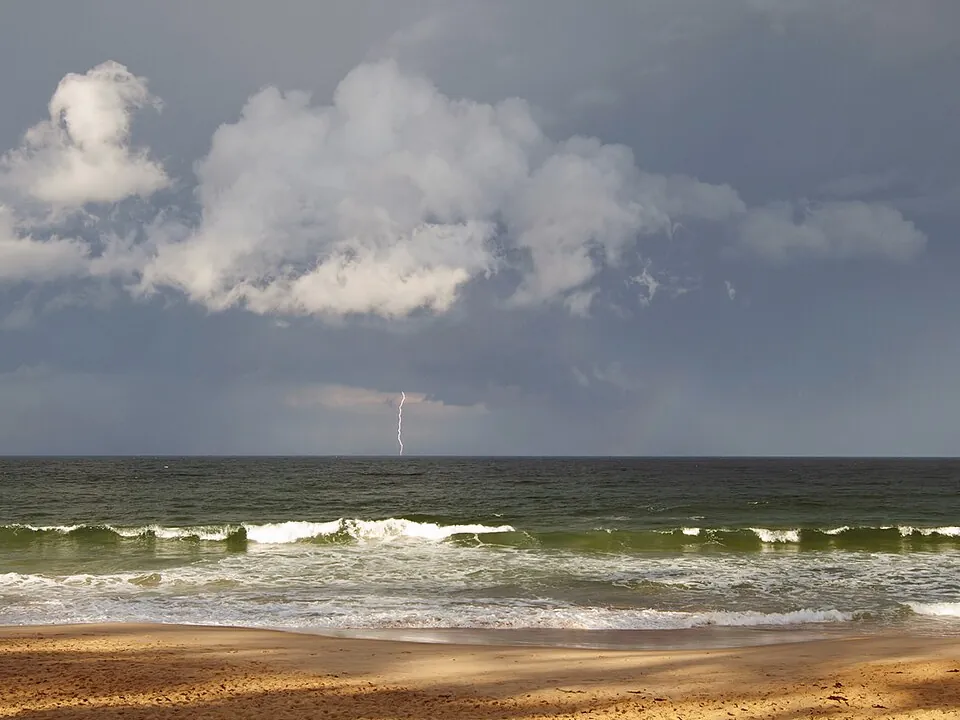
A summer storm rolls over Manly, and the base of the cloud sits at a potential hundreds of millions of volts different from the beach below. Air is normally a superb insulator, but once the field gets strong enough it breaks down and a channel of hot, conducting gas carries a few coulombs to the ground in a fraction of a second. Each coulomb releases hundreds of millions of joules. "Volts" are a measure of exactly that: how much energy each coulomb of charge gains or loses.
Work done by a uniform field
In a uniform field a charge q feels a constant force $F = qE$. If it moves a distance d along the field, the field does work on it:
$$W = Fd = qEd$$
This is exactly like a ball falling in Earth's gravitational field, where the field does work $mgh$. When the field does positive work, the charge loses electric potential energy U and (if nothing else acts) gains the same amount of kinetic energy. To move a charge against the field, something else must do work on it, and its potential energy rises.
Potential difference
The work depends on the charge, so it is useful to quote it per coulomb. The potential difference between two points is the change in potential energy per unit charge when a charge moves between them:
$$V = \frac{\Delta U}{q} \qquad\text{or}\qquad W = qV$$
The unit is the volt: 1 V = 1 J C−1. A 12 V car battery gives 12 J of energy to every coulomb that passes through it. Potential difference is often loosely called "voltage".
Combining $W = qEd$ with $W = qV$ gives $qEd = qV$, so
$$E = \frac{V}{d}$$
That is where the parallel-plate formula from 4B comes from, and why the field strength can be quoted in V m−1 as well as N C−1: the two units are identical (1 V m−1 = 1 J C−1 m−1 = 1 N C−1).
A convenient energy unit for single particles is the electron volt: the energy gained by one electron charge moving through 1 V. $1\ \text{eV} = 1.602 \times 10^{-19}$ J. You'll use it constantly in Year 12.
A +3.0 μC charge is pushed 4.0 cm directly against a uniform field of 2.0 × 10⁴ V m−1. Find the work done on the charge and the potential difference it moves through.
$W = qEd = (3.0 \times 10^{-6})(2.0 \times 10^{4})(0.040) = 2.4 \times 10^{-3}$ J. This work is done by the pushing agent, against the field, and is stored as potential energy: ΔU = +2.4 × 10⁻³ J.
$V = \dfrac{\Delta U}{q} = \dfrac{2.4 \times 10^{-3}}{3.0 \times 10^{-6}} = 800$ V. Check: $V = Ed = (2.0 \times 10^{4})(0.040) = 800$ V.
Equipotential lines
An equipotential is a line (or surface) joining points at the same potential. Moving a charge along an equipotential takes no work, because ΔU = qΔV = 0. That means the field must have no component along an equipotential: equipotentials are always perpendicular to field lines.
- Between parallel plates, the potential falls steadily from one plate to the other, so equipotentials are parallel to the plates and equally spaced. With 100 V across the plates, the 75 V, 50 V and 25 V lines divide the gap into quarters.
- Around a point charge, equipotentials are concentric circles (spheres in 3D). They get further apart as you move out because the field weakens.
- Equipotentials are like contour lines on a map: where they are close together the "slope" (the field) is steep.
Charges released in a field
A charge released from rest between plates accelerates along the field (if positive) or against it (if negative). All the work done by the field becomes kinetic energy:
$$qV = \tfrac{1}{2}mv^2 \quad\Rightarrow\quad v = \sqrt{\frac{2qV}{m}}$$
The final speed depends on the potential difference crossed, not on how far apart the plates are: closer plates give a stronger field but a shorter run. Year 12 Module 6 (topic 6A) takes this further and fires charges across a field to make them follow parabolic paths.
An electron starts from rest and is accelerated through a potential difference of 500 V. Find its kinetic energy (in joules and eV) and its final speed. ($m_e = 9.109 \times 10^{-31}$ kg)
$K = qV = (1.602 \times 10^{-19})(500) = 8.01 \times 10^{-17}$ J $= 500$ eV.
$v = \sqrt{\dfrac{2K}{m}} = \sqrt{\dfrac{2(8.01 \times 10^{-17})}{9.109 \times 10^{-31}}} = 1.33 \times 10^{7}$ m s−1.
The electron is negative, so it accelerates towards the positive plate, against the field direction.
- Proton, 100 V, 5.0 cm: E = 2,000 V m−1. A is on the positive plate and B on the negative plate, so the field does 1.60 × 10⁻¹⁷ J of work (100 eV) and ΔU = −1.60 × 10⁻¹⁷ J.
- Change the separation to 10.0 cm. E halves, but the work from plate to plate stays 1.60 × 10⁻¹⁷ J. Explain why.
- "Tap moves B", then tap B onto the positive plate, well to the side of A. A and B are now at the same potential (100 V) and the work is 0 J. Try other pairs of points on the same dashed equipotential.
- Press "Release from rest at A": the proton reaches the negative plate at 1.38 × 10⁵ m s−1. Switch to an alpha particle: the work doubles to 3.20 × 10⁻¹⁷ J, but the speed is only 9.82 × 10⁴ m s−1. Why?
- Electron with A on the positive plate and B on the negative plate: the field does −1.60 × 10⁻¹⁷ J of work. Something else must push it.
Test yourself
How much work does the field do on a −2.0 μC charge that moves from a point at 50 V to a point at 20 V?
W = q(Vstart − Vend) = (−2.0 × 10⁻⁶)(50 − 20) = −6.0 × 10⁻⁵ J. A negative charge moving to lower potential gains potential energy.
Two parallel plates 8.0 mm apart have a field of 1.5 × 10⁴ V m−1 between them. The potential difference across the plates is
V = Ed = (1.5 × 10⁴)(8.0 × 10⁻³) = 120 V.
Which statement about equipotential lines is correct?
ΔV = 0 along an equipotential, so W = qΔV = 0. The field (and force) is perpendicular to it, not zero.
A proton and an alpha particle (charge +2e, mass ≈ 4mp) are accelerated from rest through the same potential difference. The ratio of the alpha particle's speed to the proton's speed is
v = √(2qV/m): the alpha has twice q and four times m, so v ∝ √(2/4) = 1/√2 of the proton's.
One volt is equal to
V = W/q, so 1 V = 1 J C−1. (1 N C−1 is a unit of field strength, equal to 1 V m−1.)
Label the field and equipotential diagram.
Sort each movement in a uniform field.
Potential difference is the change in potential per unit charge, measured in . The work done on a charge q moved through a potential difference V is . Equipotential lines are always to field lines. An electron accelerated through 1 V gains one electron of kinetic energy.
A proton is released from rest next to the positive plate of a pair of parallel plates 2.0 cm apart, with 600 V across them. (a) Calculate the field strength and the force on the proton. (b) Calculate the speed with which the proton reaches the negative plate. (c) Explain, using energy, why the plate separation does not affect your answer to (b).
(a) E = V/d = 600/0.020 = 3.0 × 10⁴ V m−1. F = qE = (1.602 × 10⁻¹⁹)(3.0 × 10⁴) = 4.8 × 10⁻¹⁵ N towards the negative plate.
(b) The work done by the field becomes kinetic energy: K = qV = (1.602 × 10⁻¹⁹)(600) = 9.6 × 10⁻¹⁷ J. v = √(2K/m) = √(2 × 9.6 × 10−17 ÷ 1.673 × 10⁻²⁷) = 3.4 × 10⁵ m s−1.
(c) The work done by the field is W = Fd = qEd. Because E = V/d, this is W = q(V/d)d = qV. Bringing the plates closer makes the field and the force larger, but the force then acts over a proportionally shorter distance, so the work done, the kinetic energy gained and the final speed depend only on the charge and the potential difference.