 Coaching Centre
Relative motion
Relative velocity in one dimension for overtaking and approaching cars, and in two dimensions for a boat crossing a flowing river and an aeroplane in a crosswind, using vector addition and subtraction with frames of reference.
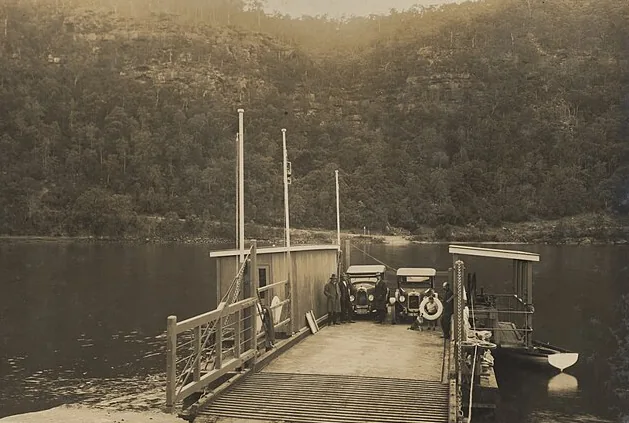
The car ferry at Wisemans Ferry crosses the Hawkesbury River on cables, so the current can't carry it off course. A small boat crossing the same river has no cables. If it simply points at the far bank, it lands somewhere downstream. Which way should it point, and does pointing upstream get it across faster or slower?
Every velocity is measured relative to something, usually the ground. Relative velocity asks what the motion looks like from somewhere else: from another car, from the water, or from the air. The rules are the vector rules from 1F and 1G.
Relative velocity in a straight line
The velocity of A relative to B is how A appears to move to an observer travelling with B:
$$\vec v_{A \text{ rel } B} = \vec v_A - \vec v_B$$Both velocities on the right are measured relative to the same frame, usually the ground.
Car A travels east at 25 m s⁻¹. Find the velocity of A relative to B when car B travels (a) east at 20 m s⁻¹, (b) west at 20 m s⁻¹.
Relative velocity makes overtaking easy to analyse. If A is 30 m behind B in (a), the gap closes at 5 m s⁻¹, so A draws level after $30 \div 5 = 6.0$ s.
Adding velocities across frames
When something moves through a medium that is itself moving (a boat in a river, a plane in the wind), add the velocities:
$$\vec v_{\text{object rel ground}} = \vec v_{\text{object rel medium}} + \vec v_{\text{medium rel ground}}$$The labels chain together: "boat rel water" + "water rel bank" = "boat rel bank". If the inner labels match, the equation is set up correctly.
A boat crossing a river
A river is 120 m wide and flows at 2.0 m s⁻¹. A boat moves at 4.0 m s⁻¹ relative to the water and points straight across. Find its velocity relative to the bank, the crossing time and how far downstream it lands.
The same boat must land directly opposite its starting point. Which way should it point, and how long does the crossing take?
The fastest crossing is always straight across, because all of the boat's velocity relative to the water then goes into crossing. Any angle upstream reduces the across component.
An aeroplane in a crosswind
Pilots use specific words:
- Heading: the direction the plane points (its velocity relative to the air).
- Airspeed: its speed relative to the air.
- Track and ground speed: its actual direction and speed relative to the ground.
- Winds are named by the direction they blow from. A southerly blows from the south, towards the north.
A plane has an airspeed of 250 km/h. A 60 km/h wind blows from the south. The destination is 300 km due east. Find the heading, the ground speed and the flight time.
- In Two cars, one road, use A = +25 and B = +20 m/s. Check the relative velocity is +5 m/s, then press Play and switch to the view from car B.
- Set B to −20 m/s. The relative velocity becomes +45 m/s. What does car A look like from car B?
- In Boat crossing a river with the defaults (4.0 m/s boat, 2.0 m/s current, heading 0°), check: 4.47 m/s, 30.0 s, 60.0 m downstream.
- Press Aim to land directly opposite. The heading becomes 30° upstream, the resultant 3.46 m/s and the crossing time 34.6 s.
- Set the current to 4.0 m/s. Why can't the boat land opposite any more?
- In Plane in a crosswind, a heading of 090° in the 60 km/h southerly gives a track of 077° at 257.1 km/h. Press Find heading to track due east: 104°, 242.6 km/h, 1.24 h. (The small difference from 242.7 km/h is from rounding the heading to a whole degree.)
Test yourself
Car P travels north at 80 km/h and car Q travels south at 60 km/h. The velocity of Q relative to P is
North positive: $v_{Q\text{ rel }P} = -60 - (+80) = -140$ km/h, so 140 km/h south.
A swimmer swims at 1.5 m s⁻¹ relative to the water, pointing straight across a river 45 m wide that flows at 0.80 m s⁻¹. The crossing takes
Only the across component counts: $45 \div 1.5 = 30$ s. The current changes where she lands, not how long it takes.
A plane heads due north at an airspeed of 200 km/h in a 50 km/h westerly wind. Its ground speed is
A westerly blows towards the east, at right angles to the heading: $\sqrt{200^2 + 50^2} = 206$ km/h.
A boat must land directly opposite its start on a river. Compared with pointing straight across, its crossing time is
Angling upstream leaves a smaller component across the river. Its speed relative to the water is unchanged.
Label the plane's vector diagram.
Which frame is each quantity measured in?
The velocity of A relative to B equals the velocity of A the velocity of B. When two cars move in opposite directions, their relative speed is the of their speeds. For a boat crossing a river, the crossing time depends only on the velocity component the river. A plane's actual path over the ground is called its .
A boat that travels at 5.0 m s⁻¹ relative to the water crosses a river 200 m wide flowing at 3.0 m s⁻¹. (a) The boat points straight across. Calculate its velocity relative to the bank, the crossing time and where it lands. (b) The boat is now pointed so it lands directly opposite. Calculate its heading and crossing time. (c) Explain which option a rescue crew should choose to reach someone on the far bank as quickly as possible, and what they must allow for.
(a) Boat rel bank $= \sqrt{5.0^2 + 3.0^2} = 5.83$ m s⁻¹, at $\tan^{-1}(3.0/5.0) = 31°$ downstream from straight across. Crossing time $= 200 \div 5.0 = 40$ s. Drift $= 3.0 \times 40 = 120$ m, so it lands 120 m downstream.
(b) The upstream component must cancel the current: $5.0\sin\theta = 3.0$, so $\theta = 37°$ upstream from straight across. Across component $= 5.0\cos37° = 4.0$ m s⁻¹, so $t = 200 \div 4.0 = 50$ s.
(c) Pointing straight across is quickest (40 s instead of 50 s), because all of the boat's velocity relative to the water goes into crossing. The crew must allow for the 120 m drift, for example by setting off 120 m upstream of the person so the current carries them to the right spot.