 Coaching Centre
Magnets and ferromagnetism
Magnetic poles and the forces between them, magnetic field lines and field strength in teslas, Earth's magnetic field, ferromagnetic materials and the domain model, induced magnetism, hard and soft magnetic materials, hysteresis and the Curie temperature.
The magnetic stripe on an old bank card, the hard drive in a data centre and the rocks of the Pilbara all record magnetism the same way: billions of microscopic regions, each one a tiny magnet, locked into position. The Pilbara's ancient lava flows froze with their domains pointing along Earth's field as it was more than three billion years ago. Geologists read them to track how the continent has drifted and how often Earth's field has flipped.
Poles and forces
Every magnet has two poles, where its effects are strongest. A freely hanging magnet turns until one end points north: that end is the north-seeking or N pole, the other the S pole. Like poles repel and unlike poles attract. Year 7 (topic 8F) explored this with real magnets; at Stage 6 the important extra facts are:
- Poles always come in pairs. Cut a bar magnet in half and you get two smaller magnets, each with an N and an S pole. No isolated magnetic "monopole" has ever been found, unlike electric charges, which exist on their own.
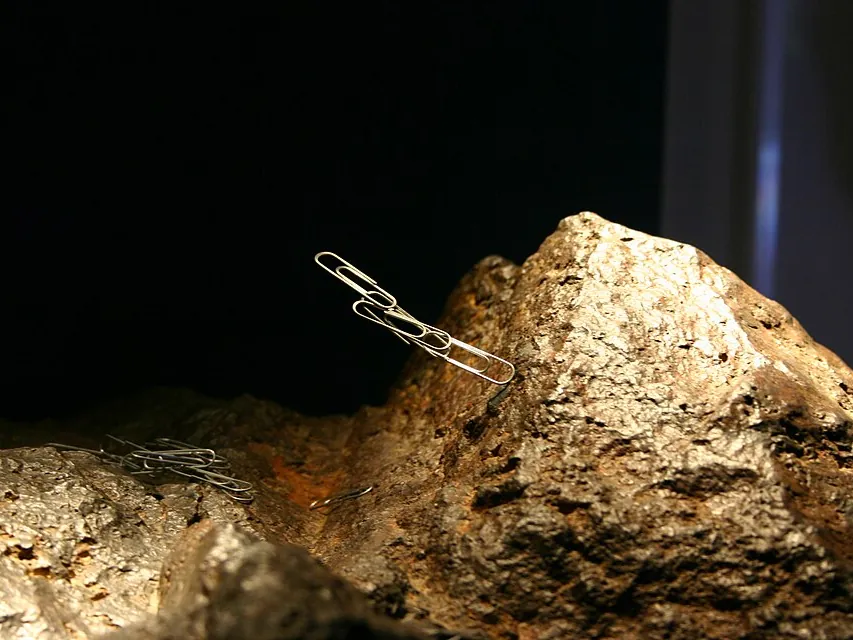
- A magnet attracts an unmagnetised piece of iron by first inducing magnetism in it: the near end of the iron becomes an opposite pole. That is why either pole of a magnet picks up a nail. As with electric charges, only repulsion proves an object is a magnet.
Magnetic fields and field lines
A magnetic field is a region where a magnetic pole, a moving charge or a current feels a force. Its strength and direction at a point are given by the vector B, the magnetic field strength (also called magnetic flux density), measured in teslas (T). The direction of B at a point is the direction a small compass needle's N pole points.
- Outside a magnet, field lines run from the N pole to the S pole. Inside the magnet they continue from S back to N, so magnetic field lines are always closed loops (electric field lines start and end on charges).
- The closer the lines, the stronger the field. Lines never cross.
- Between a flat N pole and a flat S pole facing each other, the field is nearly uniform: straight, parallel, evenly spaced lines.
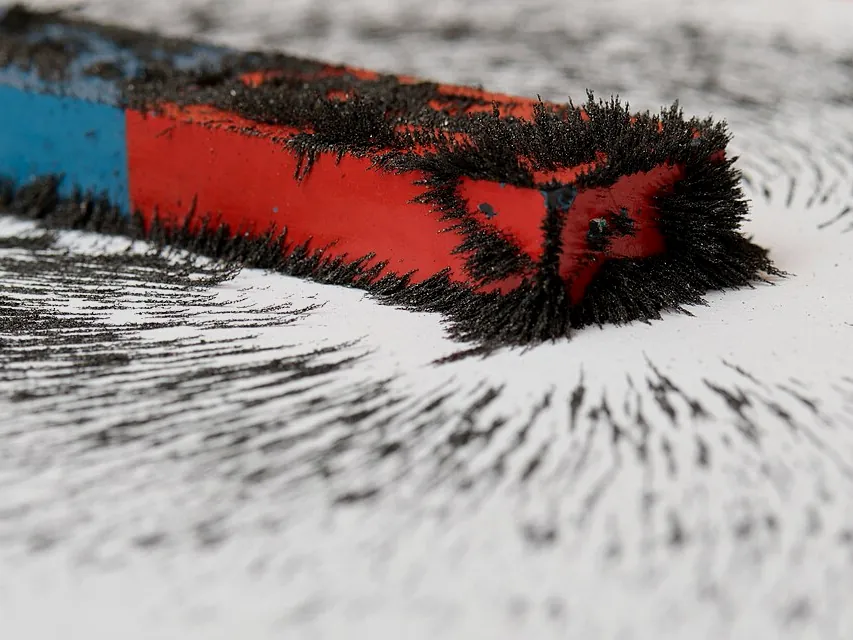
- Iron filings sprinkled around a magnet line up along the field, which is how the patterns were first mapped.
| Source | Typical B (T) |
|---|---|
| Earth's field at Sydney's surface | about 5.7 × 10⁻⁵ |
| Fridge magnet, at its surface | about 5 × 10⁻³ |
| Strong neodymium (NdFeB) magnet | about 1 |
| Hospital MRI scanner | 1.5 to 3 |
| Strongest continuous laboratory magnets | about 45 |
Earth's magnetic field
Earth's field is roughly the shape of a bar magnet's, produced by currents in its molten iron outer core. Because a compass's N pole is attracted towards the geographic north, the magnetic pole in the Arctic is actually a magnetic S pole. The magnetic axis is tilted from the rotation axis and wanders over time.
In Sydney the field is about 5.7 × 10⁻⁵ T and points steeply up out of the ground (an inclination of about −64°), so its horizontal part, the part a compass responds to, is only about 2.5 × 10⁻⁵ T. A compass in Sydney points about 13° east of true north (the magnetic declination), which navigators and bushwalkers have to correct for.
Ferromagnetism and domains
Every electron behaves like a tiny magnet because of its spin. In most materials these atomic magnets point randomly or cancel in pairs. In ferromagnetic materials (iron, nickel, cobalt, many of their alloys and some rare-earth compounds such as neodymium–iron–boron) neighbouring atoms interact so strongly that their magnetic moments line up with each other over regions of perhaps 1015 atoms. These regions are magnetic domains. Each domain is fully magnetised, but in an unmagnetised piece of iron the domains point in different directions and their fields cancel.
- Magnetising: in an external field, domains already pointing roughly along the field grow at the expense of their neighbours as the domain walls move, and at stronger fields whole domains swing round. When all are aligned the material is saturated.
- Soft magnetic materials (pure, annealed iron; silicon steel; ferrites) have domain walls that move easily. They magnetise strongly in a weak field and lose almost all of it when the field is removed. They are used for transformer and electromagnet cores, where the magnetism must switch on and off.
- Hard magnetic materials (steel, alnico, NdFeB) have domain walls pinned by impurities and crystal defects. They need a strong field to magnetise but keep their magnetism when it is removed: permanent magnets. Plotting magnetisation against applied field gives a loop (a hysteresis loop) that is wide for hard materials and narrow for soft ones.
- Demagnetising: heating, hammering, or a slowly decreasing alternating field all jumble the domains again. Above the Curie temperature (770 °C for iron, 358 °C for nickel, around 310–400 °C for NdFeB) thermal vibration destroys the alignment within domains, and the material stops being ferromagnetic at all.
Most other substances are only very weakly magnetic: paramagnetic materials such as aluminium are attracted very slightly, and diamagnetic materials such as copper, water and graphite are repelled very slightly. For everyday purposes they count as non-magnetic.
- Soft iron: raise the applied field to +20 mT. Every domain lines up (100%, saturated). Bring the field back to 0: only about 11% remains.
- Press "Demagnetise and reset", choose hard steel and raise the field to +40 mT. Only some domains flip (the sim shows 21%). Go to +100 mT to saturate it, then back to 0: it keeps 100%. You have made a permanent magnet.
- Now take the field to −40 mT, then −100 mT, and back up to +100 mT. Describe the shape the graph traces, and compare it with soft iron's.
- Magnetise the steel, set B = 0 and heat it to 800 °C. The magnetisation drops to 0. Cool it again: it stays unmagnetised.
- Copper: nothing happens at any field. Explain why in terms of domains.
Test yourself
A bar magnet is cut in half across its middle. Each piece
Magnetic poles always come in pairs; each half has its domains still aligned, so it is a complete magnet.
Which material would be best for the core of an electromagnet used to lift scrap metal and then drop it?
Soft iron magnetises strongly when the current is on and loses almost all its magnetism when it is switched off, releasing the load.
A steel magnet is heated to 800 °C and allowed to cool with no field present. It is now
Above the Curie temperature the alignment within domains is destroyed. On cooling with no field the domains form in random directions.
In Sydney, the magnetic field direction at a compass is best described as
In the southern hemisphere Earth's field points up out of the ground (inclination about −64° in Sydney) and its horizontal part is about 13° east of true north.
An unmagnetised iron nail is attracted to both the N pole and the S pole of a magnet because
The magnet's field aligns domains in the nail so that its near end becomes an unlike pole, which is attracted.
Label the bar magnet's field.
Sort the properties and uses.
Outside a magnet, field lines run from the pole to the S pole and form closed . Magnetic field strength is measured in . Ferromagnetic materials contain regions called , in which atomic magnetic moments are aligned. Above the temperature a ferromagnet loses its magnetism.
Use the domain model to explain (a) how an unmagnetised steel bar becomes a permanent magnet when placed in a strong magnetic field, (b) why soft iron does not stay magnetised, and (c) why heating a magnet strongly destroys its magnetism.
(a) Steel is ferromagnetic and contains magnetic domains: small regions in which the magnetic moments of the atoms are all aligned. In unmagnetised steel the domains point in many directions, so their fields cancel. In a strong external field, domains already aligned with the field grow as their walls move, and other domains rotate to line up with it. Steel contains impurities and defects that pin the domain walls, so when the field is removed the domains cannot move back, and the bar stays magnetised.
(b) In soft iron the domain walls move easily. When the external field is removed, the domains readily return to random orientations, so the overall magnetisation falls almost to zero.
(c) Heating increases the random thermal vibration of the atoms. Above the Curie temperature (770 °C for iron) this vibration is strong enough to destroy the alignment of the atomic moments within each domain, so the material is no longer ferromagnetic. When it cools without an external field, new domains form in random directions and the magnet is demagnetised.